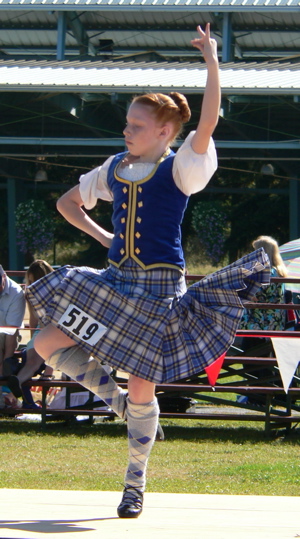
File:Highland_Dance_002.jpg · Wikimedia Commons · See Wikimedia Commons
kilt
Sign in to savethumb|300px|One of the earliest depictions of the kilt is this German print showing Highlanders around 1630 A kilt ( ) is a garment resembling a wrap-around knee-length skirt, made of twill-woven worsted wool with heavy pleats at the sides and back and traditionally a tartan pattern. Originating in the Scottish Highland dress for men, it is first recorded in the 16th century as the great kilt, a full-length garment whose upper half could be worn as a cloak. The small kilt or modern kilt emerged in the 18th century, and is essentially the bottom half of the great kilt. Since the 19th century, i
A kilt is a knee-length skirt-like garment made of pleated tartan wool that originated in Scottish Highland male dress dating back to at least the 16th century. The modern kilt, which became popular in the 18th century, evolved from the earlier "great kilt" and has remained an important part of Scottish cultural identity and traditional dress.
AI-generated from the Wikipedia summary — may contain errors.
Wikidata facts
- Subclass of
- skirt
- Image
- Plaid Kilt Nontraditional.jpg
Show 3 more facts
- Commons category
- Kilts
- described by source
- Encyclopædia Britannica 11th edition
- time of discovery or invention
- 1720-00-00
via Wikidata · CC0
~25 min read
Encyclopedic overview
18 sectionsContents
- History
- Variants
- Scotland
- Design and construction
- Fabrics
- Setts
- Measurements
- Pleating and stitching
- Accessories
- Styles of kilt wear
- Ireland
- Other Celtic nations
- Contemporary designs
- See also
- References
- Bibliography
- Further reading
- External links
thumb|300px|One of the earliest depictions of the kilt is this German print showing Highlanders around 1630 A kilt ( ) is a garment resembling a wrap-around knee-length skirt, made of twill-woven worsted wool with heavy pleats at the sides and back and traditionally a tartan pattern. Originating in the Scottish Highland dress for men, it is first recorded in the 16th century as the great kilt, a full-length garment whose upper half could be worn as a cloak. The small kilt or modern kilt emerged in the 18th century, and is essentially the bottom half of the great kilt. Since the 19th century, it has become associated with the wider culture of Scotland, and more broadly with Gaelic or Celtic heritage.
Although the kilt is most often worn by men on formal occasions and at Highland games and other sporting events, it has also been adapted as an item of informal male clothing, returning to its roots as an everyday garment. Kilts are now made for casual wear in a variety of materials. Alternative fastenings may be used and pockets inserted to avoid the need for a sporran. Kilts have also been adopted as female wear for some sports.
Excerpted from Wikipedia’s “kilt” article, available under the CC BY-SA 4.0 licence.
Gallery (36)
Available in 60 languages
- Español
- Français
- Deutsch
- 中文
- 日本語
- Русский
- Português
- Italiano
- العربية
- Afrikaans
- Armenian
- Azerbaijani
- Bahasa Indonesia
- Banjar
- Bashkir
- Basque
- Belarusian
- Bikol
Show 41 more
- Catalan
- Central Kurdish
- Colognian
- Czech
- Danish
- Esperanto
- Estonian
- Filipino
- Finnish
- Galician
- Greek
- Hebrew
- Hungarian
- Icelandic
- Irish
- Lombard
- Malay
- Manx
- Nederlands
- Norwegian
- Norwegian Nynorsk
- Polski
- Romanian
- Sardinian
- Scots
- Scottish Gaelic
- Serbian
- Serbian (Latin)
- simple
- Slovak
- Slovenian
- Svenska
- Tiếng Việt
- Türkçe
- Ukrainian
- Veps
- Welsh
- Western Frisian
- فارسی
- ไทย
- 한국어
via Wikidata sitelinks · CC0