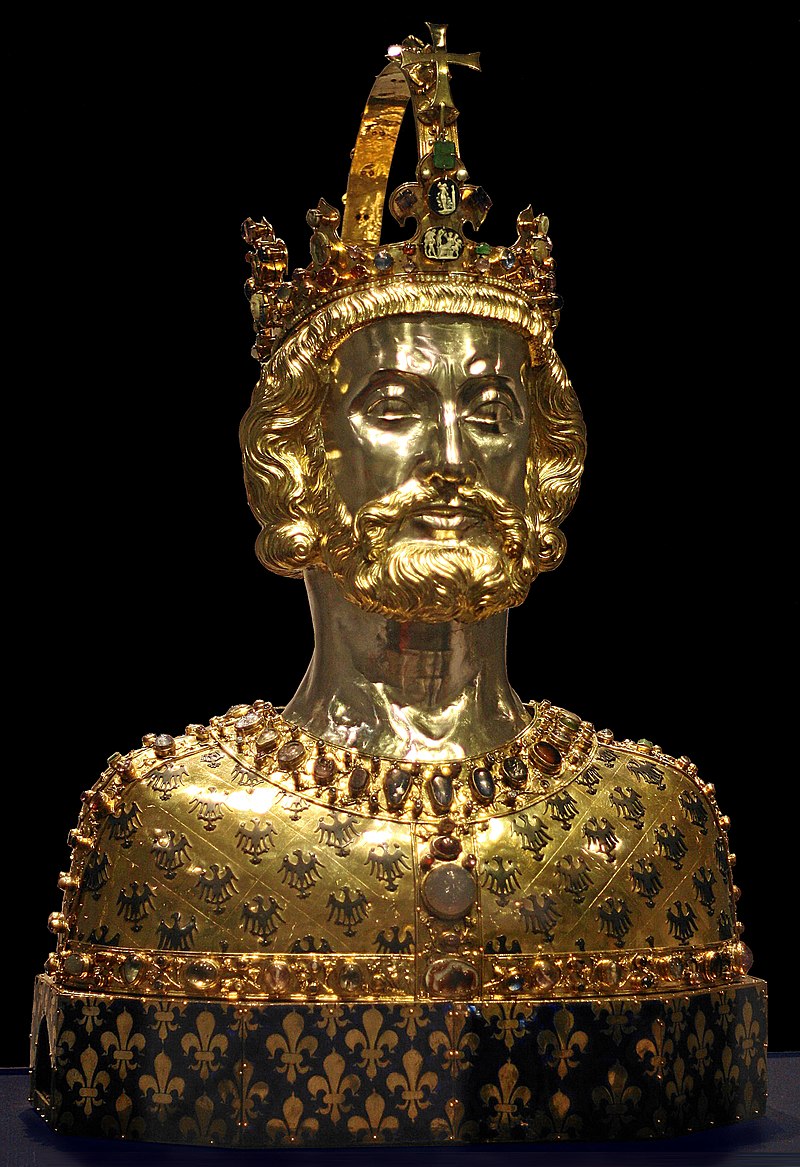
File:Aachen_Domschatz_Bueste1.jpg · Wikimedia Commons · See Wikimedia Commons
king
Sign in to savealt=|thumb|341x341px|Charlemagne or Charles the Great (748–814) was [[King of the Franks, King of the Lombards, and the first Holy Roman Emperor. Due to his military accomplishments and conquests, he has been called the "Father of Europe".]]
A king is a male monarch who rules over a kingdom or territory, typically holding supreme authority over his lands and subjects. Kings matter historically because they shaped the development of Europe and civilization—as shown by Charlemagne, whose military conquests and leadership earned him recognition as the "Father of Europe" and the first Holy Roman Emperor.
AI-generated from the Wikipedia summary — may contain errors.
Wikidata facts
- Subclass of
- man
- Image
- Tanéka-Béri-Le roi Tinigassawa (2).jpg
- Said to be same as
- queen regnant
Show 9 more facts
- female form of label
- ماليكة
- honorific prefix
- Majesty
- opposite of
- queen regnant
- Commons category
- Kings
- topic's main category
- Category:Kings
- described by source
- Encyclopædia Britannica 11th edition
- male form of label
- ماليك
- organization directed by the office or position
- kingdom
- different from
- emperor
Sources (2)
via Wikidata · CC0
~5 min read
Encyclopedic overview
6 sectionsContents
- Etymology
- Current kings
- See also
- Notes
- References
- External links
alt=|thumb|341x341px|Charlemagne or Charles the Great (748–814) was [[King of the Franks, King of the Lombards, and the first Holy Roman Emperor. Due to his military accomplishments and conquests, he has been called the "Father of Europe".]]
King is a royal title given to a male monarch. A king is an absolute monarch if he holds unrestricted governmental power or exercises full sovereignty over a nation. In a modern context, the title may refer to the ruler of one of a number of modern monarchies (either absolute or constitutional). The title of king is used alongside other titles for monarchs: in the West, emperor, grand prince, prince, archduke, duke or grand duke, and in the Islamic world, malik, sultan, emir or hakim, among others.
Excerpted from Wikipedia’s “king” article, available under the CC BY-SA 4.0 licence.
Gallery (31)
Available in 119 languages
- Español
- Français
- Deutsch
- 中文
- 日本語
- Русский
- Português
- Italiano
- العربية
- हिन्दी
- Afrikaans
- Albanian
- Albanian
- azb
- Azerbaijani
- Bahasa Indonesia
- Bangla
- Basque
Show 100 more
- bat_smg
- Bavarian
- be_x_old
- Belarusian
- Bikol
- Bosnian
- Breton
- Bulgarian
- Burmese
- Catalan
- Central Kurdish
- Chechen
- Chuvash
- Corsican
- Croatian
- Czech
- Danish
- Egyptian Arabic
- Esperanto
- Estonian
- Extremaduran
- Filipino
- Finnish
- Galician
- Ganda
- Georgian
- Gothic
- Greek
- Haitian Creole
- Hausa
- Hebrew
- Hungarian
- Icelandic
- Ido
- Interlingua
- Interlingue
- Jju
- Kabyle
- Kannada
- Kashmiri
- kge
- Khmer
- Kurdish
- Latin
- Latvian
- Limburgish
- Lithuanian
- Lombard
- Low German
- Macedonian
- Manipuri
- Marathi
- Mazanderani
- Mirandese
- Moksha
- Moroccan Arabic
- nds_nl
- Nederlands
- Northern Frisian
- Northern Sami
- Norwegian
- Norwegian Nynorsk
- nrm
- Old English
- Pashto
- Polski
- Quechua
- Santali
- Serbian
- Serbian (Latin)
- Shona
- Silesian
- simple
- Sindhi
- Slovak
- Slovenian
- Somali
- Standard Moroccan Tamazight
- Svenska
- Swahili
- Telugu
- Tiếng Việt
- Türkçe
- Tyap
- Udmurt
- Ukrainian
- Upper Sorbian
- Urdu
- Uzbek
- Venetian
- Western Frisian
- Western Panjabi
- Wu Chinese
- Yoruba
- Zaza
- zh_min_nan
- zh_yue
- فارسی
- ไทย
- 한국어
via Wikidata sitelinks · CC0