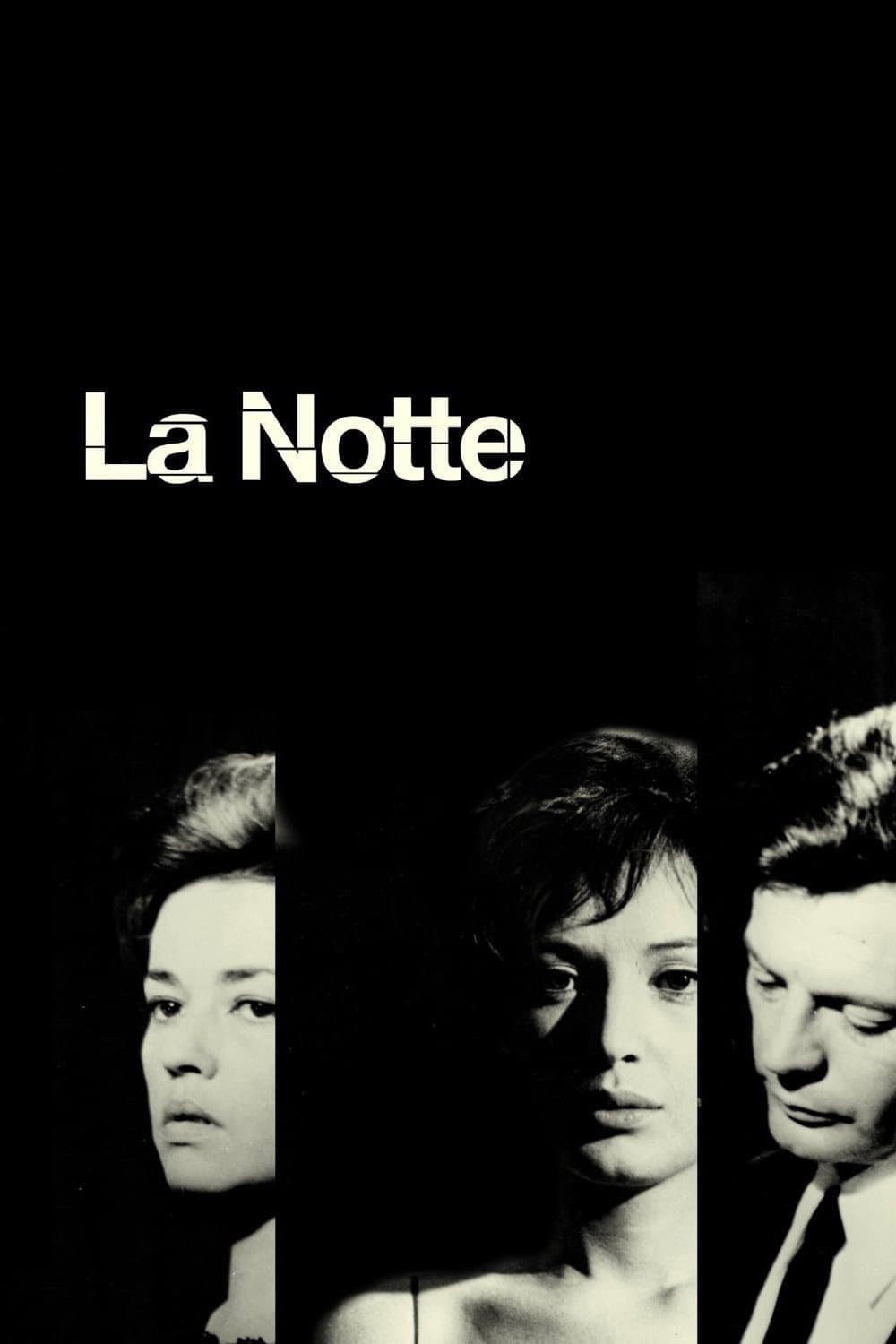
Poster from TMDB
Film · TMDB
7.9A day in the life of an unfaithful married couple and their steadily deteriorating relationship in Milan.
Cast
- Marcello Mastroianni as Giovanni Pontano
- Jeanne Moreau as Lidia
- Monica Vitti as Valentina Gherardini
- Bernhard Wicki as Tommaso Garani
- Rosy Mazzacurati as Rosy
- Maria Pia Luzi as Un'invitata
Themes
- infidelity
- milan
- hospital
- black and white
- writer
- socialite party
This product uses the TMDB API but is not endorsed or certified by TMDB.
Ratings
IMDb
7.9/10
25,718 votes
Rotten Tomatoes
84%
- Year
- 1961
- Runtime
- 122 min
- Genres
- Drama
- Rated
- Not Rated
- Awards
- 6 wins & 4 nominations total
via OMDb · IMDb
Key facts
- Directed by
- Michelangelo Antonioni
- Written by
- Michelangelo Antonioni Ennio Flaiano Tonino Guerra
- Produced by
- Emanuele Cassuto
- Starring
- Marcello Mastroianni Jeanne Moreau Maria Pia Luzi Rosy Mazzacurati Monica Vitti Bernhard Wicki
- Cinematography
- Gianni Di Venanzo
- Edited by
- Eraldo Da Roma
- Music by
- Giorgio Gaslini
- Production companies
- Nepi Film Sofitedip Silver Film
- Distributed by
- Dino de Laurentiis Distribuzione (Italy) Les Artistes Associés (France)
- Release dates
- 24 January 1961 ( 1961-01-24 ) (Italy) 24 February 1961 ( 1961-02-24 ) (France)
- Running time
- 122 minutes
- Countries
- Italy France
- Language
- Italian
- Box office
- ₤ 470 million ($752,000)
via Wikipedia infobox
Wikidata facts
- Instance of
- film
- Award
- Golden Bear
- Genre
- drama film
- Country of origin
- Italy
- Original language
- Italian
- Director
- Michelangelo Antonioni
- Screenwriter
- Tonino Guerra
- Composer
- Giorgio Gaslini
- Cinematographer
- Gianni Di Venanzo
- Narrative location
- Milan
- Filming location
- Milan
- Duration
- 122
- FilmAffinity ID
- 253181
- Distribution format
- video on demand
Show 9 more facts
- publication date
- 1962-02-19
- film editor
- Eraldo Da Roma
- title
- La notte
- color
- black-and-white
- production designer
- Piero Zuffi
- distributed by
- Netflix
- assessment
- Bechdel test
- review score
- 83%
- Commons category
- La notte
Sources (9)
via Wikidata · CC0
~10 min read
Encyclopedic overview
La Notte ([la ˈnɔtte]; English: "The Night") is a 1961 drama film co-written and directed by Michelangelo Antonioni and starring Marcello Mastroianni, Jeanne Moreau and Monica Vitti. Filmed on location in Milan, the film depicts a single day and night in the lives of a disillusioned novelist (Mastroianni) and his alienated wife (Moreau) as they move through various social circles. The film continues Antonioni's technique of abandoning traditional storytelling in favor of visual composition, atmosphere, and mood.
Grossing 470 million lire and receiving acclaim for its exploration of modernist themes of isolation, La Notte received the Golden Bear at the 11th Berlin International Film Festival. The film also earned Antonioni the 1961 David di Donatello Award for Best Director. Although selected as the Italian entry for Best Foreign Language Film at the 34th Academy Awards, it was not nominated. La Notte is considered the central film of a trilogy beginning with L'Avventura (1960) and ending with L'Eclisse (1962). It was one of Stanley Kubrick's 10 favorite films, received 4 votes from critics and 6 votes from directors in the 2012 Sight & Sound greatest films poll, and ranked as the 52nd greatest film of all time in the 2022 director's poll with 12 votes.
Excerpted from Wikipedia’s “La Notte” article, available under the CC BY-SA 4.0 licence.