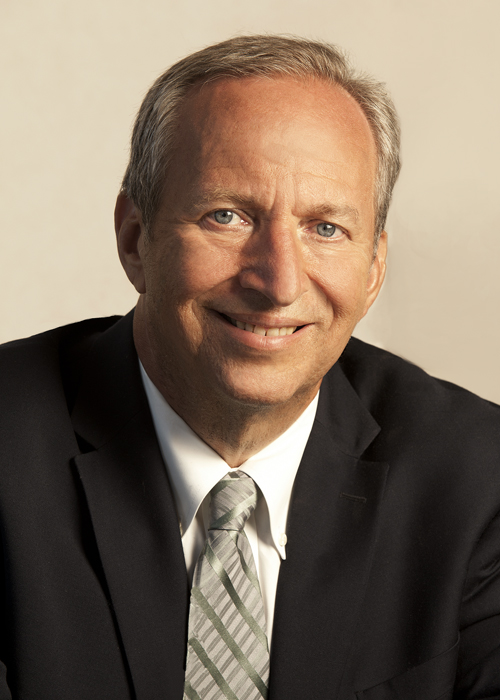
Larry Summers
Sign in to saveAlso known as Lawrence H. Summers, Lawrence Henry Summers
Lawrence Henry Summers is an American economist. He served as the 71st United States Secretary of the Treasury from 1999 to 2001, the 27th president of Harvard University from 2001 to 2006, and the eighth director of the National Economic Council from 2009 to 2010. He was the Charles W. Eliot University Professor at Harvard Kennedy School until his resignation in February 2026.
In the Vinony graph
Vinony catalogs Larry Summers in its American Academy of Arts & Sciences collection (9,870 entries).
Within Vinony's link graph, Larry Summers is referenced by 888 other articles, and connects out to John F. Kennedy School of Government, presidency of Barack Obama and Harvard University.
Vinony files it under 1954 births, 20th-century American economists and 21st-century American economists.
Its subject is documented across 33 Wikipedia language editions.
Person · Open Library
- Works
- 1
via Open Library + Wikidata
Wikipedia views (30d)
18,813 totalvia Wikimedia Pageviews API
Key facts
- President
- Barack Obama
- Deputy
- Diana Farrell , Jason Furman
- Preceded by
- Keith Hennessey
- Succeeded by
- Gene Sperling
- Born
- Lawrence Henry Summers , ( 1954-11-30 ) November 30, 1954 (age 71) , New Haven, Connecticut , U.S.
- Party
- Democratic
- Spouses
- Victoria Perry ( married</span>"}]]}'>m. 1984 ; divorced</span>"}]]}'>div. 2003 ) Elisa New ( married</span>"}]]}'>m. December 11, 2005</span>"}]]}'>2005 )
- Education
- Massachusetts Institute of Technology ( BS ), Harvard University ( MA , PhD )
- Awards
- John Bates Clark Medal (1993)
- Thesis
- An Asset Price Approach to the Analysis of Capital Income Taxation (1982)
- Doctoral advisor
- Martin Feldstein
- Discipline
- Macroeconomics
- School or tradition
- New Keynesian economics
- Institutions
- Harvard University , London School of Economics
- Doctoral students
- Alan Krueger , Kiminori Matsuyama , James R. Hines Jr. , Rhee Chang-yong
- Website
- Information at IDEAS / RePEc
via Wikipedia infobox
Wikidata facts
- Instance of
- human
- Gender
- male
- Citizenship
- United States
- Place of birth
- New Haven
- Occupation
- banker
- Political party
- Democratic Party (United States)
- Languages spoken
- English language
- Religion
- Judaism
- Academic degree
- doctorate
- Doctoral advisor
- Martin Feldstein
- Field of work
- economics
- Image
- Lawrence Summers Treasury portrait.jpg
Show 10 more facts
- Commons category
- Lawrence Summers
- date of birth
- 1954-11-30
- member of
- Econometric Society
- student
- Sheryl Sandberg
- Commons gallery
- Lawrence Summers
- social media followers
- 269458
- P10632
- Larry Summers
- affiliation string
- Harvard University
- affiliation
- Harvard University Press
- maintained by WikiProject
- WikiProject Mathematics
Sources (15)
via Wikidata · CC0
~36 min read
Encyclopedic overview
Lawrence Henry Summers (born November 30, 1954) is an American economist. He served as the 71st United States Secretary of the Treasury from 1999 to 2001, the 27th president of Harvard University from 2001 to 2006, and the eighth director of the National Economic Council from 2009 to 2010. He was the Charles W. Eliot University Professor at Harvard Kennedy School until his resignation in February 2026.
Summers became a professor of economics at Harvard University in 1983. He left Harvard in 1991, working as the chief economist of the World Bank from 1991 to 1993. In 1993, Summers was appointed Under Secretary for International Affairs of the United States Department of the Treasury under President Bill Clinton's administration. In 1995, he was promoted to Deputy Secretary of the Treasury under his long-time political mentor Robert Rubin. In 1999, he succeeded Rubin as Secretary of the Treasury. While working for the Clinton administration, Summers played a leading role in the American response to the 1994 economic crisis in Mexico, the 1997 Asian financial crisis, and the 1998 Russian financial crisis. He was also influential in the Harvard Institute for International Development and American-advised privatization of the economies of the post-Soviet states, and in the deregulation of the U.S. financial system, including the repeal of the Glass–Steagall Act.
Excerpted from Wikipedia’s “Larry Summers” article, available under the CC BY-SA 4.0 licence.