
Lebanon
Sign in to saveAlso known as Lebanese Republic, lb, Republic of Lebanon, Lubnan, State of Lebanon
Lebanon, officially the Lebanese Republic, is a country in the Levant region of West Asia. Situated at the crossroads of the Mediterranean Basin and the Arabian Peninsula, it is bordered by Syria to the north and east, Israel to the south, and the Mediterranean Sea to the west; Cyprus lies a short distance from the coastline. Lebanon has a population of more than five million and an area of . Beirut is the country's capital and largest city.
OverviewAI-generated
Lebanon, officially the Lebanese Republic, is a country in Western Asia. Its capital is Beirut. The nation has a population of 5,490,000 according to REST Countries data, while other sources list figures such as 6,100,075 and 5,805,962. The total area is 10,452. The official languages are Arabic and French. The native label for the country is الجمهورية اللبنانية or لبنان.
The country uses the Lebanese pound as currency. Its internet top-level domain is .lb. The diplomatic relations include ties with Italy, Brazil, Palestine, and Australia. Michel Aoun and Joseph Aoun are listed as heads of state, holding the office of President of Lebanon. The head of government holds the office of Prime Minister of Lebanon. The legislative body is the Parliament of Lebanon. The country was established on 1943-11-22.
Synthesized by Vinony from 72 facts across 10 sources: Wikidata, REST Countries, Openweathermap, Open Meteo, World Bank, OpenStreetMap, Firecrawl, PubMed, Vinony graph, Geo. Generated from structured data (not the Wikipedia text) and checked against those facts — may still contain errors.
Weather now
cached 211h ago7-day forecast
via Open-Meteo
Country

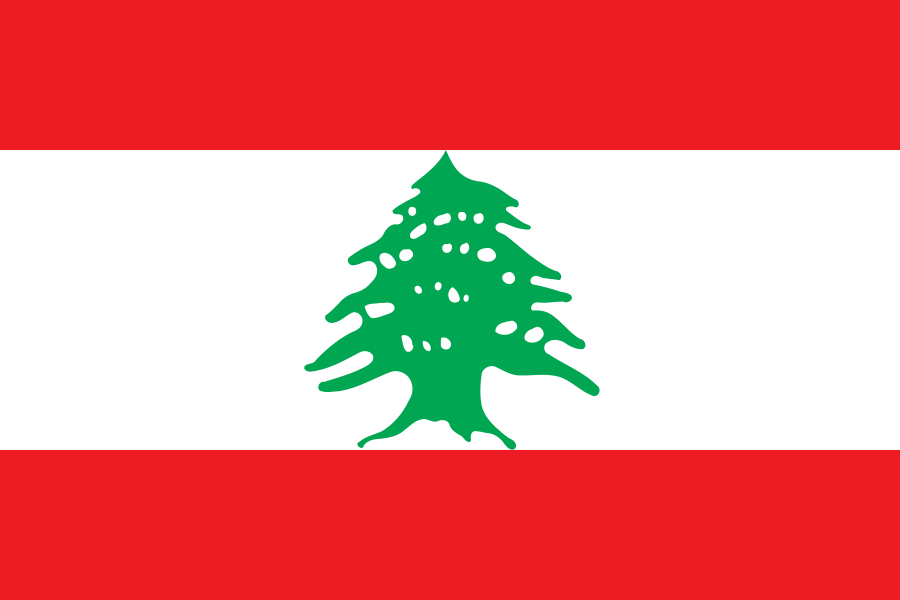
- Capital
- Beirut
- Population
- 5,490,000
- Region
- Asia · Western Asia
- Demonym
- Lebanese
- Currencies
- LBP (ل.ل)
- Languages
- Arabic, French
- Calling code
- +961
- Drives on
- Right
- Gini
- 31.8 (2011)
- FIFA code
- LBN
- TLD
- .lb
- Timezones
- UTC+02:00
- Borders
- ISR, SYR
via REST Countries
Indicators · World Bank
- GDP
- $20.1B(2023)
- Population
- 5,805,962(2024)
- Life expectancy
- 77.9 yrs(2024)
- Unemployment
- 11 %(2023)
- Urban population
- 90.7 %(2024)
- Internet users
- 80.6 %(2024)
- Forest area
- 14.2 %(2023)
- Renewable energy
- 6.8 %(2021)
via World Bank Open Data · CC BY 4.0
Wikipedia views (30d)
178,545 totalvia Wikimedia Pageviews API
Key facts
- Country.conventional_long_name
- Lebanese Republic
- Country.common_name
- Lebanon
- Country.image_flag
- Flag of Lebanon.svg
- Country.image_map
- Lebanon (orthographic_projection).svg
- Country.image_map_caption
- Location of Lebanon (in green)
- Country.image_map2
- Lebanon - Location Map_(2012)_-_LBN_-_UNOCHA.svg
- Country.capital
- Beirut
- Country.largest_city
- Beirut
- Country.official_languages
- Arabic
- Country.languages
- Lebanese Arabic
- Country.languages_type
- Local vernacular
- Country.languages2_type
- Recognised minority language
- Country.languages2
- French
- Country.demonym
- Lebanese
- Country.government_type
- Unitary parliamentary republic under confessionalism
- Country.leader_title1
- President
- Country.leader_name1
- Joseph Aoun
- Country.leader_title2
- Prime Minister
via Wikipedia infobox
Research
57,219 papers- Pharmacogenomics in Lebanon: current status, challenges and opportunities.ReviewThe pharmacogenomics journal · 2024Chidiac L, Yazbeck H, Mahfouz R et al.DOI: 10.1038/s41397-024-00336-z
- Planning for TB elimination in Lebanon.The international journal of tuberculosis and lung disease : the official journal of the International Union against Tuberculosis and Lung Disease · 2023Yaacoub H, Farhat AM, Najjar-Pellet J et al.DOI: 10.5588/ijtld.22.0673
- Alzheimer's Disease in Lebanon: Exploring Genetic and Environmental Risk Factors-A Comprehensive Review.ReviewJournal of Alzheimer's disease : JAD · 2024Khaled M, Al-Jamal H, Tajer L et al.DOI: 10.3233/JAD-231432
- An overview of the poisonous plants of Lebanon and their effects.ReviewToxicon : official journal of the International Society on Toxinology · 2024El Zahran T, Halabi Z, Barakat A et al.DOI: 10.1016/j.toxicon.2024.108177
- Deliveries in Lebanon, the Country with the Highest Refugee Density in the World: A Descriptive Review.ReviewMaternal and child health journal · 2024Sammouri J, Khachfe HH, Fares MY et al.DOI: 10.1007/s10995-023-03826-x
- Overview in Breast Cancer Screening in Lebanon.ReviewCancer control : journal of the Moffitt Cancer Center · 2021Sbaity E, Bejjany R, Kreidieh M et al.DOI: 10.1177/10732748211039443
- Neglected Tropical Diseases in Lebanon.Acta parasitologica · 2022Alam W, Mobayed T, Younis N et al.DOI: 10.1007/s11686-021-00510-4
- Experts' opinion on the detection and management of prediabetes in Lebanon.ReviewScience progress · 2021Andari E, Atallah P, Azar S et al.DOI: 10.1177/00368504211029439
via PubMed
Described at
68k.news: Headlines From the Future
68k.news →Link to a page describing this subject · 1,003 chars · not written by Vinony
Travel guide
Get around
thumb|"Another rainy Beirut day" Due to the relatively small size of the country, the best way to get around the country quickly is by car.
A trip from Tyre to Beirut will easily take you 1½ hours, depending on traffic and security conditions. This is not to say that it's entirely safe — Lebanese roads are not in perfect condition and drivers aren't known for being very cautious. Still, travelling by car is your best bet.
See
thumb|Roman ruins in Tyre thumb|Inside the Upper Jeita Grotto thumb|Port of Byblos Lebanon is a country rich in natural scenery from beautiful beaches to mountains and valleys. Lebanese people take pride that Lebanon is one of the few countries that gives you the opportunity to go skiing in the morning and going to the beach in the afternoon (although it is impossible to actually do that because of traffic). This is only possible for a few days in the year, usually in the few days when winter shifts to spring and/or summer shifts to autumn.
Beirut Downtown Visitors from all around are astonished by its beautiful downtown. At Place de l'Etoile, tourists can enjoy a delightful meal or a cup of coffee at the outdoor cafes. In addition to those, the capital provides other restaurants and hangouts that people of all ages can enjoy. There are also many nightclubs, bars, cafes, and restaurants, catering to a diverse amount of styles and budgets.
Baalbeck Roman Temples in the city of Baalbeck are among the largest and most beautiful Roman ruins.
Al Bass Archaeological Site, Tyre, a UNESCO World Heritage site and one of the largest and best preserved Roman archeological sites in the world. The site is made up of a huge Necropolis, a massive monumental arch leading to a Roman Road, alongside which there is an excellent example of an aqueduct as well as the largest and best preserved Roman Hippodrome found to date.
Jeita Grotto is a compound of crystallized caves in Lebanon 20 …
Eat
thumb|Lebanese meze (small dishes)
Lebanon fosters exquisite cuisine ranging from a mezza of vegetarian dishes such as tabouleh, fattoush, and waraq ainab to delicious dips like hommos and moutabal.
Must haves include Lebanese barbeque such as shish tawouq (barbequed chicken) – usually consumed with garlic, lahm mashwiye (barbequed meat), and kafta (barbequed seasoned minced meat).
Lebanese "fast food" is also available as sandwiches offered in roadside shops, such as shawarma sandwiches (known in other countries as doner - or gyros in Greece). Shawarma is rolled in Lebanese thin bread. Various barbequed meat sandwiches are also available, and even things such as lamb or chicken spleen, brains, lamb bone marrow or lamb testicles can be served as sandwiches.
Breakfast usually consists of manaeesh which look like folded pizza, the most common toppings being zaatar (a mixture of thyme, olive oil, sesame seeds), jebneh (cheese), or minced meat (this version is more properly referred to as lahm bi ajin).
Another traditional breakfast food is knefeh, a special kind of breaded cheese that is served with a dense syrup in a sesame seed bread. It is also served as dessert.
Lebanon is also very famous for its Arabic sweets which can be found at leading restaurants. The city of Tripoli, however, is considered to be "the" city for Lebanese sweets, and is sometimes even referred to as the "Sweet Capital" of Lebanon.
International food chains are widely spread across the country. Ita…
Drink
Lebanon's wines have an international reputation. Grapes have been grown since antiquity, and the vineyards, largely in the Bekaa Valley, produce the base wine for distillation into the national spirit Arak, which, like Ouzo, is flavoured with aniseed and becomes cloudy when diluted with water. Arak is the traditional accompaniment to Meze.
But the grapes have also historically been used to make wine. This used to be predominantly white and sweet, but the soldiers and administrators that came to administer the French mandate after World War I created a demand for red wine, and large acreages were planted especially with the Cinsault grape. Over the last 20 years, these have been supplemented with the most popular international varieties, such as Cabernet Sauvignon and Chardonnay.
Wineries often offer wine tasting and are very welcoming. The highly individual, old-fashioned, Chateau Musar, is based at Ghazir, 25 km (15 miles) north of Beirut, and trucks in the grapes from Bekaa. In Bekaa itself, wineries include the large Kefraya, Ksara, the oldest winery of all, Massaya, a fashionable new producer in Tanail, and Nakad in Jdeita, which like Musar has stuck with an idiosyncratic old-fashioned approach. Kefraya, in the West Bekaa region, also has a nice restaurant attached, and the region is beautiful to pass through.
Sleep
Lebanon is full of hotels, with a range in price and quality, from USD10/night to many hundreds of dollars per night, and the quality ranges just as much. Many international hotel chains, such as Intercontinental, Holiday Inn, and Crowne Plaza, can be found here. In Beirut, in coastal cities, and around the historic site of Baalbek, many luxury hotels built in the “Golden Age” boom of the 1960s and early 1970s can be found all over and stayed in for a luxurious and nostalgic experience. They offer a variety of services, including pools and restaurants, amidst the ongoing financial crisis they, although expensive, are your best bet for staying somewhere in Lebanon, as 24-hour electricity is generally nowadays only found in these hotels.
If you want something more affordable, although be prepared to suffer electricity and wifi outages for long hours each day, you can also stay in the many “mom-and-pop” style hotels and boutique hotels found in the country. The best way to save money if you are staying for a long visit is furnished apartments or all-suite hotels, as they come with cleaning and other services.
Connect
In Lebanon, there are 2 mobile internet providers (Touch and Alfa).
Touch: Advertised as the Visitor Line, Touch offers an exlusive plan for tourists including a SIM card containing 10GB of Mobile Internet, 100 minutes of talk and 100 SMS messages with a 14 days validity, with an initial price of 19$(This plan can be renewed by recharging a 15$ card on your account and sending an SMS with "VB" to 1100).
It is also possible to get a normal line and benefit from normal data plans without restrictions.
Alfa: Alfa on the other hand, doesn't offer any kind of special plans for tourists. It is still possible however to get a normal line and benefit from normal data plans without restrictions.
P.S: Due to the duopoly nature of telecommunications in Lebanon and the fact that both Touch and Alfa are owned by the Lebanese Ministry of Telecommunications, Touch and Alfa nearly share the same data plans for the same price as their prices are also regulated by law. However, there still are some interesting different plans that you might want to consider depending on your needs.
Stay safe
thumb|Narrow street in the Christian quarter, Tyre Though many foreign visitors fear widespread violence and destruction upon arrival in Lebanon, since the end of the Lebanese Civil War in 1990 Lebanon has remained relatively peaceful. The vast majority of Lebanese are friendly, and most tourists experience no problems. Nevertheless tensions with neighbours Israel and Syria sometimes erupt (but are usually confined to South Lebanon) and therefore travellers should follow the independent press while in the country.
Like in any country, it is preferable to be accompanied when visiting certain locations. In general, immediate proximity to the borders with Syria and Israel, and any Palestinian or Syrian refugee camps should be avoided.
Some areas in Lebanon are likely to be dangerous for tourists, such as the town of Arsal in the Northern Bekaa, known for kidnapping expats for ransom. In the 2010s, Arsal was also known for the activities of ISIS cells in the area fighting in neighbouring Syria, and some may still operate in the area. As such, you should generally avoid the town of Arsal.
Since the end of the war, in Southern Lebanon, the pro-Iran Shi’a militia Hezbollah holds complete dominance over everyday life, with virtually no government presence and no army presence. As such, the region has been described as “lawless”. You should avoid making any kind of criticism of Hezbollah or Iran while in Southern Lebanon, or any praise of Israel, Saudi Arabia, or Western countries…
Stay healthy
As a key destination for health tourism in the region, Lebanon has a professional and private healthcare system. Located mainly in Beirut, key hospitals include:
AUH (American University Hospital), Hamra area: +961-1-344704. RHUH (Rafic Hariri University Hospital), Bir Hassan area: +961-1-830000. Hotel Dieu de France, Ashrafieh area: +961-1-386791. Rizik Hospital, Ashrafieh area: +961-1-200800. Mont Liban Hospital, Hazmieh area: +961-1-955444. Sacré Coeur Hospital, Hazmieh area: +961-1-451704. Saint George Hospital, Ashrafieh area: +961-1-441000. Tel Shiha - Zahle, Beqaa Nini Hospital - Tripoli, North Lebanon: +961-6-431400. Hopital Albert Haykel - Koura, North Lebanon: +961-6-411111. Sahel Hospital - Airport Ave Area: +961-1-858333 Jabal Amel Hospital - Jal Al Baher Area, Tyre: +961-7-740343, 07-740198, 07-343852, 03-280580 Labib Medical Center - Abou Zahr Street, Sidon Area: +961-7-723444, 07-750715/6 Bahman Hospital - Beirut, Haret Hreik Area: +961-1-544000 or 961-3-544000
It is extremely important that you get travel insurance prior to your departure to Lebanon. Hospitals in the country can be very expensive and, with the lack of insurance, cash payments may be expected beforehand.
It's recommended to drink bottled water rather than tap water.
Respect
Lebanon is a country of many different religious sects, so it is wise to respect the religious differences of the Lebanese population. It is recommended to wear modest clothing when visiting religious sites (churches, mosques, etc.) and when visiting rural towns and villages. Sectarian attitudes, although widespread during the war, have largely decreased, especially in the wake of the recent financial crisis, which has seen large sectors of Lebanese society come together in unity. However it has not fully disappeared in areas such as the South.
Even in Beirut, some areas (notably the Shi’a-majority southern suburbs) are more conservative than others, thus visitors should bear that in mind when exploring the city. Overall, however, clothing considered 'western' is largely acceptable, with a large number of Lebanese women not wearing hijab in stark contrast to neighbouring Syria, and with a huge cosmetics, plastic surgery, and beauty industry. But to hedge your bets, keep your dress generally modest. Bear in mind, however, that as open and western as Beirut is, this is not Europe; "topless" at any beach, whether private or public, is not recommended at all.
In Tripoli, especially in the old city, it is recommended that women dress conservatively. The same applies on most traditional "souks" in the country. In general, Lebanese are accustomed to different lifestyles and some do not take offense easily, especially with matters related to dress. The Lebanese are people accustome…
Travel guide from Wikivoyage (CC BY-SA 4.0)
~40 min read
Encyclopedic overview
50 sectionsContents
- Etymology
- History
- Antiquity
- Middle Ages
- Ottoman rule
- French Mandate
- Pressure on German-occupied France
- Independence from Free France
- Civil War and occupation
- Post-war revolution and spillover of the Syrian conflict
- National crisis (2019–present)
- Geography
- Climate
- Environment{{anchor|Environmental issues}}
- Government and politics
- Administrative divisions
- Foreign relations
- Military
- Law
- LGBT rights
- Economy
- Agriculture
- Manufacturing and industry
- Science and technology
- Development
- Tourism
- Demographics
- Religion
- Language
- Education
- Health
- Mental health
- Culture
- Arts
- Literature
- Music
- Media and cinema
- Holidays and festivals
- Cuisine
- Sports
- See also
- Notes
- References
- Citations
- Works cited
- General references
- External links
- Government
- History
- Maps
Lebanon, officially the Lebanese Republic, is a country in the Levant region of West Asia. Situated at the crossroads of the Mediterranean Basin and the Arabian Peninsula, it is bordered by Syria to the north and east, Israel to the south, and the Mediterranean Sea to the west; Cyprus lies a short distance from the coastline. Lebanon has a population of more than five million and an area of 10,452 square kilometres (4,036 sq mi). Beirut is the country's capital and largest city.
Human habitation in Lebanon dates to 5000 BC. From 3200 to 539 BC, it was part of Phoenicia, a maritime civilization that spanned the Mediterranean Basin. In 64 BC, the region became part of the Roman Empire and the subsequent Byzantine Empire. After the seventh century, it came under the rule of different Arab Islamic caliphates, including the Rashidun, Umayyad and Abbasid caliphates. The 11th century saw the establishment of Christian Crusader states, which fell to the Ayyubids and the Mamluks. Lebanon came under Ottoman rule in the early 16th century. Under Ottoman sultan Abdulmejid I, the first Lebanese proto-state, the Mount Lebanon Mutasarrifate, was established as a home for Maronite Christians, as part of the Tanzimat reforms.
Excerpted from Wikipedia’s “Lebanon” article, available under the CC BY-SA 4.0 licence.
Gallery (59)
On the map
6 mapped locations
Available in 260 languages
- Español
- Français
- Deutsch
- 中文
- 日本語
- Русский
- Português
- Italiano
- العربية
- हिन्दी
- Abkhazian
- Acehnese
- Adyghe
- Afrikaans
- Albanian
- Albanian
- Amharic
- ami
Show 241 more
- Angika
- Aragonese
- Aramaic
- Armenian
- Arpitan
- Assamese
- Asturian
- Avaric
- Awadhi
- azb
- Azerbaijani
- Bahasa Indonesia
- Balinese
- Bambara
- Bangla
- Bashkir
- Basque
- bat_smg
- Batak Toba
- Bavarian
- be_x_old
- Belarusian
- Betawi
- Bhojpuri
- Bikol
- Bishnupriya
- Bislama
- Bosnian
- Breton
- Buginese
- Bulgarian
- Buriat
- Burmese
- Catalan
- cbk_zam
- cdo
- Cebuano
- Central Dusun
- Central Kurdish
- Chechen
- Chuvash
- Cornish
- Crimean Tatar
- Croatian
- Czech
- dag
- Danish
- Divehi
- dty
- Dzongkha
- Egyptian Arabic
- Esperanto
- Estonian
- Extremaduran
- Faroese
- Fiji Hindi
- Filipino
- Finnish
- fiu_vro
- Fula
- Gagauz
- Galician
- gcr
- Georgian
- Gilaki
- Gorontalo
- Greek
- Guarani
- Gujarati
- Haitian Creole
- Hakka Chinese
- Hausa
- Hawaiian
- Hebrew
- Hungarian
- hyw
- Icelandic
- Ido
- Igbo
- Iloko
- Inari Sami
- Interlingua
- Interlingue
- Irish
- Jamaican Creole English
- Javanese
- Kabardian
- Kabyle
- Kannada
- Kanuri
- Kara-Kalpak
- Karachay-Balkar
- Kashmiri
- Kashubian
- Kazakh
- kbp
- kge
- Khmer
- Kikuyu
- Kinyarwanda
- Komi
- Kongo
- Konkani
- Kurdish
- Kyrgyz
- Ladino
- Lao
- Latin
- Latvian
- Lezghian
- Ligurian
- Limburgish
- Lingala
- Lingua Franca Nova
- Lithuanian
- lld
- Lojban
- Lombard
- Low German
- Lower Sorbian
- Luxembourgish
- Macedonian
- Madurese
- Maithili
- Malagasy
- Malay
- Malayalam
- Maltese
- Manipuri
- Manx
- Māori
- Marathi
- Mari
- Mazanderani
- Minangkabau
- Mingrelian
- Mirandese
- Moksha
- Mongolian
- Moroccan Arabic
- Navajo
- Neapolitan
- Nederlands
- Nepali
- Newari
- Northern Frisian
- Northern Sami
- Norwegian
- Norwegian Nynorsk
- Novial
- Occitan
- Old English
- olo
- Oromo
- Ossetic
- Pampanga
- Papiamento
- Pashto
- Picard
- Piedmontese
- Polski
- Pontic
- Punjabi
- Quechua
- Romanian
- Rusyn
- Samoan
- Sanskrit
- Santali
- Sardinian
- Saterland Frisian
- Scots
- Scottish Gaelic
- Serbian
- Serbian (Latin)
- Shan
- Shona
- Sicilian
- Silesian
- simple
- Sindhi
- Sinhala
- Slovak
- Slovenian
- Somali
- Sranan Tongo
- Standard Moroccan Tamazight
- Sundanese
- Svenska
- Swahili
- Swati
- syl
- szy
- Tajik
- Talysh
- Tamil
- Taroko
- Tatar
- tay
- Telugu
- Tetum
- Tibetan
- Tiếng Việt
- Tigre
- Tok Pisin
- Toki Pona
- Tongan
- Tsonga
- Tumbuka
- Türkçe
- Turkmen
- Tyap
- Udmurt
- Ukrainian
- Upper Sorbian
- Urdu
- Uyghur
- Uzbek
- Venetian
- Veps
- Volapük
- Walloon
- Waray
- Welsh
- West Flemish
- Western Frisian
- Western Panjabi
- Wolof
- Wu Chinese
- Yakut
- Yiddish
- Yoruba
- Zaza
- Zeelandic
- zh_classical
- zh_min_nan
- zh_yue
- Zhuang
- فارسی
- ไทย
- 한국어
via Wikidata sitelinks · CC0