File:Schurenbachhalde_11_ies.jpg · Wikimedia Commons · See Wikimedia Commons
Ligustrum
Sign in to saveAlso known as privet
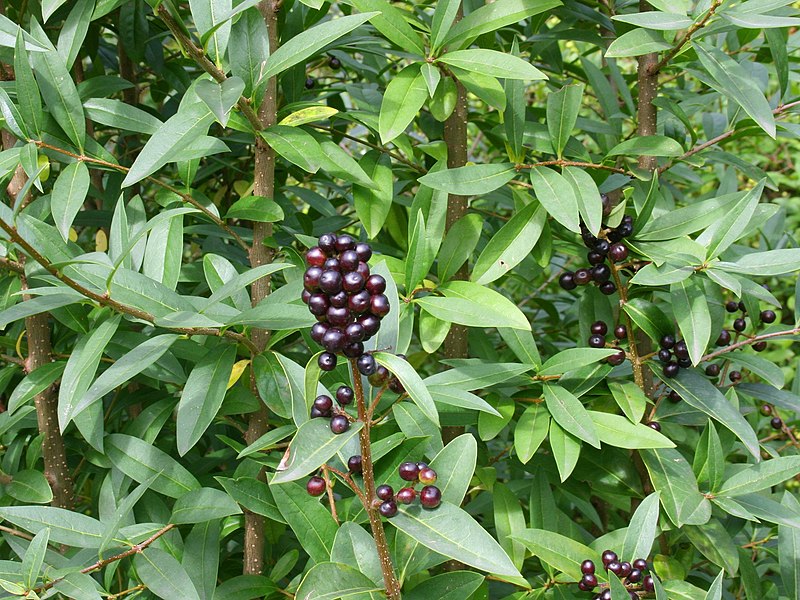
thumb|right|Wild privet, also sometimes known as common privet or European privet (Ligustrum vulgare)
OverviewAI-generated
Ligustrum is a genus of plants within the family Oleaceae. It belongs to the kingdom Plantae, phylum Tracheophyta, class Magnoliopsida, and order Lamiales. The genus was described by Linnaeus in 1753 and has the type species Ligustrum vulgare. Common names for the genus include privet, Liguster, ptačí zob, and 女贞属. Its taxonomic status is accepted.
Specimens of Ligustrum have been recorded in the United States, Mexico, the Philippines, China, and Japan. These records are held by institutions such as BRIT, FCB-BUAP, INECOL, LOB, and CAS. The genus is described in the Encyclopædia Britannica 11th edition. Specific species mentioned in general descriptions include Ligustrum glomeratum Blume and L. novoguineense Lingelsh.
Synthesized by Vinony from 39 facts across 8 sources: Wikidata, GBIF, PubMed, Gbif Occ, Plants of the World, iDigBio, WoRMS, Vinony graph. Generated from structured data (not the Wikipedia text) and checked against those facts — may still contain errors.
Species
Ligustrum
GENUS
- KingdomPlantae
- PhylumTracheophyta
- ClassMagnoliopsida
- OrderLamiales
- FamilyOleaceae
General: are recorded: Ligustrum glomeratum Blume and L. novoguineense Lingelsh.
via GBIF · Kew POWO
Museum specimens
- Specimen records
- 856
- With media
- 610
- Family
- Oleaceae
- Collections
- BRIT, FCB-BUAP, INECOL, LOB, CAS, CM
- Recorded in
- United States, Mexico, Philippines, China, Japan, Australia, Papua New Guinea
Research
584 papers- Ligustrum pollen: New insights into allergic disease.The World Allergy Organization journal · 2020
- Ligustrum lucidum and its Constituents: A Mini-Review on the Anti-Osteoporosis Potential.Natural product communications · 2015
- Valorization of ligustrum species: biosynthesis, metabolic engineering, and pharmacology of bioactive compounds.Bioresources and bioprocessing · 2026
- A review of botany, phytochemistry, pharmacology, and applications of the herb with the homology of medicine and food: Ligustrum lucidum W.T. Aiton.Frontiers in pharmacology · 2024
- [Species identification of Ligustrum lucidum].Zhongguo Zhong yao za zhi = Zhongguo zhongyao zazhi = China journal of Chinese materia medica · 2023
via PubMed
Wikidata facts
Show 7 more facts
- Commons category
- Ligustrum
- taxon rank
- genus
- taxon name
- Ligustrum
- taxonomic type
- Ligustrum vulgare
- topic's main category
- Category:Ligustrum
- taxon common name
- kalina
Sources (2)
via Wikidata · CC0
~4 min read
Encyclopedic overview
6 sectionsContents
- Description
- Uses and cultivation
- Ecology
- Invasiveness
- Species
- References
thumb|right|Wild privet, also sometimes known as common privet or European privet (Ligustrum vulgare)
A privet is a flowering plant in the genus Ligustrum. The genus contains about 50 species of erect, deciduous or evergreen shrubs or trees, with a native distribution from Europe to tropical and subtropical Asia, and with one species each native to Australia and north Africa. Some species have become widely naturalized or invasive where introduced. Privet was originally the name for the European semi-evergreen shrub Ligustrum vulgare, and later also for the more reliably evergreen Ligustrum ovalifolium and its hybrid Ligustrum × ibolium used extensively for privacy hedging, though now the name is applied to all members of the genus. The generic name was applied by Pliny the Elder (23–79 AD) to L. vulgare. It is often suggested that the name privet is related to private, but the Oxford English Dictionary states that there is no evidence to support this.
Excerpted from Wikipedia’s “Ligustrum” article, available under the CC BY-SA 4.0 licence.