Lindbergh kidnapping
Sign in to saveKidnapping and murder of 20 month old Charles Lindbergh Jr
Described at
The Kidnapping | American Experience | Official Site | PBS
The abduction of Charles Lindbergh, Jr. and the subsequent "Trial of the Century"
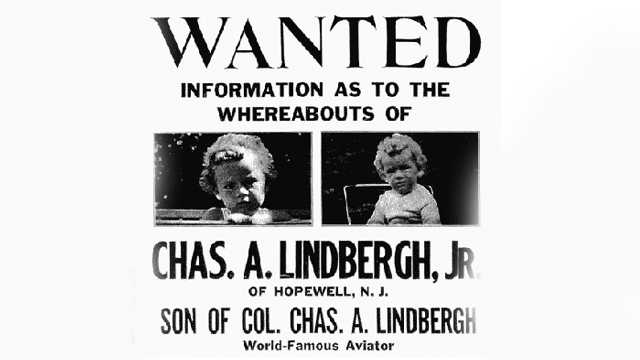
pbs.org →helps your community explore new worlds and ideas through programs that educate, inform and inspire. Your tax-deductible donation helps make it all possible. Charles Augustus Lindbergh, Jr. was born on June 22, 1930. The son of Charles Lindbergh, the famed aviator, and Anne Morrow Lindbergh, the daughter of a diplomat, Baby Charlie was destined for fame. But his parents could not have imagined just how famous their baby would become, nor could they have imagined the tragedy that would put him and themselves on the front pages of America's newspapers. Baby Charlie was suffering from a cold during the last weekend in February, 1932. On Tuesday, March 1, Charles and Anne were spending a quiet evening at home in Hopewell, New Jersey. Betty Gow, Charlie's nurse, rubbed medication on the baby's chest to relieve congestion. At about 7:30, Betty and Anne put Charlie Jr. to bed. Betty and the Lindberghs went on about their separate chores that night. At 10 p.m., Betty Gow made a horrible discovery -- baby Charlie was gone. Charles Lindbergh later recounted his initial reactions: "...I went upstairs to the child's nursery, opened the door, and immediately noticed a lifted window. A strange-looking envelope lay on the sill. I looked at the crib. It was empty. I ran downstairs, grabbed my rifle, and went out into the night..." By 10:30 that night, radio news bulletins were announcing the story to the nation. Nearly every newspaper in the country gave the story prominent placement in their March 2 editions. Soon, sightings of the Lindbergh baby were coming from all quarters: California, Michigan, Mexico. None turned out to be genuine. Colonel H. Norman Schwarzkopf of the New Jersey State Police was officially in charge of the investigation, but Schwarzkopf, the father of 1991 Gulf War leader U.S. General H. Norman Schwarzkopf, willingly ceded major responsibility for the investigation to Charles Lindbergh. But running a kidnapping investigation was no job for an amateur. Lindbergh's inexperience allowed for major errors -- footprints near the house were trampled and pieces of evidence were handled by a variety of people assembled at the compound. Other blunders would follow. Then, on May 12, 1932, 72 days after the kidnapping, the decomposed body of a baby was found in the woods near the Lindbergh house. The child had been dead, probably due to a fractured skull, since the night of the kidnapping. Two days later Charles Lindbergh identified his son's body by examining its teeth. The kidnapping investigation was now a murder investigation. Serial numbers from the money used to pay the ransom had been carefully recorded, despite Lindbergh's initial reluctance. The first bill surfaced in New York only three days after the ransom was paid. Over the next two years more and more would appear. Slowly the authorities moved forward. The "Trial of the Century" got underway in the small town of Flemington, New Jersey on January 2, 1935. Sixty thousand people -- reporters, novelists, movie stars, and society matrons -- crammed into tiny Flemington. The town had one hotel and one bar to accommodate some of the biggest names in journalism, Walter Winchell, Fanny Hurst, and Damon Runyon among them. Hauptmann was defended by Edward "Big Ed" Reilly, a flamboyant attorney who was reputed to have seen his better days. Both Charles and Anne Morrow Lindbergh were called as witnesses. Charles testified that he recognized Hauptmann's voice from the night that he and Condon had delivered the ransom money to the cemetery. When Hauptmann took the stand he denied all involvement with the crimes. He went on to say that he had been beaten by the police and forced to alter the way he wrote so that his handwriting matched that found in the ransom note. Testimony ended in early February of 1935. Following 11 hours of deliberation, the jury found Hauptmann guilty of murder in the first degree. He was sentenced to death. At 8:44 p.m. on April 3, 1936, Bruno Richard
Excerpt from a page describing this subject · 14,050 chars · not written by Vinony
Wikidata facts
- Instance of
- kidnapping
- Country
- United States
- Location
- New Jersey
- Image
- Lindbergh baby poster1.jpg
Show 5 more facts
- Commons category
- Lindbergh kidnapping
- significant person
- Richard Hauptmann
- point in time
- 1932-03-01
- described at URL
- www.nytimes.com/2024/03/05/nyregion/charles-lindbergh-baby.html
- perpetrator
- Richard Hauptmann
Sources (2)
via Wikidata · CC0