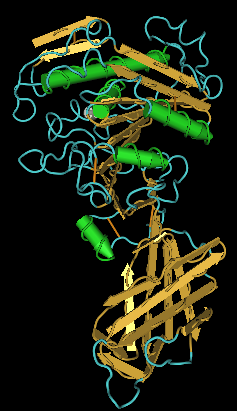
File:Lipase_PLRP2.png · Wikimedia Commons · See Wikimedia Commons
lipases
Sign in to saveAlso known as lipase
Lipase is a class of enzymes that catalyzes the hydrolysis of fats. Some lipases display broad substrate scope including esters of cholesterol, phospholipids, and of lipid-soluble vitamins and sphingomyelinases; however, these are usually treated separately from "conventional" lipases. Unlike esterases, which function in water, lipases "are activated only when adsorbed to an oil–water interface". Lipases perform essential roles in digestion, transport and processing of dietary lipids in most, if not all, organisms.
Key facts
- Diagnostic.name
- Lipase
- Diagnostic.image
- Lipase PLRP2.png
- Diagnostic.caption
- A computer-generated image of a type of pancreatic lipase (PLRP2) from the guinea pig.
- Diagnostic.test of
- Pancreatitis
via Wikipedia infobox
Research
57,992 papers- Lipases: it's not just pancreatic lipase!American journal of veterinary research · 2022
- Microbial lipases and their industrial applications: a comprehensive review.Microbial cell factories · 2020
- Extremophilic lipases for industrial applications: A general review.Biotechnology advances · 2022
- Lipases: Sources, Production, Purification, and Applications.Recent patents on biotechnology · 2019
- Microbial halophilic lipases: A review.Journal of basic microbiology · 2021
via PubMed
Wikidata facts
- Image
- Triacilglicerol lipasa.jpg
Show 2 more facts
- Commons category
- Lipase
- EC enzyme number
- 3.1.1.-
via Wikidata · CC0
~7 min read
Encyclopedic overview
8 sectionsContents
- Structure and catalytic mechanism
- Physiological distribution
- Human lipases
- Uses
- Biomedicine
- See also
- References
- External links
Lipase is a class of enzymes that catalyzes the hydrolysis of fats. Some lipases display broad substrate scope including esters of cholesterol, phospholipids, and of lipid-soluble vitamins and sphingomyelinases; however, these are usually treated separately from "conventional" lipases. Unlike esterases, which function in water, lipases "are activated only when adsorbed to an oil–water interface". Lipases perform essential roles in digestion, transport and processing of dietary lipids in most, if not all, organisms.
==Structure and catalytic mechanism== Classically, lipases catalyse the hydrolysis of triglycerides: \begin{align} \text{triglyceride} + \ce{H2O} &\longrightarrow \text{fatty acid} + \text{diacylglycerol} \\[4pt] \text{diacylglycerol} + \ce{H2O} &\longrightarrow \text{fatty acid} + \text{monacylglycerol} \\[4pt] \text{monacylglycerol} + \ce{H2O} &\longrightarrow \text{fatty acid} + \text{glycerol} \end{align}
Excerpted from Wikipedia’s “lipases” article, available under the CC BY-SA 4.0 licence.