File:Charles_Marion_Russell_-_The_Custer_Fight_(1903).jpg · Wikimedia Commons · See Wikimedia Commons
lithography
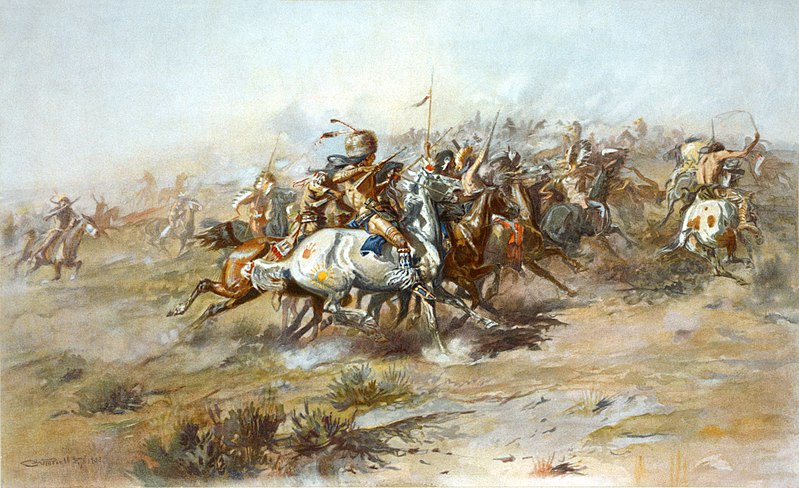
Sign in to savethumb|upright=1.3|A lithograph of Charles Marion Russell's The Custer Fight (1903), with the range of tones fading toward the edges.
Lithography is a printing technique that creates images on stone or metal surfaces based on the principle that oil and water don't mix, allowing artists to draw designs that can be reproduced multiple times. It was historically important for making affordable copies of artwork and images, as shown by this 1903 print of Charles Marion Russell's famous painting.
AI-generated from the Wikipedia summary — may contain errors.
Wikidata facts
- Instance of
- industry
- Image
- Centenaire de la lithographie par Puvis de Chavannes 1895.jpg
Show 6 more facts
- time of discovery or invention
- 1796-00-00
- Commons category
- Lithography
- topic's main category
- Category:Lithography
- practiced by
- lithographer
- P13411
- April 14
- significant person
- Edgar Degas
Sources (3)
via Wikidata · CC0
~17 min read
Encyclopedic overview
7 sectionsContents
- Principle
- Lithography on limestone
- Modern lithographic process
- Lithography as an artistic medium
- See also
- References
- External links
thumb|upright=1.3|A lithograph of Charles Marion Russell's The Custer Fight (1903), with the range of tones fading toward the edges.
Lithography () is a planographic method of printing originally based on the immiscibility of oil and water. The printing is from a stone (lithographic limestone) or a metal plate with a smooth surface. It was invented in 1796 by the German author and actor Alois Senefelder and was initially used mostly for musical scores and maps. Lithography can be used to print text or images onto paper or other suitable material. A lithograph is something printed by lithography, but this term is only used for fine art prints and some other, mostly older, types of printed matter, not for those made by modern commercial lithography.
Excerpted from Wikipedia’s “lithography” article, available under the CC BY-SA 4.0 licence.
Gallery (28)
Available in 81 languages
- Español
- Français
- Deutsch
- 中文
- 日本語
- Русский
- Português
- Italiano
- العربية
- हिन्दी
- Albanian
- Albanian
- Armenian
- azb
- Azerbaijani
- Bahasa Indonesia
- Bangla
- Basque
Show 62 more
- be_x_old
- Belarusian
- Bosnian
- Breton
- Bulgarian
- Burmese
- Catalan
- Chuvash
- Croatian
- Czech
- Danish
- Egyptian Arabic
- Esperanto
- Estonian
- Filipino
- Finnish
- Galician
- Georgian
- Greek
- Hebrew
- Hungarian
- Kazakh
- Kurdish
- Kyrgyz
- Latin
- Latvian
- Lithuanian
- Luxembourgish
- Macedonian
- Malay
- Malayalam
- Marathi
- Nederlands
- Norwegian
- Norwegian Nynorsk
- Occitan
- Polski
- rki
- Romanian
- Sardinian
- Serbian
- Serbian (Latin)
- simple
- Slovak
- Slovenian
- Svenska
- Tamil
- Tiếng Việt
- Türkçe
- Ukrainian
- Urdu
- Uzbek
- Welsh
- West Flemish
- Western Frisian
- Western Panjabi
- Wu Chinese
- Yakut
- zh_yue
- فارسی
- ไทย
- 한국어
via Wikidata sitelinks · CC0