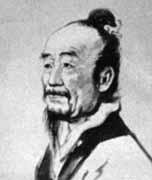
File:Liu_hui.jpg · Wikimedia Commons · See Wikimedia Commons
Liu Hui
Sign in to saveChinese mathematician from Cao Wei (Three Kingdoms period)
Key facts
- Born
- c. 225 , Zibo , Shandong
- Died
- c. 295
- Occupations
- Mathematician, writer
via Wikipedia infobox
Wikidata facts
- Instance of
- human
- Family name
- Liu
- Gender
- male
- Citizenship
- Western Jin dynasty
- Place of birth
- Zibo
- Place of death
- China
- Occupation
- mathematician
- Languages spoken
- Classical Chinese
- Image
- Hunan International Economics University20.jpg
- Residence
- Cao Wei
Show 8 more facts
- date of death
- 0295-00-00
- date of birth
- 0225-00-00
- floruit
- 0300-00-00
- Commons category
- Liu Hui (mathematician)
- interested in
- mathematics
- maintained by WikiProject
- WikiProject Mathematics
- birth name
- 刘徽
- name in native language
- 刘徽
via Wikidata · CC0
~7 min read
Encyclopedic overview
Liu Hui (fl. 3rd century CE) was a Chinese mathematician who published a commentary in 263 CE on Jiu Zhang Suan Shu (The Nine Chapters on the Mathematical Art). He was a descendant of the Marquis of Zixiang of the Eastern Han dynasty and lived in the state of Cao Wei during the Three Kingdoms period (220–280 CE) of China.
His major contributions as recorded in his commentary on The Nine Chapters on the Mathematical Art include a proof of the Pythagorean theorem, theorems in solid geometry, an improvement on Archimedes's approximation of π, and a systematic method of solving linear equations in several unknowns. In his other work, Haidao Suanjing (The Sea Island Mathematical Manual), he wrote about geometrical problems and their application to surveying. He probably visited Luoyang, where he measured the sun's shadow.
Excerpted from Wikipedia’s “Liu Hui” article, available under the CC BY-SA 4.0 licence.