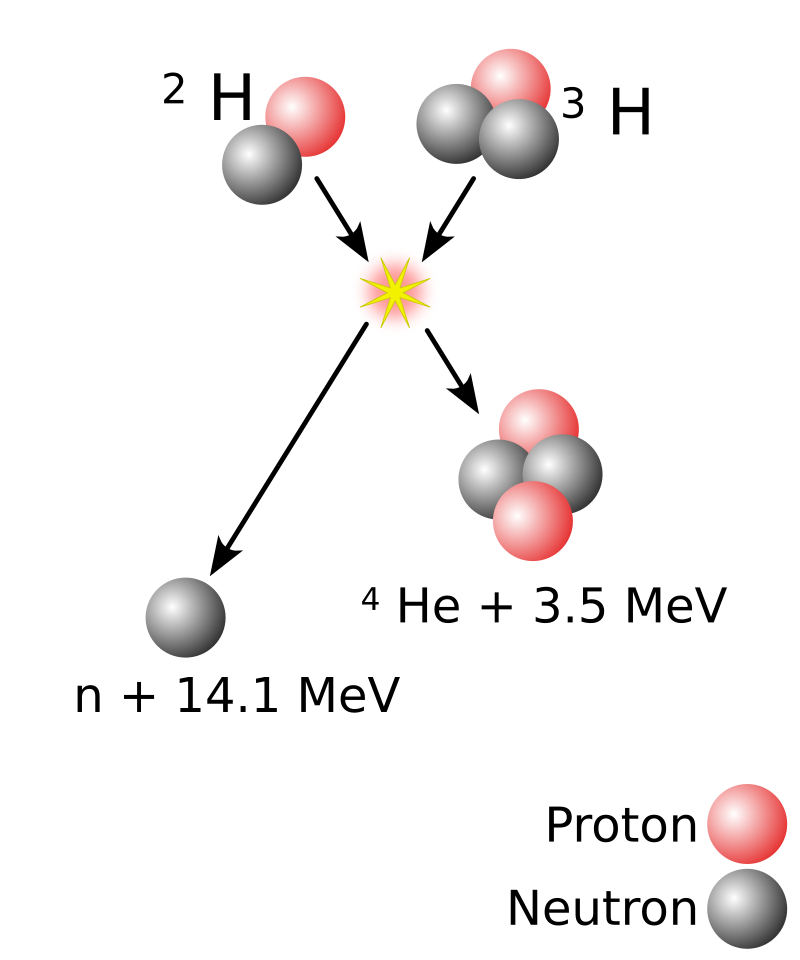
File:Deuterium-tritium_fusion.svg · Wikimedia Commons · See Wikimedia Commons
livermorium
Sign in to saveAlso known as Lv, eka-polonium, element 116, ununhexium, Uuh
Livermorium is a synthetic chemical element; it has symbol Lv and atomic number 116. It is an extremely radioactive element that has only been created in a laboratory setting and has not been observed in nature. The element is named after the Lawrence Livermore National Laboratory in the United States, which collaborated with the Joint Institute for Nuclear Research (JINR) in Dubna, Russia, to discover livermorium during experiments conducted between 2000 and 2006. The name of the laboratory refers to the city of Livermore, California, where it is located, which in turn was named after the ran
Livermorium is a human-made chemical element (symbol Lv, atomic number 116) that is so radioactive it can only exist briefly in laboratory conditions and has never been found in nature. It was discovered through a collaboration between the Lawrence Livermore National Laboratory in California and a Russian research institute between 2000 and 2006, and was named after the American laboratory that helped create it.
AI-generated from the Wikipedia summary — may contain errors.
Wikidata facts
- Instance of
- synthetic element
- Subclass of
- group 16
- Part of
- group 16
- Named after
- Lawrence Livermore National Laboratory
Show 9 more facts
- element symbol
- Uuh
- Commons category
- Livermorium
- topic's main category
- Category:Livermorium
- Commons gallery
- Livermorium
- atomic number
- 116
- time of discovery or invention
- 2000-07-00
- discoverer or inventor
- Joint Institute for Nuclear Research
- Unicode character
- 鉝
- on focus list of Wikimedia project
- Wikipedia:Vital articles/Level/4
Sources (1)
via Wikidata · CC0
~24 min read
Encyclopedic overview
17 sectionsContents
- Introduction
- History
- Unsuccessful synthesis attempts
- Unconfirmed discovery claims
- Discovery
- Road to confirmation
- Naming
- Other routes of synthesis
- Predicted properties
- Nuclear stability and isotopes
- Physical and atomic
- Chemical
- Experimental chemistry
- Notes
- References
- Bibliography
- External links
Livermorium is a synthetic chemical element; it has symbol Lv and atomic number 116. It is an extremely radioactive element that has only been created in a laboratory setting and has not been observed in nature. The element is named after the Lawrence Livermore National Laboratory in the United States, which collaborated with the Joint Institute for Nuclear Research (JINR) in Dubna, Russia, to discover livermorium during experiments conducted between 2000 and 2006. The name of the laboratory refers to the city of Livermore, California, where it is located, which in turn was named after the rancher and landowner Robert Livermore. The name was adopted by IUPAC on May 30, 2012. Six isotopes of livermorium are known, with mass numbers of 288–293 inclusive; the longest-lived among them is livermorium-293 with a half-life of about 80 milliseconds. A seventh possible isotope with mass number 294 has been reported but not yet confirmed.
In the periodic table, it is a p-block transactinide element. It is a member of the 7th period and is placed in group 16 as the heaviest chalcogen, but it has not been confirmed to behave as the heavier homologue to the chalcogen polonium. Livermorium is calculated to have some similar properties to its lighter homologues (oxygen, sulfur, selenium, tellurium, and polonium), and be a post-transition metal, though it should also show several major differences from them.
Excerpted from Wikipedia’s “livermorium” article, available under the CC BY-SA 4.0 licence.
Gallery (10)
Available in 128 languages
- Español
- Français
- Deutsch
- 中文
- 日本語
- Русский
- Português
- Italiano
- العربية
- हिन्दी
- abstract
- Afrikaans
- Albanian
- Amharic
- Angika
- Aragonese
- Armenian
- Asturian
Show 109 more
- Azerbaijani
- Bahasa Indonesia
- Balinese
- Bangla
- Basque
- be_x_old
- Belarusian
- Bhojpuri
- Bosnian
- Breton
- Bulgarian
- Burmese
- Catalan
- cdo
- Cebuano
- Central Kurdish
- Chuvash
- Cornish
- Corsican
- Croatian
- Czech
- Danish
- Egyptian Arabic
- Esperanto
- Estonian
- Fiji Hindi
- Finnish
- Friulian
- Galician
- Georgian
- Greek
- Hakka Chinese
- Hebrew
- Hungarian
- Icelandic
- Ido
- Interlingua
- Irish
- Kalmyk
- Kannada
- Kazakh
- kbp
- Komi
- Kurdish
- Latin
- Latvian
- Ligurian
- Limburgish
- Lithuanian
- Low German
- Luxembourgish
- Macedonian
- Malay
- Malayalam
- Manx
- Marathi
- Mongolian
- Nederlands
- Newari
- Northern Frisian
- Norwegian
- Norwegian Nynorsk
- Novial
- Occitan
- olo
- Pashto
- Polski
- Punjabi
- Quechua
- roa_rup
- Romanian
- Sanskrit
- Sardinian
- Scottish Gaelic
- Serbian
- Serbian (Latin)
- Sicilian
- simple
- Sindhi
- Slovak
- Slovenian
- Somali
- Svenska
- Swahili
- Tajik
- Tamil
- Tatar
- Telugu
- Tiếng Việt
- Türkçe
- Ukrainian
- Urdu
- Uyghur
- Uzbek
- Veps
- Volapük
- Waray
- Welsh
- Western Frisian
- Western Mari
- Wu Chinese
- Yoruba
- zh_classical
- zh_min_nan
- zh_yue
- Zulu
- فارسی
- ไทย
- 한국어
via Wikidata sitelinks · CC0