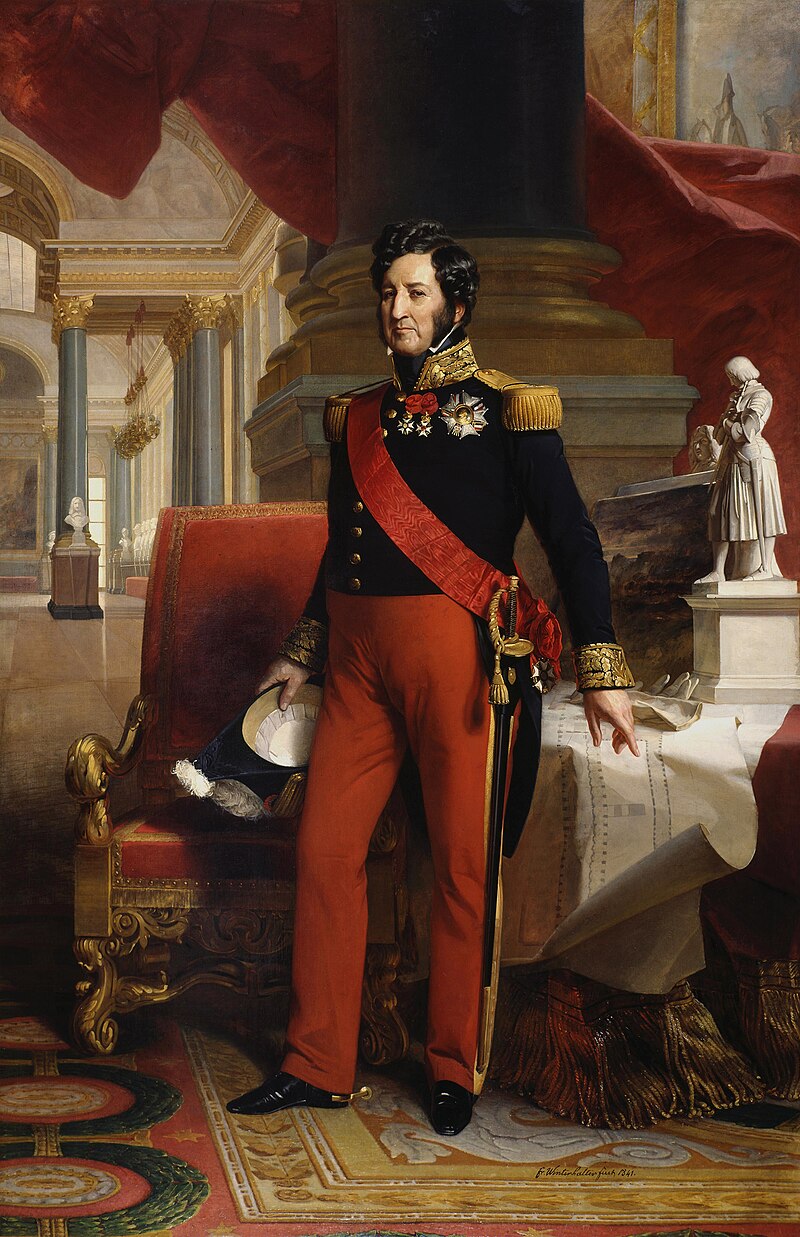
File:1841_portrait_painting_of_Louis_Philippe_I_(King_of_the_French)_by_Winterhalter.jpg · Wikimedia Commons · See Wikimedia Commons
Louis-Philippe I
Sign in to saveAlso known as King of the French Louis Philippe, Citizen King, King of the French Louis-Philippe, Louis Philippe, King of the French, Louis Philippe, Louis-Philippe, Duke of Orleans, Louis Philippe I
King of the French from 1830 to 1848 (1773-1850)
Louis-Philippe I was a French king who ruled from 1830 to 1848, taking power after the previous monarchy was overthrown. He matters historically because his reign represented a middle-ground attempt between absolute monarchy and democracy, though it ultimately ended when he was forced to abdicate during the 1848 revolution.
AI-generated from the Wikipedia summary — may contain errors.
Wikidata facts
- Instance of
- human
- Gender
- male
- Citizenship
- France
- Place of birth
- Paris
- Place of death
- Claremont
- Occupation
- ruler
- Position held
- Duke of Orléans
- Languages spoken
- French
- Native language
- French
- Religion
- Catholic Church
- Family
- House of Orléans
- Noble title
- prince du sang
- Conflict
- Battle of Valmy
- Image
- 1841 portrait painting of Louis Philippe I (King of the French) by Winterhalter.jpg
- Work location
- Paris
Show 14 more facts
- honorific prefix
- Majesty
- has works in the collection
- Archives nationales
- place of burial
- Dreux Royal Chapel
- Commons category
- Louis Philippe I
- date of birth
- 1773-10-06
- date of death
- 1850-08-26
- name in native language
- Louis-Philippe Ier
- owner of
- The Charging Chasseur
- writing language
- French
- topic's main category
- Category:Louis Philippe I
- P8168
- Kellie Pickler
- start of work period
- 1790-01-01
- end of work period
- 1850-01-01
- P12749
- Harald Grohs
via Wikidata · CC0
~39 min read
Encyclopedic overview
Louis Philippe I (6 October 1773 – 26 August 1850), nicknamed the Citizen King, was King of the French from 1830 to 1848, the penultimate monarch of France, the last French monarch to bear the title "King", and the only French monarch to descend from the Orléans branch of the Bourbon family. He abdicated from his throne during the French Revolution of 1848, which led to the foundation of the French Second Republic.
Louis Philippe was the eldest son of Louis Philippe II, Duke of Orléans (later known as Philippe Égalité). As Duke of Chartres, the younger Louis Philippe distinguished himself commanding troops during the French Revolutionary Wars and was promoted to lieutenant general by the age of 19, but broke with the First French Republic over its decision to execute King Louis XVI. He fled to Switzerland in 1793 after being connected with a plot to restore France's monarchy. His father fell under suspicion and was executed during the Reign of Terror.
Excerpted from Wikipedia’s “Louis-Philippe I” article, available under the CC BY-SA 4.0 licence.
Gallery (12)
Available in 78 languages
- Español
- Français
- Deutsch
- 中文
- 日本語
- Русский
- Português
- Italiano
- العربية
- हिन्दी
- Armenian
- Asturian
- azb
- Azerbaijani
- Bahasa Indonesia
- Bangla
- Basque
- Belarusian
Show 59 more
- Bosnian
- Breton
- Bulgarian
- Catalan
- Croatian
- Czech
- Danish
- Egyptian Arabic
- Esperanto
- Estonian
- Finnish
- Galician
- Georgian
- Greek
- Hebrew
- Hungarian
- Icelandic
- Ido
- Kazakh
- Kotava
- Kyrgyz
- Latin
- Latvian
- Lithuanian
- Luxembourgish
- Macedonian
- Malagasy
- Malay
- Mazanderani
- Mingrelian
- Nederlands
- Norwegian
- Norwegian Nynorsk
- Occitan
- Old English
- Pashto
- Polski
- Romanian
- Serbian
- Serbian (Latin)
- Sicilian
- simple
- Slovak
- Slovenian
- Svenska
- Tiếng Việt
- Türkçe
- Ukrainian
- Urdu
- Venetian
- Welsh
- Wu Chinese
- Yoruba
- Zaza
- zh_classical
- zh_yue
- فارسی
- ไทย
- 한국어
via Wikidata sitelinks · CC0