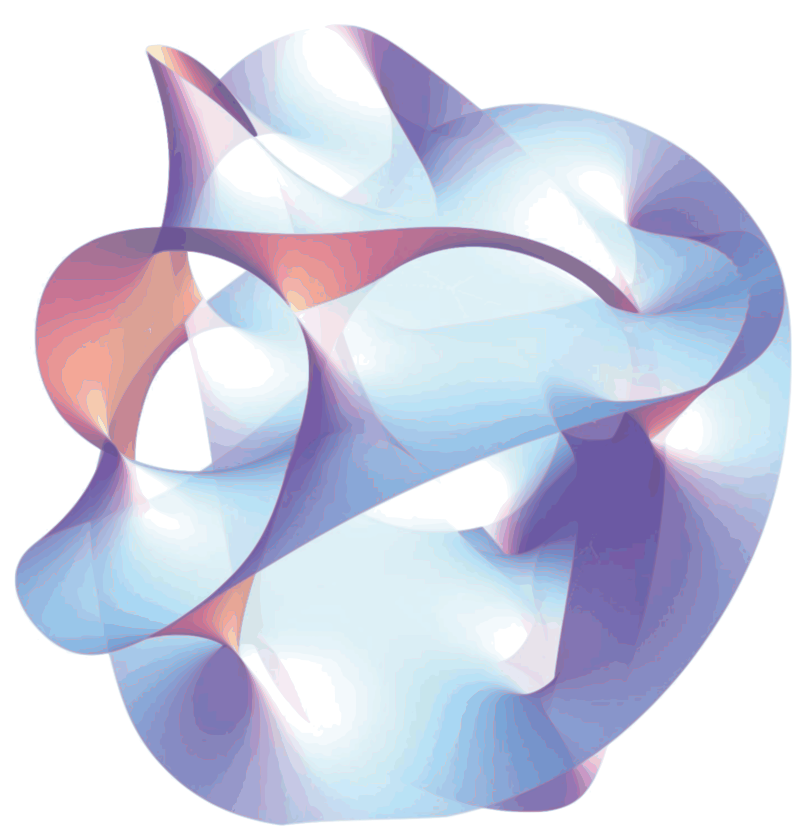
File:Calabi_yau_formatted.svg · Wikimedia Commons · See Wikimedia Commons
M-theory
Sign in to saveAlso known as M theory
In physics, M-theory is a theory that unifies all consistent versions of superstring theory. Edward Witten first conjectured the existence of such a theory at a string theory conference at the University of Southern California in 1995. Witten's announcement initiated a flurry of research activity known as the second superstring revolution. Prior to Witten's announcement, string theorists had identified five versions of superstring theory. Although these theories initially appeared to be very different, work by many physicists showed that the theories were related in intricate and nontrivial wa
Wikidata facts
Show 2 more facts
- discoverer or inventor
- Edward Witten
- time of discovery or invention
- 1995-00-00
Sources (3)
via Wikidata · CC0
~40 min read
Encyclopedic overview
31 sectionsContents
- Background
- Quantum gravity and strings
- Number of dimensions
- Dualities
- Supersymmetry
- Branes
- History and development
- Kaluza–Klein theory
- Early work on supergravity
- Relationships between string theories
- Membranes and fivebranes
- Second superstring revolution
- Origin of the term
- Matrix theory
- BFSS matrix model
- Noncommutative geometry
- AdS/CFT correspondence
- Overview
- 6D (2,0) superconformal field theory
- ABJM superconformal field theory
- Phenomenology
- Overview
- Compactification on {{math|''G''<sub>2</sub>}} manifolds
- Heterotic M-theory
- References
- Notes
- Citations
- Bibliography
- Popularization
- See also
- External links
In physics, M-theory is a theory that unifies all consistent versions of superstring theory. Edward Witten first conjectured the existence of such a theory at a string theory conference at the University of Southern California in 1995. Witten's announcement initiated a flurry of research activity known as the second superstring revolution. Prior to Witten's announcement, string theorists had identified five versions of superstring theory. Although these theories initially appeared to be very different, work by many physicists showed that the theories were related in intricate and nontrivial ways. Physicists found that apparently distinct theories could be unified by mathematical transformations called S-duality and T-duality. Witten's conjecture was based in part on the existence of these dualities and in part on the relationship of the string theories to a field theory called eleven-dimensional supergravity.
Although a complete formulation of M-theory is not known, such a formulation should describe two- and five-dimensional objects called branes and should be approximated by eleven-dimensional supergravity at low energies. Modern attempts to formulate M-theory are typically based on matrix theory or the AdS/CFT correspondence. According to Witten, the M should stand for "magic", "mystery" or "membrane" (according to one's taste), and the true meaning of the title should be decided when a more fundamental formulation of the theory is known.
Excerpted from Wikipedia’s “M-theory” article, available under the CC BY-SA 4.0 licence.