File:Circulation_in_macroeconomics.svg · Wikimedia Commons · See Wikimedia Commons
macroeconomics
Sign in to saveAlso known as macroeconomy
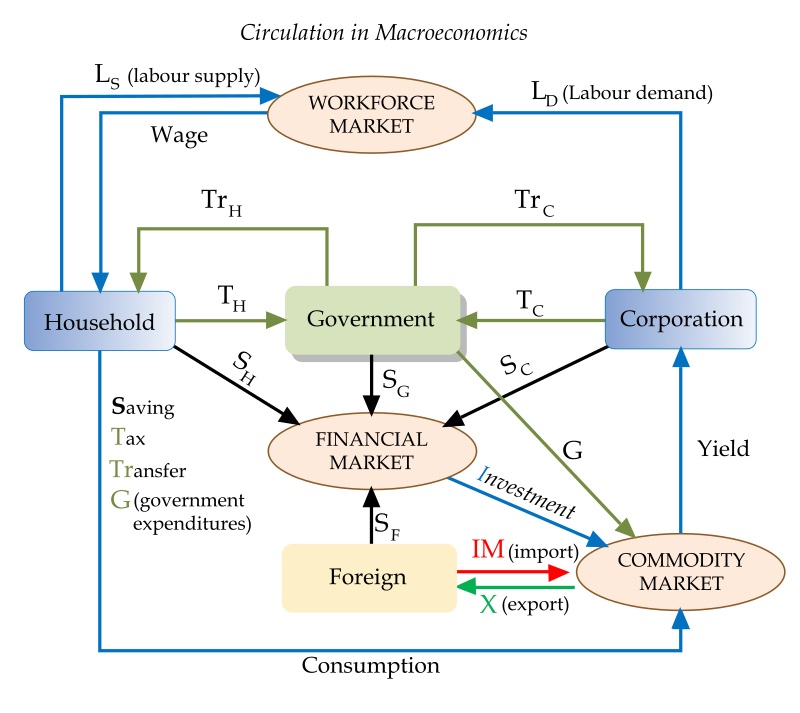
thumb|250px|Production and national income: Macroeconomics takes a big-picture view of the entire economy, including examining the roles of, and relationships between, firms, households and governments, and the different types of markets, such as the financial market and the labour market.
Macroeconomics studies the economy as a whole, looking at how firms, households, and governments interact with each other and examining different markets like the financial and labor markets. Understanding macroeconomics matters because it helps explain how these large-scale economic forces and relationships affect overall economic performance and national income.
AI-generated from the Wikipedia summary — may contain errors.
Wikidata facts
- Instance of
- theory
- Subclass of
- economics
- Part of
- general economics
- Image
- Einfacher Wirtschaftskreislauf.png
Show 9 more facts
- Commons category
- Macroeconomics
- Stack Exchange tag
- economics.stackexchange.com/tags/macroeconomics
- topic's main category
- Category:Macroeconomics
- topic has template
- Template:Macroeconomics sidebar
- is the study of
- business cycle
- Wikimedia import URL
- en.wikipedia.org/wiki/Macroeconomics
- on focus list of Wikimedia project
- Wikipedia:Vital articles/Level/4
- opposite of
- microeconomics
- facet of
- economic theory
Sources (8)
via Wikidata · CC0
~44 min read
Encyclopedic overview
30 sectionsContents
- Basic concepts
- Output and income
- Unemployment
- Inflation and deflation
- GDP Measurement
- Equation Using Expenditure Approach
- GDP Deflator
- Measuring the supply of money
- Open economies
- History
- Before Keynes
- Keynes and Keynesian economics
- Monetarism
- New classical economics
- New Keynesian response
- 2008 financial crisis
- Growth models
- Climate change in macroeconomics
- Heterodox macroeconomics
- Macroeconomic policy
- Monetary policy
- Fiscal policy
- Comparison of fiscal and monetary policy
- Macroeconomic models
- Specific models
- IS–LM model
- AD-AS model
- See also
- References
- Further reading
thumb|250px|Production and national income: Macroeconomics takes a big-picture view of the entire economy, including examining the roles of, and relationships between, firms, households and governments, and the different types of markets, such as the financial market and the labour market.
Macroeconomics is a branch of economics that deals with the performance, structure, behavior, and decision-making of an economy as a whole. This includes regional, national, and global economies. Macroeconomists study aggregate measures of the economy, such as output or gross domestic product (GDP), national income, unemployment, inflation, consumption, saving, investment, or trade. Macroeconomics is primarily focused on questions which help to understand aggregate variables in relation to long run economic growth.
Excerpted from Wikipedia’s “macroeconomics” article, available under the CC BY-SA 4.0 licence.
Gallery (22)
Available in 100 languages
- Español
- Français
- Deutsch
- 中文
- 日本語
- Русский
- Português
- Italiano
- العربية
- हिन्दी
- Afrikaans
- Albanian
- Armenian
- Assamese
- Asturian
- azb
- Azerbaijani
- Bahasa Indonesia
Show 81 more
- Bangla
- Bashkir
- Basque
- be_x_old
- Belarusian
- Bhojpuri
- Bosnian
- Bulgarian
- Burmese
- Catalan
- Cebuano
- Central Kurdish
- Chuvash
- Croatian
- Czech
- Danish
- Egyptian Arabic
- Esperanto
- Estonian
- Filipino
- Finnish
- Galician
- Georgian
- Greek
- Hakka Chinese
- Hebrew
- Hungarian
- Icelandic
- Ido
- Kannada
- Kazakh
- Khmer
- Kyrgyz
- Lao
- Latin
- Latvian
- Lithuanian
- Macedonian
- Malay
- Malayalam
- Mongolian
- Nederlands
- Newari
- Norwegian
- Norwegian Nynorsk
- Occitan
- Ossetic
- Pashto
- Polski
- Punjabi
- Romanian
- Sanskrit
- Serbian
- Serbian (Latin)
- simple
- Sindhi
- Sinhala
- Slovak
- Slovenian
- Sundanese
- Svenska
- Tajik
- Tamil
- Telugu
- Tibetan
- Tiếng Việt
- Tok Pisin
- Türkçe
- Tuvinian
- Ukrainian
- Urdu
- Uzbek
- Waray
- Wu Chinese
- Yakut
- Zaza
- zh_min_nan
- zh_yue
- فارسی
- ไทย
- 한국어
via Wikidata sitelinks · CC0