
Madagascar
Sign in to saveAlso known as mg, Republic of Madagascar, MAD, Malagaskar, Malagascar, MDG
Madagascar, officially the Republic of Madagascar, is an island country in the Indian Ocean that includes the island of Madagascar and numerous smaller peripheral islands. Lying off the southeastern coast of Africa, it is the world's fourth-largest island, the second-largest island country, and the 46th-largest country overall. Its capital and largest city is Antananarivo.
OverviewAI-generated
Madagascar, officially the Republic of Madagascar, is a country in Eastern Africa. Its capital is Antananarivo. The nation has a population of 31,964,956 and covers an area of 587,041. It gained independence in 1960. The official languages are Malagasy and French. The currency consists of the ariary and the Malagasy franc. The head of state holds the office of President of Madagascar, while the head of government is the Prime Minister of Madagascar. The legislative body is the Parliament of Madagascar.
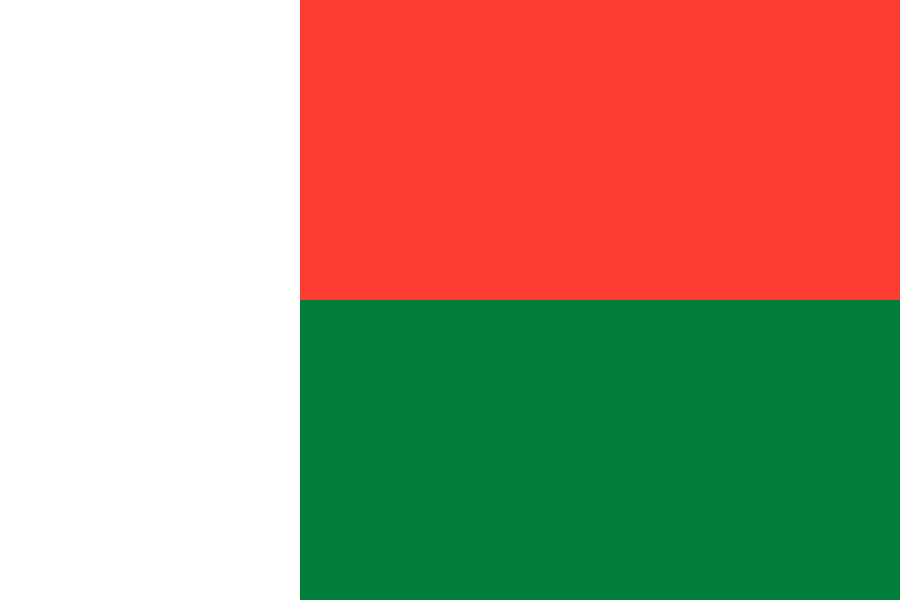
The country maintains diplomatic relations with Germany, Russia, Indonesia, and North Korea. Its license plate code is RM. The flag is represented by the Unicode character 🇲🇬. Madagascar has a forest area percentage of 21.2962600550017 and renewable energy accounts for 83.1 percent of its total. The urban population percentage is 32.4339893339844. Life expectancy is 63.835 years. The unemployment percentage is 3.041. Internet users comprise 18.67790031 percent of the population. The gross domestic product is 17,420,501,490.1231 US dollars.
Synthesized by Vinony from 68 facts across 9 sources: Wikidata, REST Countries, Open Meteo, Openweathermap, World Bank, OpenStreetMap, PubMed, Vinony graph, Geo. Generated from structured data (not the Wikipedia text) and checked against those facts — may still contain errors.
Weather now
7-day forecast
via Open-Meteo
Country
- Capital
- Antananarivo
- Population
- 31,727,042
- Region
- Africa · Eastern Africa
- Demonym
- Malagasy
- Currencies
- MGA (Ar)
- Languages
- French, Malagasy
- Calling code
- +261
- Drives on
- Right
- Gini
- 42.6 (2012)
- FIFA code
- MAD
- TLD
- .mg
- Timezones
- UTC+03:00
via REST Countries
Indicators · World Bank
- GDP
- $17.4B(2024)
- Population
- 31,964,956(2024)
- Life expectancy
- 63.8 yrs(2024)
- Unemployment
- 3 %(2025)
- Urban population
- 32.4 %(2024)
- Internet users
- 18.7 %(2024)
- Forest area
- 21.3 %(2023)
- Renewable energy
- 83.1 %(2022)
via World Bank Open Data · CC BY 4.0
Place details
- Locality
- Soaniakarana
- Region
- Vakinankaratra
- Country
- Madagasikara / Madagascar
via OpenStreetMap · GeoNames
Wikipedia views (30d)
135,763 totalvia Wikimedia Pageviews API
Key facts
- Country.calling_code
- +261
- Country.established_event6
- Referendum
- Country.established_date6
- 21 December 1975
- Country.population_density_rank
- 164th
- Country.GDP_PPP
- $68.110 billion
- Country.conventional_long_name
- Republic of Madagascar
- Country.common_name
- Madagascar
- Country.image_flag
- 110px
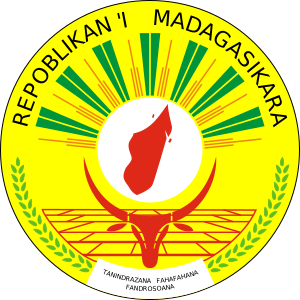
- Country.image_coat
- 90px
- Country.symbol_type
- Emblem
- Country.national_anthem
- "Oh, land of our beloved ancestors!"
- Country.image_map
- Madagascar (centered orthographic projection).svg
- Country.capital
- Antananarivo
- Country.largest_city
- Antananarivo
- Country.ethnic_groups_year
- 2017
- Country.demonym
- Malagasy
- Country.government_type
- Unitary semi-presidential republic under a transitional government
- Country.leader_title1
- President
via Wikipedia infobox
Research
8,617 papers- Madagascar's extraordinary biodiversity: Threats and opportunities.ReviewScience (New York, N.Y.) · 2022Ralimanana H, Perrigo AL, Smith RJ et al.DOI: 10.1126/science.adf1466
- Cysticercosis in Madagascar.ReviewJournal of infection in developing countries · 2020Carod JF, Dorny PDOI: 10.3855/jidc.13450
- Madagascar's extraordinary biodiversity: Evolution, distribution, and use.ReviewScience (New York, N.Y.) · 2022Antonelli A, Smith RJ, Perrigo AL et al.DOI: 10.1126/science.abf0869
- The colonisation of Madagascar by land-bound vertebrates.ReviewBiological reviews of the Cambridge Philosophical Society · 2023Ali JR, Hedges SBDOI: 10.1111/brv.12966
- Madagascar's EPI vaccine programs: A systematic review uncovering the role of a child's sex and other barriers to vaccination.Frontiers in public health · 2022Hahesy E, Cruz-Espinoza LM, Nyirenda G et al.DOI: 10.3389/fpubh.2022.995788
- Factors influencing the re-emergence of plague in Madagascar.ReviewEmerging topics in life sciences · 2020Alderson J, Quastel M, Wilson E et al.DOI: 10.1042/ETLS20200334
- Review of genotyping methods for Yersinia pestis in Madagascar.ReviewPLoS neglected tropical diseases · 2024Randriantseheno LN, Andrianaivoarimanana V, Pizarro-Cerdá J et al.DOI: 10.1371/journal.pntd.0012252
- Madagascar's vulnerable children.The Lancet. Infectious diseases · 2020Bagcchi SDOI: 10.1016/S1473-3099(20)30183-3
via PubMed
Wikidata facts
- Instance of
- country
- Official name
- Madagasikara
- Demonym
- Malagásach
- Country
- Madagascar
- Contains
- Toliara Province
- Continent
- Africa
- Capital
- Antananarivo
- Official language
- French
- Currency
- Malagasy franc
- Population
- 31964956
- Area
- 587295
- Head of government
- Ruphin Zafisambo
- Head of state
- Andry Rajoelina
- Form of government
- republic
- Legislature
- Parliament of Madagascar
- Shares border with
- Seychelles
- Highest point
- Maromokotro
- Official website
- www.madagascar.gov.mg
- Image
- Satellite image of Madagascar in September 2003.jpg
- Life expectancy
- 65.932
- Nominal GDP
- 14954967604
- Unemployment rate
- 4
Show 57 more facts
- Calling code
- +261
- Licence plate code
- RM
- Mains voltage
- 220
- Motto
- Cariad, Mamwlad, Cynnydd
- Coat of arms
- Seal of Madagascar
- topic's main Wikimedia portal
- Portal:Madagascar
- Unicode character
- 🇲🇬
- category of associated people
- Category:Malagasy people
- geography of topic
- geography of Madagascar
- office held by head of government
- Prime Minister of Madagascar
- number of out-of-school children
- 2178182
- diplomatic relation
- China
- office held by head of state
- President of Madagascar
- Commons gallery
- Madagasikara / Madagascar
- inception
- 1960-01-01
- history of topic
- history of Madagascar
- marriageable age
- 17
- mobile country code
- 646
- total fertility rate
- 4.409
- maritime identification digits
- 647
- topic's main category
- Category:Madagascar
- member of
- African Continental Free Trade Area
- category for people who died here
- Category:Deaths in Madagascar
- Commons category
- Madagascar
- top-level Internet domain
- .mg
- category for people born here
- Category:Births in Madagascar
- driving side
- right
- on focus list of Wikimedia project
- Wikipedia:Vital articles/Level/4
- lowest point
- Indian Ocean
- central bank
- Central Bank of Madagascar
- language used
- Southern Betsimisaraka Malagasy
- culture
- culture of Madagascar
- native label
- République de Madagascar
- VAT rate
- 20
- BTI Status Index
- 4.5
- BTI Governance Index
- 4.94
- replaces
- French Madagascar
- economy of topic
- economy of Madagascar
- demographics of topic
- demographics of Madagascar
- different from
- Madagaskar
- Democracy Index
- 5.70
- Human Development Index
- 0.501
- hashtag
- Madagascar
- Happy Planet Index score
- 44.2
- Gini coefficient
- 42.6
- Inequality-adjusted Human Development Index
- 0.367
- located in/on physical feature
- East Africa
- coextensive with
- Madagascar
- P12749
- Ramón Freire
- birth rate
- 30.595
- male population
- 14836218
- death rate
- 6.799
- rural population
- 17801970
- female population
- 14775496
- urban population
- 11809744
Sources (15)
via Wikidata · CC0
Travel guide
See
300px|thumb|Baobab near Morondava Sites from the Merina Kingdom can be seen across different parts of Madagascar.
Do
Most people visiting Madagascar do so for the wildlife, and there are a number of national parks and private reserves scattered throughout the country. Some are easier to reach than others - the dual Andasibe-Mantadia National Park area is a few hours from the capital via a paved road, while other parks require days of driving and trekking to explore.
Scuba diving and snorkeling is exceptional in Nosy Be, and is also possible in other areas like Toliara. Be aware that the nearest hyperbaric chamber lies across the Mozambique Channel, and that outside of Nosy Be scuba equipment may not be up to expected standards, so exercise caution and be careful to minimize risks when diving. The condition of corals varies from pristine at Nosy Tanikely to completely destroyed elsewhere, and depending on time of year the visibility may exceed 30 metres, or may be reduced to zero by the outflow from rivers, which, due erosion caused by deforestation, can turn the ocean brown. In the far north near Diego kitesurfing and windsurfing are exceptional between April and November when a constant 30 knot-wind makes the area one of the best surfing spots in the southern hemisphere. Kayaking and deep sea fishing are always rewarding water activities.
The Rainforests of the Atsinanana is made up of six national parks along the eastern coast of Madagascar; Marojejy National Park, Masoala National Park, Zahamena National Park, Ranomafana National Park, Andringitra National Park and Andohahela National …
Eat
thumb|Hotely malagasy The cheapest way to get a meal is to eat at a "hotely". A plate of rice, laoka (malagasy for a side dish accompanying rice) like chicken, beans or pork, and rice water costs about 3000 Ar (2020). For 1000 Ar extra you can get a small glass of homemade yoghurt.
Bananas (hundreds of varieties) and rice cakes (Malagasy 'bread') are staple 'street food' and available everywhere. Coffee is very good, usually hand-made by the cup and served very sweet with condensed milk.
Steak-frites is available in restaurants in the larger towns.
Drink
There is no safe tap water so be prepared with bottled water, which is usually easily obtainable. The only other option is ranon'apango (RAN-oo-na-PANG-oo) or rice water (water used to cook rice, which will therefore have been boiled). It's particularly important to plan ahead if visiting rural areas. It is worth taking with you some chlorine tablets, which can be used to make the local water drinkable.
In towns, roadside drink stands, stores and bars are plentiful. Most sell a range of drinks including bottled water, Fanta, Coca Cola and Madagascar's beer, Three Horses Beer (THB). You can also try the bubblegum flavoured 'Bonbon Anglais', which is to South American Inka Cola, although it may be sold as 'limonade' - leading you to think it may be lemonade.
Home brewed rum, and crème de coco, is also available in many flavours.
Sleep
Lodging quality varies dramatically throughout the country, from dorm-style rooms to luxury five-star resorts. In most places room prices will be quoted per room, although many luxury resorts quote prices per person. Insect nets and private bathrooms are provided in nearly all of the more upscale lodging, although in lower-priced establishments you may need to provide your own bug net. There are backpacker hostels in a few places with prices from US$5.
Stay safe
Madagascar is a fairly safe country. You must, however, respect some simple principles:
Don't walk around at night in Antananarivo (other cities are pretty safe). Don't exhibit signs of wealth (cameras, jewels). Similarly, always carry small notes. Paying with large denomination notes shows off your wealth, can insult the seller because they will not have change, and opens you up for becoming a target for crime. Keep an eye on your belongings when using public transport or visiting markets where numerous pickpockets swarm. Learn the Malagasy word for thief, "Mpangalatra" which is pronounced "Pun-gul-ah-tra". If someone is trying to rob you in a busy market area scream this. The fact that a vazaha is screaming thief will unsettle the thief and alert the people near you to help. Always listen for the words "vazaha" or "vazongo" when spoken in low tones. If you hear these words be aware that someone is talking about you, for better or for worse! The centre of Antananarivo should be avoided, as well as the Ankato area, Avenue de L'Indépendance, Ambohijatovo, Analakely, Bohorika, Isoraka, Ampasamandinika, 67ha, Isotry and the area around the military barracks. Elsewhere in the country, Nosy Be, Toamasina (Tamatave), Mahajunga, Ankarana, Isalo, Montagne d'Ambre Nature Reserve, Tuléar and Batterie Beach, and the RN 7 and RN 27 roads are particularly to be avoided.
Like any other developing country, there are a lot of beggars. This is sometimes uncomfortable for tourists, but these…
Stay healthy
Visitors to Madagascar should be aware of a vast number of health concerns. Diseases such as the plague, which are almost unheard of elsewhere, still occur in Madagascar. Drinking water is almost never safe for foreigners; treated or bottled water should always be used, and salads or dishes containing unpeeled fruits or vegetables should be avoided. While the AIDS epidemic has not reached the devastating level found in many southern African countries, it is widely assumed that the incidence of AIDS is underestimated and rising, so you should take no risks and avoid unprotected sex in all cases. When swimming, beware of the possibility of human waste in the water, which can cause cholera, typhoid, and a number of other diseases. Leeches and tropical parasites are also a concern.
Research malaria prophylaxis options, and follow through. If you are not taking any prophylactics, be sure to always use a mosquito net for sleeping, and apply mosquito repellents once dusk sets in. On-skin repellent (only repellents containing ~40% DEET are effective, such as NoBite, or Azeron Before Tropics) is good but should be used in combination with on-clothes repellent (i.e., NoBite). The clothes repellent is odorless approximately an hour after application, and clothes can be washed up to 4 times before it needs to be re-applied. If you wear long-sleeve clothing treated with the repellent and apply on-skin repellent to the skin parts not covered, you will be very safe against mosquito bites a…
Respect
right|150px|thumb|Picture of a tomb taken in the 70s Everyday life in Madagascar is regulated by numerous fady (taboos) which vary from one region to another. They can forbid foods (lemur, turtle, beef), wearing clothes of a particular colour, bathing in a river or a lake, etc. Observance of "Fady" is mostly limited to rural areas, as tourists will most likely not encounter this problem if they stay in the main towns. However, there are Fadys in places such as Antananarivo but most vazaha are exempt.
Fady are attributed to ancestors, to whom Malagasy adopt a respectful attitude whatever their religion. It is safest to respect these prohibitions and not violate them, even if you feel they don't make sense. Inform yourself about local fady when you arrive in a new place.
When addressing anyone older than you or in a position of authority (e.g. police, military, customs officials), use the word "tompoko (toom-pook)" the same way you would use "Sir" or "Ma'am" in English. Respect for elders and authority figures is important in Madagascar.
Do not ever take photos of a tomb without permission. Always ask permission before taking photos. Also, if you go to a remote village or hamlet it is fomba or tradition that you first meet with the head of the village if you have business in the village. Meeting this person can save you a lot of time if you have work to do there.
Connect
International phone calls and 4G Internet via data can be done via cell phone companies such as Airtel, Orange or Telma they work off prepaid phone cards. International phone calls using Telma to Europe cost 900 Ar per minute. There are also Internet cafes in the major cities and most large towns. Electricity may be erratic. Many areas have either mandatory shutdown hours or rationing. It's best to bring an openline smart phone and buy a SIM card when you get to Madagascar. It's also useful to have a powerbank. Most hotels now also have Wi-Fi.
You can also easily buy a SIM card from anyone of the cell phone companies and get a data plan. The process is fairly easy compared to other countries and SIM cards can be bought directly in the airport with the whole activation and buying process being done in less than 10 minutes. SIM cards and credit are also among the few things you can easily get hold of throughout the country, including in provincial towns and small rural villages. As of December 2018, a 12GB data plan good for 30 days is 75 000 Ar.
Do not expect a data connection everywhere on the island, but when you do have data connection, the fast 4G network is fairly impressive and allows free VoIP calls. Telma sells their SIM cards for 500 Ar. Orange sells their SIM card for 2000 Ar.
A stamp for a postcard to anywhere in Europe costs 1100 Ar.
Travel guide from Wikivoyage (CC BY-SA 4.0)
~40 min read
Encyclopedic overview
35 sectionsContents
- Etymology
- History
- Early period
- Rise of early kingdoms and contact with Europeans
- 19th century and the Kingdom of Madagascar
- French colonization and the colonial period
- Independent state
- Geography
- Climate
- Biodiversity and conservation
- Government
- Structure
- Politics
- Military and law enforcement
- Administrative divisions
- United Nations involvement
- Economy
- Natural resources and trade
- Infrastructure and media
- Demographics
- Ethnic groups
- Largest cities
- Languages
- Religion
- Health
- Education
- Culture
- Arts
- Sport and recreational activities
- Cuisine
- See also
- Notes
- References
- Bibliography
- External links
Madagascar, officially the Republic of Madagascar, is an island country in the Indian Ocean that includes the island of Madagascar and numerous smaller peripheral islands. Lying off the southeastern coast of Africa, it is the world's fourth-largest island, the second-largest island country, and the 46th-largest country overall. Its capital and largest city is Antananarivo.
Following the prehistoric breakup of the supercontinent Gondwana, Madagascar split from Africa during the Early Jurassic period, around 180 million years ago, and from the Indian subcontinent approximately 90 million years ago. This isolation allowed native plants and animals to evolve in relative seclusion. As a result, Madagascar is a biodiversity hotspot and one of the world's 17 megadiverse countries, with over 90% of its wildlife being endemic. The island has a subtropical to tropical maritime climate.
Excerpted from Wikipedia’s “Madagascar” article, available under the CC BY-SA 4.0 licence.
Gallery (59)
On the map
6 mapped locations
Available in 262 languages
- Español
- Français
- Deutsch
- 中文
- 日本語
- Русский
- Português
- Italiano
- العربية
- हिन्दी
- Abkhazian
- Achinese
- Afrikaans
- Albanian
- Albanian
- Amharic
- ami
- Angika
Show 243 more
- Aragonese
- Armenian
- Arpitan
- Assamese
- Asturian
- azb
- Azerbaijani
- Bahasa Indonesia
- Balinese
- Bambara
- Bangla
- Banjar
- Bashkir
- Basque
- bat_smg
- Batak Toba
- Bavarian
- be_x_old
- Belarusian
- Betawi
- Bhojpuri
- Bikol
- Bishnupriya
- Bislama
- Bosnian
- Breton
- Bulgarian
- Buriat
- Burmese
- Catalan
- cbk_zam
- cdo
- Cebuano
- Central Kurdish
- Chechen
- Cheyenne
- Chuvash
- Cornish
- Corsican
- Crimean Tatar
- Croatian
- Czech
- dag
- Danish
- Dinka
- Divehi
- dty
- Egyptian Arabic
- Esperanto
- Estonian
- Ewe
- Extremaduran
- Faroese
- Fiji Hindi
- Fijian
- Filipino
- Finnish
- fiu_vro
- Fon
- Frafra
- Fula
- Gagauz
- Galician
- Ganda
- gcr
- Georgian
- Gilaki
- gpe
- Greek
- Guarani
- Gujarati
- Haitian Creole
- Hakka Chinese
- Hausa
- Hebrew
- Hungarian
- hyw
- Iban
- Icelandic
- Ido
- Igbo
- Iloko
- Inari Sami
- Interlingua
- Interlingue
- Irish
- Jamaican Creole English
- Javanese
- Kabyle
- kai
- Kannada
- Kara-Kalpak
- Karachay-Balkar
- Kashmiri
- Kashubian
- Kazakh
- kbp
- Khmer
- Kikuyu
- Kinyarwanda
- Kongo
- Kotava
- Kurdish
- Kyrgyz
- Ladino
- Lao
- Latgalian
- Latin
- Latvian
- Ligurian
- Limburgish
- Lingala
- Lingua Franca Nova
- Lithuanian
- lld
- Lombard
- Low German
- Lower Sorbian
- Luxembourgish
- Macedonian
- Malagasy
- Malay
- Malayalam
- Maltese
- Manipuri
- Manx
- Māori
- Marathi
- Mazanderani
- Minangkabau
- Mingrelian
- Moksha
- Mongolian
- Moroccan Arabic
- Navajo
- nds_nl
- Nederlands
- Nepali
- Newari
- Nigerian Pidgin
- Northern Frisian
- Northern Sami
- Northern Sotho
- Norwegian
- Norwegian Nynorsk
- Novial
- nup
- Nyanja
- Obolo
- Occitan
- Old English
- olo
- Oromo
- Ossetic
- Pampanga
- Papiamento
- Pashto
- Pennsylvania German
- Picard
- Piedmontese
- Polski
- Pontic
- Punjabi
- Quechua
- Romanian
- Samoan
- Sango
- Sanskrit
- Santali
- Sardinian
- Saterland Frisian
- Scots
- Scottish Gaelic
- Serbian
- Serbian (Latin)
- Shan
- Shona
- Sicilian
- Silesian
- simple
- Sindhi
- Sinhala
- Slovak
- Slovenian
- Somali
- Southern Sotho
- Standard Moroccan Tamazight
- Sundanese
- Svenska
- Swahili
- Swati
- syl
- szy
- Tachelhit
- Tahitian
- Tajik
- Talysh
- Tamil
- Taroko
- Tatar
- tay
- Telugu
- Tibetan
- Tiếng Việt
- Tigrinya
- Toki Pona
- Tongan
- Tsonga
- Tumbuka
- Türkçe
- Turkmen
- Tyap
- Udmurt
- Ukrainian
- Upper Sorbian
- Urdu
- Uyghur
- Uzbek
- Venetian
- Veps
- Volapük
- Walloon
- Waray
- Welsh
- West Flemish
- Western Frisian
- Western Mari
- Western Panjabi
- Wolof
- Wu Chinese
- Yakut
- Yiddish
- Yoruba
- Zaza
- Zeelandic
- zh_classical
- zh_min_nan
- zh_yue
- Zhuang
- Zulu
- فارسی
- ไทย
- 한국어
via Wikidata sitelinks · CC0