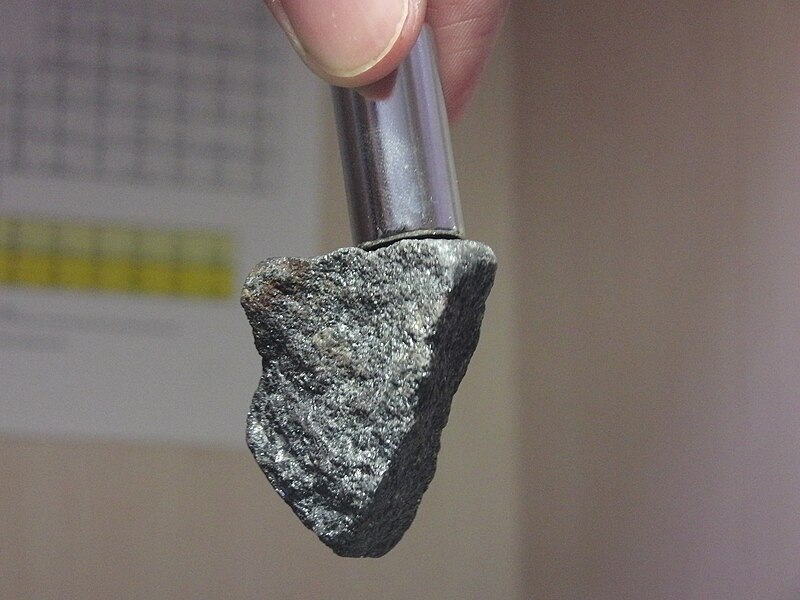
File:Magnetite_sample_with_neodymium_magnet.jpg · Wikimedia Commons · See Wikimedia Commons
magnet
Sign in to saveAlso known as magnets
thumb|upright=1.5|A magnetite rock is being pulled by a [[neodymium magnet on top.]]
A magnet is a material or object that produces an invisible force field capable of attracting certain metals like iron. Magnets are useful in countless everyday applications, from holding notes on refrigerators to powering electric motors and generating electricity.
AI-generated from the Wikipedia summary — may contain errors.
Research
1,223,189 papers- Come aboard the Magnet Journey.Medical reference services quarterly · 2023Brown Epstein HADOI: 10.1080/02763869.2023.2160130
- Nanostructures as the Substrate for Single-Molecule Magnet Deposition.ReviewInternational journal of molecular sciences · 2023Adamek M, Pastukh O, Laskowska M et al.DOI: 10.3390/ijms25010052
- Commissioning of the Iseult CEA 11.7 T whole-body MRI: current status, gradient-magnet interaction tests and first imaging experience.ReviewMagma (New York, N.Y.) · 2023Boulant N, Quettier L, Iseult ConsortiumDOI: 10.1007/s10334-023-01063-5
- Tatoo Ink, Magnetism and Sensation of Burn during Magnetic Resonance Imaging, and Introduction of Hand-Held Magnet Testing of Commercial Tattoo Ink Stock Products prior to Use.ReviewCurrent problems in dermatology · 2022Hjorth Johannesen H, Hvass Hansen R, Alsing K et al.DOI: 10.1159/000521482
- Ultrasound-Controlled Manual Magnet Repositioning in Magnet Dislocation of Cochlear Implants.Otology & neurotology : official publication of the American Otological Society, American Neurotology Society [and] European Academy of Otology and Neurotology · 2021Rupp R, Hornung J, Balk M et al.DOI: 10.1097/MAO.0000000000003019
- Skin flap thickness and magnet strength in Cochlear implants.Cochlear implants international · 2021Searle T, Marshall E, Craddock L et al.DOI: 10.1080/14670100.2020.1824640
- Power supply for fast-scanning magnet in proton therapy: Design and test.The Review of scientific instruments · 2022Yuan J, Pang S, Chen T et al.DOI: 10.1063/5.0053863
- Magnet-Assisted Robotic Prostatectomy Using the da Vinci SP Robot: An Initial Case Series.Journal of endourology · 2019Steinberg RL, Johnson BA, Meskawi M et al.DOI: 10.1089/end.2019.0263
via PubMed
Wikidata facts
- Subclass of
- material
- Image
- Bar magnet crop.jpg
Show 8 more facts
- Commons category
- Magnets
- topic's main category
- Category:Types of magnets
- Commons gallery
- Magnet
- has effect
- magnetic field
- on focus list of Wikimedia project
- Wikipedia:Vital articles/Level/4
- Unicode character
- 🧲
- MCN code
- 8511.20.10
- maintained by WikiProject
- WikiProject Mathematics
via Wikidata · CC0
~42 min read
Encyclopedic overview
35 sectionsContents
- Discovery and development
- Physics
- Magnetic field
- Magnetic moment
- Magnetization
- Modelling magnets
- Polarity
- Magnetic materials
- Shape
- Common uses
- Medical issues and safety
- Magnetizing ferromagnets
- Demagnetizing ferromagnets
- Types of permanent magnets
- Magnetic metallic elements
- Composites
- Rare-earth magnets
- Single-molecule magnets (SMMs) and single-chain magnets (SCMs)
- Nano-structured magnets
- Rare-earth-free permanent magnets
- Costs
- Temperature
- Electromagnets
- Units and calculations
- Fields of a magnet
- Calculating the magnetic force
- Pull force of a single magnet
- Force between two magnetic poles
- Force between two nearby magnetized surfaces of area ''A''
- Force between two bar magnets
- Force between two cylindrical magnets
- See also
- Notes
- References
- External links
thumb|upright=1.5|A magnetite rock is being pulled by a [[neodymium magnet on top.]]
A magnet is a material or object that produces a magnetic field. This magnetic field is invisible but is responsible for the most notable property of a magnet: a force that pulls on other ferromagnetic materials, such as iron, steel, nickel, cobalt, etc. and attracts or repels other magnets.
Excerpted from Wikipedia’s “magnet” article, available under the CC BY-SA 4.0 licence.
Gallery (30)
Available in 133 languages
- Español
- Français
- Deutsch
- 中文
- 日本語
- Русский
- Português
- Italiano
- العربية
- हिन्दी
- Afrikaans
- Albanian
- Albanian
- Amharic
- Aragonese
- Armenian
- Assamese
- Asturian
Show 114 more
- Aymara
- azb
- Azerbaijani
- Bahasa Indonesia
- Bangla
- Bashkir
- Basque
- bat_smg
- Batak Toba
- Bavarian
- be_x_old
- Belarusian
- Bosnian
- Bulgarian
- Buriat
- Burmese
- Catalan
- cdo
- Central Kurdish
- Chuvash
- Colognian
- Croatian
- Czech
- Danish
- Egyptian Arabic
- Esperanto
- Estonian
- Fiji Hindi
- Filipino
- Finnish
- Galician
- Georgian
- Greek
- Haitian Creole
- Hebrew
- Hungarian
- Icelandic
- Ido
- Interlingua
- Interlingue
- Irish
- Javanese
- Kannada
- Kashmiri
- Kazakh
- kge
- Kikuyu
- Kurdish
- Kyrgyz
- Latin
- Latvian
- Limburgish
- Lithuanian
- Lombard
- Low German
- Macedonian
- Malagasy
- Malay
- Malayalam
- Marathi
- Minangkabau
- Mingrelian
- Mongolian
- Moroccan Arabic
- Nederlands
- Nepali
- Newari
- Northern Frisian
- Norwegian
- Norwegian Nynorsk
- Occitan
- Oromo
- Pashto
- Piedmontese
- Polski
- Punjabi
- Quechua
- Romanian
- Rusyn
- Scots
- Serbian
- Serbian (Latin)
- Sicilian
- simple
- Sindhi
- Slovak
- Slovenian
- Sundanese
- Svenska
- Swahili
- Tajik
- Tamil
- Telugu
- Tiếng Việt
- Tulu
- Türkçe
- Tuvinian
- Ukrainian
- Urdu
- Uzbek
- Veps
- Walloon
- Waray
- Welsh
- Western Panjabi
- Wolof
- Wu Chinese
- Yiddish
- Yoruba
- zh_min_nan
- zh_yue
- فارسی
- ไทย
- 한국어
via Wikidata sitelinks · CC0