
Malaysia
Sign in to saveAlso known as Federation of Malaysia, Malaysia Federation, MAS
Malaysia is a country in Southeast Asia. A federal constitutional monarchy, it consists of 13 states and three federal territories, separated by the South China Sea into two regions: Peninsular Malaysia on the Indochinese Peninsula and East Malaysia on the island of Borneo. Peninsular Malaysia shares land and maritime borders with Thailand, as well as maritime borders with Singapore, Vietnam, and Indonesia; East Malaysia shares land borders with Brunei and Indonesia, and maritime borders with the Philippines and Vietnam. Kuala Lumpur is the country's national capital, largest city, and the sea
OverviewAI-generated
Malaysia is a country located in South-Eastern Asia. Its capital is Kuala Lumpur. The nation operates as a constitutional, federal, elective, and parliamentary monarchy. The head of state holds the office of Yang di-Pertuan Agong. The head of government is the Prime Minister of Malaysia. The legislative body is the Parliament of Malaysia. The official language is Malay. The currency is the Malaysian ringgit.
The country has a population of 34,231,700 and covers an area of 330,803. The ethnic groups include Malays, Malaysian Chinese, Orang Asli, and Indian Malaysians. Traditional foods include Nasi lemak. Malaysia participates in the Asian Highway Network. It has diplomatic relations with Canada, Germany, Australia, and Indonesia. The emergency phone number is 999. The electrical plug type is BS 1363. The top-level domain is .my.
Synthesized by Vinony from 68 facts across 9 sources: Wikidata, REST Countries, Open Meteo, Openweathermap, World Bank, OpenStreetMap, PubMed, Vinony graph, Geo. Generated from structured data (not the Wikipedia text) and checked against those facts — may still contain errors.
Weather now
7-day forecast
via Open-Meteo
Country

- Capital
- Kuala Lumpur
- Population
- 34,231,700
- Region
- Asia · South-Eastern Asia
- Demonym
- Malaysian
- Currencies
- MYR (RM)
- Languages
- English, Malay
- Calling code
- +60
- Drives on
- Left
- Gini
- 41.1 (2015)
- FIFA code
- MAS
- TLD
- .my
- Timezones
- UTC+08:00
- Borders
- BRN, IDN, THA
via REST Countries
Indicators · World Bank
- GDP
- $422.2B(2024)
- Population
- 35,557,673(2024)
- Life expectancy
- 76.8 yrs(2024)
- Unemployment
- 3.8 %(2025)
- Urban population
- 76.9 %(2024)
- Internet users
- 98 %(2024)
- Forest area
- 57.7 %(2023)
- Renewable energy
- 7.5 %(2021)
via World Bank Open Data · CC BY 4.0
Place details
- Locality
- Machan
- Region
- Sarawak
- Country
- Malaysia
- Population
- 31,528,585
via OpenStreetMap · GeoNames
Wikipedia views (30d)
232,475 totalvia Wikimedia Pageviews API
Key facts
- Country.conventional_long_name
- Malaysia
- Country.common_name
- Malaysia
- Country.image_flag
- Flag of Malaysia.svg
- Country.alt_flag
- A blue rectangle with a gold star and crescent in the canton, with 14 horizontal red and white stripes on the rest of the flag
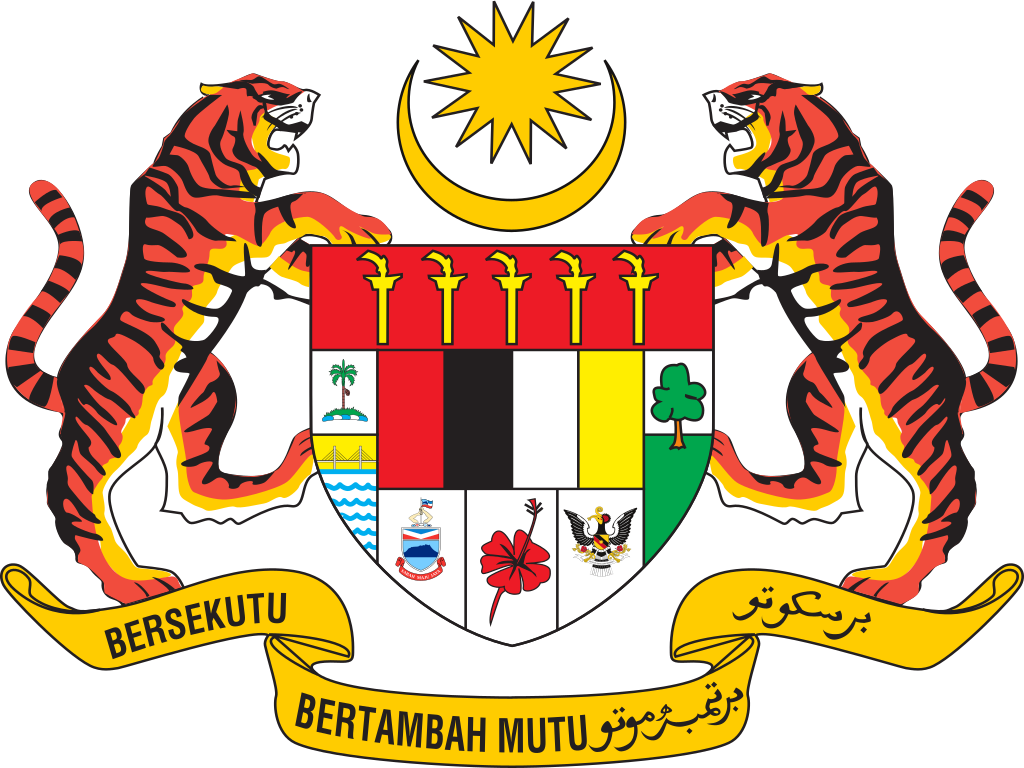
- Country.image_coat
- Coat of arms of Malaysia.svg
- Country.coa_size
- 90
- Country.symbol_type
- Coat of arms
- Country.alt_coat
- Shield showing the symbols of the Malaysian states with a star and crescent above and a motto below, supported by two tigers
- Country.map_width
- 250px
- Country.national_motto
- (Jawi)()
- Country.national_anthem
- ()
- Country.capital
- Kuala Lumpur
- Country.admin_center
- Putrajaya
- Country.largest_city
- capital
- Country.languages_type
- National language (official)
- Country.languages
- Malay
- Country.languages2_type
- Recognised languages
- Country.languages2
- English
via Wikipedia infobox
Research
128,392 papers- Malaysia's Health Systems Response to COVID-19.ReviewInternational journal of environmental research and public health · 2021Ang ZY, Cheah KY, Shakirah MS et al.DOI: 10.3390/ijerph182111109
- Rheumatology in Malaysia.ReviewRheumatology international · 2020Yeap SS, Gun SC, Das Gupta E et al.DOI: 10.1007/s00296-020-04577-6
- Letter from Malaysia.Respirology (Carlton, Vic.) · 2021Sirol Aflah SS, Mohd Thabit AA, Chidambaram SKDOI: 10.1111/resp.14057
- Malaysia's Pain Free programme.Lancet (London, England) · 2019The LancetDOI: 10.1016/S0140-6736(19)31005-0
- COVID-19 Epidemic in Malaysia: Epidemic Progression, Challenges, and Response.ReviewFrontiers in public health · 2021Hashim JH, Adman MA, Hashim Z et al.DOI: 10.3389/fpubh.2021.560592
- Advance Care Planning in Malaysia.Zeitschrift fur Evidenz, Fortbildung und Qualitat im Gesundheitswesen · 2023Lim ZN, Ng WJ, Lee CCDOI: 10.1016/j.zefq.2023.05.019
- Early phase oncology clinical trials in Malaysia: current status and future perspectives.ReviewAsia-Pacific journal of clinical oncology · 2023Voon PJ, Lai WH, Bustaman RS et al.DOI: 10.1111/ajco.13886
- Stroke Burden in Malaysia.Cerebrovascular diseases extra · 2022Tan KS, Venketasubramanian NDOI: 10.1159/000524271
via PubMed
Wikidata facts
- Instance of
- sovereign state
- Official name
- مليسيا
- Demonym
- Malaeisiach
- Participant in
- Asian Highway Network
- Country
- Malaysia
- Contains
- Putrajaya
- Continent
- Asia
- Capital
- Kuala Lumpur
- Official language
- Malay
- Currency
- Malaysian ringgit
- Population
- 32447385
- Area
- 330803
- Body of water
- Celebes Sea
- Head of government
- Anwar Ibrahim
- Head of state
- Ibrahim Iskandar of Johor
- Form of government
- parliamentary monarchy
- Legislature
- Parliament of Malaysia
- Anthem
- Negaraku
- Shares border with
- Philippines
- Highest point
- Mount Kota Kinabalu
- Official website
- www.malaysia.gov.my
- Life expectancy
- 76
- Nominal GDP
- 406305924656
- Unemployment rate
- 2
Show 77 more facts
- Calling code
- +60
- Licence plate code
- MAL
- Electrical plug type
- BS 1363
- Mains voltage
- 240
- Motto
- Mae Undod yn Gryfder
- Flag
- flag of Malaysia
- Coat of arms
- coat of arms of Malaysia
- topic's main Wikimedia portal
- Portal:Malaysia
- Unicode character
- 🇲🇾
- category of associated people
- Category:Malaysian people
- emergency phone number
- 999
- ethnic group
- Kerinci people
- geography of topic
- Geography of Malaysia
- office held by head of government
- Prime Minister of Malaysia
- Gini coefficient
- 46.2
- foods traditionally associated
- Nasi lemak
- diplomatic relation
- Bangladesh
- office held by head of state
- Yang di-Pertuan Agong
- Commons gallery
- Malaysia
- inception
- 1963-09-16
- trunk prefix
- 0
- history of topic
- history of Malaysia
- compulsory education (maximum age)
- 12
- on focus list of Wikimedia project
- WikiProject Malaysia
- mobile country code
- 502
- total fertility rate
- 1.76
- maritime identification digits
- 533
- compulsory education (minimum age)
- 6
- retirement age
- 60
- marriageable age
- 21
- topic's main category
- Category:Malaysia
- age of majority
- 18
- railway traffic side
- left
- GS1 country code
- 955
- category for films shot at this location
- Category:Films shot in Malaysia
- executive body
- Cabinet of Malaysia
- category for people who died here
- Category:Deaths in Malaysia
- Commons category
- Malaysia
- top-level Internet domain
- .my
- category for people born here
- Category:Births in Malaysia
- short name
- MYS
- number of out-of-school children
- 1263297
- driving side
- left
- lowest point
- Indian Ocean
- language used
- Laraʼ
- central bank
- Bank Negara Malaysia
- WordLift URL
- data.thenextweb.com/tnw/entity/malaysia
- native label
- Malaysia
- culture
- culture of Malaysia
- VAT rate
- 6
- BTI Status Index
- 6.57
- BTI Governance Index
- 5.15
- economy of topic
- economy of Malaysia
- social media followers
- 346220
- demographics of topic
- demographics of Malaysia
- official religion
- Islam
- highest judicial authority
- Federal Court of Malaysia
- Democracy Index
- 7.24
- topic has template
- Template:Malaysia
- Human Development Index
- 0.803
- Happy Planet Index score
- 41.7
- male population
- 16999500
- female population
- 15652000
- urban population
- 22379800
- rural population
- 7420200
- P12749
- Avast Antivirus
- located in/on physical feature
- Southeast Asia
- replaces
- Federation of Malaya
- public holiday
- New Year's Day
- birth rate
- 15.016
- death rate
- 5.443
- P8168
- Bulson
- most populous urban area
- Kuala Lumpur
- Commonwealth Sport country code
- MAS
- template has topic
- Template:Malaysia
Sources (15)
via Wikidata · CC0
Travel guide
Understand
Malaysia is a mix of the modern world and a developing nation. With its investment in high technology industries and moderate oil wealth, it has become a rich nation in Southeast Asia. Malaysia, for most visitors, presents a happy mix: there is high-tech infrastructure and things generally work well and more or less on schedule, but prices remain more reasonable than in, say, Singapore. The demographics between the rich and poor can also be quite apparent: for example, a high rise luxury condominium building built right across the street from old, rundown shop lots or flats. However, you will not find extreme rural poverty or gigantic urban slums as in most other countries of Southeast Asia.
In terms of attractions, peninsular (West) Malaysia contains islands with gorgeous beaches and a fraction of visitors found in Thailand's most popular beaches, mountain retreats surrounded by tea plantations, interesting historical cities, world-famous food, and the highly modern, multi-cultural capital of Kuala Lumpur. East Malaysia contains lush jungles with diverse native population and wildlife, as well as stunning natural attractions such as giant caves, beautiful mountains and fantastic diving sites. Notably, however, Malaysia is not as popular among backpackers as other Southeast Asian destinations such as Thailand, Cambodia and Vietnam, partly due to the relatively higher costs, and partly due to the more religious and conservative, albeit generally tolerant, culture. It also lac…
Get around
Immigration controls are in place for travel between Peninsular Malaysia and East Malaysia, as well as between the East Malaysian states of Sabah and Sarawak. Malaysian citizens need to present their ID cards, while foreign citizens are required to present their passports in order to travel.
See
thumb|Wat Chaiyamangkalaram in [[George Town (Malaysia)|George Town, Penang]] thumb|Tea plantations in the [[Cameron Highlands, Pahang]]
Malaysia is a fascinating country with many faces. It's multi-ethnic and multi-cultural, and its attractions vary from the iconic Petronas Towers in bustling Kuala Lumpur to perfect sandy beaches lined with palm trees and dense jungles with orangutangs and tigers.
There are various impressive national parks. Expeditions range from those where you hardly lose sight of the hotel to those where you are fully immersed in the jungle for weeks, with only the guide and yourself. To spot a tiger or wild elephant in its natural habitat you might have to spend more than a few days in the wild, but you'll have no trouble seeing smaller wildlife. Bako National Park is the oldest national park in Malaysia and one of the best places to see proboscis monkeys. The vast jungles of Taman Negara have become a popular destination for nature travellers, just like the remote but gorgeous Gunung Mulu National Park, a World Heritage Site famous for its limestone karst formations, stone pinnacles and huge caves. To escape from the muggy tropics, do as the English did and head up to the cool tea plantations of the Cameron Highlands, the quaint Tudor-style village on Fraser's Hill or climb Mount Kinabalu in Sabah.
For many people, Malaysia brings pictures of pristine beaches with great diving opportunities to mind - and for good reason. Sipadan off the coast of Sab…
Do
thumb|A beach on [[Perhentian Islands, Terengganu.]] thumb|A first glance at Sipadan's colourful underwater life
Malaysia has excellent scuba diving. Some of the more popular spots are the islands off the East Coast of peninsular Malaysia (Perhentian, Redang, Tioman and many more), although the dive season is limited to April to September. However, the most famous dive site — often ranked among the best in the world — is Sipadan, off the easternmost tip of Malaysian Borneo. There are many other less well known sites, like Layang Layang.
Eat
thumb|Nasi lemak coconut rice with sotong pedas (spicy squid), sambal chili paste, boiled egg, slices of cucumber, ikan bilis fried anchovies and peanuts served at a restaurant in Penang
The crossroads of Malay, Chinese and Indian cuisine, Malaysia is an excellent place to eat (makan in Malay). Look out for regional specialities and Nyonya (Peranakan) cuisine, the fusion between Malay and Chinese cooking. There is even unique Eurasian cooking to be found in the Portuguese Settlement in Malacca, the heartland of the Portuguese Eurasian community.
Malaysians are very proud of their cooking and most towns or even villages have their own delicious specialities such as Penang char kway teow, Kajang satay, Ipoh bean sprout chicken, Sarawak laksa, Kelantanese nasi dagang and Sabahan hinava. Most eateries rely on word of mouth for advertising and are frequently located in the most inconvenient, out-of-the-way places, so you might want to try asking the locals for their personal recommendations.
If you intend to travel around Malaysia trying out the local food, don't be fooled by the names. Sometimes two entirely different dishes from different parts of the country can be known by the same name. For example, laksa refers to completely different noodle dishes in Penang and Sarawak.
Generally, you can eat pretty much anywhere in Malaysia. Food outlets are comparatively clean – the only thing you might avoid when you frequent the street or hawker stalls is ice for your drinks, since …
Drink
thumb|A tea house in [[Melaka.]]
Malaysians like both coffee (kopi) and tea (teh), especially the national drink teh tarik ("pulled tea"), made by the Mamak (Indian Muslim) community, and named after the theatrical 'pulling' motion used to pour it. By default, both will be served hot, sweet and with a dose of condensed milk; request teh o to skip the milk, teh ais for iced milky tea, or teh o ais for iced milkless tea. Drinking with no sugar at all is considered odd, but asking for kurang manis (less sugar) will ease the pain. However, if you really want no sugar at all, you can try asking for "teh kosong."
Malaysia produces its own tea, but little of it is exported except to neighbouring Singapore due to high domestic demand, so be sure to try some locally-grown tea when you are here. BOH, with its plantations in Cameron Highlands, is Malaysia's largest tea brand.
Another peculiar local favourite is the kopi tongkat ali ginseng, a mixture of coffee, a local aphrodisiacal root, and ginseng served with condensed milk that's touted as an alternative to viagra and red bull combined and is usually advertised with a picture of a bed broken in half.
Other popular nonalcoholic options include the chocolate drink Milo and lime juice (limau). Freshly made fruit juices are also widely available, as well as a wide range of canned drinks (some familiar to many foreigners, some less so).
There is also a local drink comprised of white soya milk and black grass jelly (cincau) called so…
Sleep
Malaysia has ample affordable accommodations in all of its cities and towns, with full range from budget until luxury ones. Service charges and taxes are not yet part of the advertised price so be sure to add 16% to the listed price. Hotels and hostels are required to charge a tourism tax on international visitors: RM10 per room per night, which may not be included in the advertised rates.
In other information, Durians are strictly banned in almost all hotels due to the smell. Bringing one into your room will result in a hefty cleaning fee.
Stay safe
Though the crime rate is higher than in neighbouring Singapore, Malaysia is generally a safe country for visitors. Crimes towards tourists are usually restricted to bag-snatching, pickpocketing and petty theft. It is important to keep a close eye on valuable items. Theft is more common in crowded places, such as markets and on public transport. Generally, if you avoid deserted areas, get back to your hotel before midnight and use your common sense, you're unlikely to be assaulted.
Homosexuality is a crime and gay bars may be raided by police; gay and lesbian tourists should be discreet and avoid any public displays of affection.
Stay healthy
There are differences of opinion about whether and to what degree tap water is safe to drink. It is treated and monitored, but the condition of the pipes is not always reliable. Therefore, you may want to boil or filter it first just to be on the safe side, as most locals do. You can also buy bottled water, which is very inexpensive.
Ice in drinks might be made from tap water, but nowadays, most restaurants and even roadside stalls use the cylindrical variety with a hollow tube down the middle that are mass-produced at ice factories and are safer to consume.
Heat exhaustion is rare, but do consume lots of fluids, use a hat and sunscreen and shower often!
Peninsular Malaysia is largely malaria-free, but there is a significant risk in Borneo especially in inland and rural areas. Dengue fever occurs throughout Malaysia in both urban and rural areas, and can be avoided only by preventing mosquito bites. The mosquito that transmits dengue feeds throughout the daytime, and is most active at dawn and dusk. If you experience a sudden fever with aches and lethargy, seek medical attention immediately. Aspirin and ibuprofen should not be used until dengue fever has been ruled out. Mosquito repellents (ubat nyamuk) are widely available. Be careful with mosquito coils, which can easily start fires: set them on a plate or other non-flammable surface and extinguish them before going to sleep.
Haze from burning vegetation in neighbouring Indonesia may come and go without warning from the…
Respect
When entering a home or a place of worship, always take off your shoes (this is often required at hostels too). Also, never eat with your left hand or give a gift with your left hand, and never point with your forefinger (you may use a closed fist with the thumb instead). Do not point with your feet or touch a person's head either.
Swastikas are commonly seen in Hindu and Buddhist temples, and are regarded as a religious symbol by these communities. They emphatically do not represent Nazism or anti-Semitism.
Travel guide from Wikivoyage (CC BY-SA 4.0)
~40 min read
Encyclopedic overview
29 sectionsContents
- Etymology
- History
- Government and politics
- Administrative divisions
- Foreign relations and military
- Human rights
- Geography
- Biodiversity and conservation
- Economy
- Infrastructure
- Demographics
- Religion
- Languages
- Health
- Education
- Culture
- Fine arts
- Cuisine
- Media
- Holidays and festivals
- Sports
- See also
- Notes
- References
- External links
- Government
- History
- Tourism
- Maps
Malaysia is a country in Southeast Asia. A federal constitutional monarchy, it consists of 13 states and three federal territories, separated by the South China Sea into two regions: Peninsular Malaysia on Mainland Southeast Asia and East Malaysia on the island of Borneo. Peninsular Malaysia shares land and maritime borders with Thailand, as well as maritime borders with Singapore, Vietnam, and Indonesia; East Malaysia shares land borders with Brunei and Indonesia, and maritime borders with the Philippines and Vietnam. Kuala Lumpur is the country's national capital, largest city, and the seat of the legislative branch of the federal government, while Putrajaya is the federal administrative capital, representing the seat of both the executive branch and the judicial branch of the federal government. With a population of over 34 million, it is the world's 42nd-most populous country.
The country has its origins in the Malay kingdoms, which, from the 18th century on, became subject to the British Empire, along with the British Straits Settlements protectorate. During World War II, British Malaya, along with other nearby British and American colonies, was occupied by the Empire of Japan. Following three years of occupation, Malaya was briefly unified as the Malayan Union in 1946 until 1948 when it was restructured as the Federation of Malaya. The country achieved independence on 31 August 1957. On 16 September 1963, independent Malaya united with the then British crown colonies of North Borneo, Sarawak, and Singapore to become Malaysia. In August 1965, Singapore was separated from the federation and became an independent country.
Excerpted from Wikipedia’s “Malaysia” article, available under the CC BY-SA 4.0 licence.
Gallery (39)
On the map
6 mapped locations
Available in 278 languages
- Español
- Français
- Deutsch
- 中文
- 日本語
- Русский
- Português
- Italiano
- العربية
- हिन्दी
- Abkhazian
- abstract
- Achinese
- Adyghe
- Afrikaans
- Akan
- Albanian
- Albanian
Show 259 more
- Amharic
- ami
- Angika
- Aragonese
- Armenian
- Arpitan
- Assamese
- Asturian
- Awadhi
- Aymara
- azb
- Azerbaijani
- Bahasa Indonesia
- Balinese
- Bambara
- Bangla
- Banjar
- Bashkir
- Basque
- bat_smg
- Batak Toba
- Bavarian
- bdr
- be_x_old
- Belarusian
- Betawi
- Bhojpuri
- Bikol
- Bishnupriya
- Bislama
- blk
- Bosnian
- Breton
- btm
- Buginese
- Bulgarian
- Buriat
- Burmese
- Catalan
- cdo
- Cebuano
- Central Dusun
- Central Kurdish
- Chamorro
- Chechen
- Cherokee
- Chuvash
- Cornish
- Corsican
- Crimean Tatar
- Croatian
- Czech
- dag
- Danish
- Divehi
- dty
- Dzongkha
- Egyptian Arabic
- Esperanto
- Estonian
- Extremaduran
- Faroese
- Fiji Hindi
- Fijian
- Filipino
- Finnish
- fiu_vro
- Fula
- Gagauz
- Galician
- Gan Chinese
- gcr
- Georgian
- Gilaki
- Goan Konkani
- Gorontalo
- Gothic
- Greek
- Guarani
- Gujarati
- Haitian Creole
- Hakka Chinese
- Hausa
- Hawaiian
- Hebrew
- Hungarian
- hyw
- Iban
- Icelandic
- Ido
- Igbo
- Iloko
- Inari Sami
- Interlingua
- Interlingue
- Inupiaq
- Irish
- Jamaican Creole English
- Javanese
- Kabardian
- Kabyle
- Kannada
- Kanuri
- Kara-Kalpak
- Karachay-Balkar
- Kashmiri
- Kashubian
- Kazakh
- kbp
- kge
- Khmer
- Kikuyu
- Kinyarwanda
- Komi
- Kongo
- Kurdish
- Kyrgyz
- Ladino
- Lao
- Latin
- Latvian
- Lezghian
- Ligurian
- Limburgish
- Lingala
- Lingua Franca Nova
- Lithuanian
- lld
- Lojban
- Lombard
- Low German
- Lower Sorbian
- Luxembourgish
- Macedonian
- Madurese
- Maithili
- Malagasy
- Malay
- Malayalam
- Maltese
- Manipuri
- Manx
- Māori
- map_bms
- Marathi
- Mari
- Mazanderani
- Minangkabau
- Mingrelian
- Mirandese
- Moksha
- Mongolian
- Moroccan Arabic
- Navajo
- Nederlands
- Nepali
- Newari
- Nias
- Nigerian Pidgin
- Northern Frisian
- Northern Sami
- Norwegian
- Norwegian Nynorsk
- Novial
- Nyanja
- Occitan
- Odia
- Old English
- olo
- Oromo
- Ossetic
- Pampanga
- Pangasinan
- Papiamento
- Pashto
- Picard
- Piedmontese
- Polski
- Punjabi
- pwn
- Quechua
- rki
- Romanian
- Rusyn
- Samoan
- Sango
- Sanskrit
- Santali
- Sardinian
- Scots
- Scottish Gaelic
- Serbian
- Serbian (Latin)
- Shan
- Shona
- Sicilian
- Silesian
- simple
- Sindhi
- Sinhala
- skr
- Slovak
- Slovenian
- Somali
- Sranan Tongo
- Standard Moroccan Tamazight
- Sundanese
- Svenska
- Swahili
- Swati
- szy
- Tajik
- Talysh
- Tamil
- Taroko
- Tatar
- tay
- tdd
- Telugu
- Tetum
- Tibetan
- Tiếng Việt
- Tok Pisin
- Toki Pona
- Tongan
- Tsonga
- Tulu
- Tumbuka
- Türkçe
- Turkmen
- Udmurt
- Ukrainian
- Upper Sorbian
- Urdu
- Uyghur
- Uzbek
- Venetian
- Veps
- Volapük
- Waray
- Welsh
- West Flemish
- Western Frisian
- Western Panjabi
- Wolof
- Wu Chinese
- Yakut
- Yiddish
- Yoruba
- Zaza
- Zeelandic
- zh_classical
- zh_min_nan
- zh_yue
- Zhuang
- Zulu
- فارسی
- ไทย
- 한국어
via Wikidata sitelinks · CC0