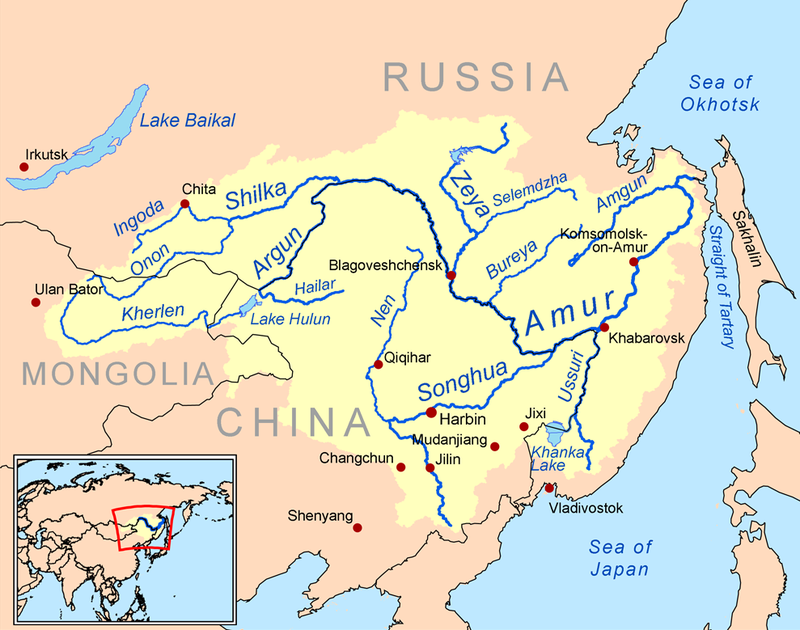
File:Amurrivermap.png · Wikimedia Commons · See Wikimedia Commons
Manchuria
Sign in to saveAlso known as Mandchuria, Manzhou, Man-chou, Manchouria, Mandchouria, Manchooria, Dongbei, Northeast
Manchuria is a historical region in Northeast Asia encompassing the entirety of present-day Northeast China and parts of the modern-day Russian Far East south of the Uda River and the Tukuringra-Dzhagdy ranges. The exact geographical extent varies depending on the definition: in the narrow sense, the area constituted by three Chinese provinces of Heilongjiang, Jilin, and Liaoning as well as the eastern Inner Mongolian prefectures of Hulunbuir, Hinggan, Tongliao, and Chifeng; in a broader sense, historical Manchuria includes those regions plus the Amur river basin, parts of which were ceded to
Manchuria is a historical region in Northeast Asia that today spans northeastern China and parts of the Russian Far East, with its exact boundaries varying depending on historical and geographical definitions. It matters because it represents an important area in Asian history where different territories and political boundaries have been contested and reshaped over time.
AI-generated from the Wikipedia summary — may contain errors.
Key facts
- Chinese.pic
- File: Manchuria.png
- Chinese.piccap
- Map of Manchuria with the central part coloured in red (northeast China); eastern Inner Mongolia to the west, in slightly lighter red; and Outer Manchuria to the north-east, in pink.
- Chinese.p
- Mǎnzhōu
- Chinese.w
- Man-chou
- Chinese.gr
- Maanjou
- Chinese.tp
- Mǎnjhou
- Chinese.bpmf
- ㄇㄢˇ ㄓㄡ
- Chinese.j
- Mun5-zau1
- Chinese.wuu
- Moe上-tseu平
- Chinese.mnc
- ᠮᠠᠨᠵᡠᡤᡠᡵᡠᠨ
- Chinese.mnc_rom
- Manju Gurun
- Chinese.mong
- ᠮᠠᠨᠵᠤᠤᠷ
- Chinese.mon
- Манжуур
- Chinese.monr
- Manjuur
- Chinese.rus
- Маньчжурия
- Chinese.rusr
- Man'chzhuriya
- Chinese.kana
- まんしゅう
- Chinese.romaji
- Manshū
via Wikipedia infobox
Wikidata facts
- Instance of
- historical region
- Has part
- Russian Manchuria
- Named after
- Manchu
- Demonym
- Manchurian
- Country
- Russia
- Continent
- Asia
- Image
- Grasslands-menggu.jpg
Show 5 more facts
- native label
- Маньчжурия
- category of associated people
- Category:Manchu people
- Commons category
- Manchuria
- topic's main category
- Category:Manchuria
- history of topic
- history of Manchuria
Sources (7)
via Wikidata · CC0
~35 min read
Encyclopedic overview
22 sectionsContents
- Boundaries
- Names
- Manchuria
- Origins
- China
- Japan
- Nurgan
- Three Provinces
- Guandong
- Northeast Region
- Geography and climate
- History
- Early history
- Population change
- Russian invasions
- History after 1860
- People's Republic of China
- See also
- References
- Citations
- Bibliography
- External links
Manchuria is a historical region in Northeast Asia encompassing the entirety of present-day Northeast China and parts of the modern-day Russian Far East south of the Uda River and the Tukuringra-Dzhagdy ranges. The exact geographical extent varies depending on the definition: in the narrow sense, the area constituted by three Chinese provinces of Heilongjiang, Jilin, and Liaoning as well as the eastern Inner Mongolian prefectures of Hulunbuir, Hinggan, Tongliao, and Chifeng; in a broader sense, historical Manchuria includes those regions plus the Amur river basin, parts of which were ceded to the Russian Empire by the Manchu-led Qing dynasty during the Amur Annexation of 1858–1860. The parts of Manchuria ceded to Russia are collectively known as Outer Manchuria or Russian Manchuria, which include present-day Amur Oblast, Primorsky Krai, the Jewish Autonomous Oblast, the southern part of Khabarovsk Krai, and the eastern edge of Zabaykalsky Krai.
The name Manchuria is an exonym (derived from the endonym "Manchu") of Japanese origin. The history of "Manchuria" (Manzhou) as a toponym in China is disputed, with some scholars believing it was never used while others believe it was by the late 19th century. The area was historically referred to by various names in the Qing dynasty such as Guandong (East of the Pass) or the Three Provinces referring to Fengtian (Liaoning), Heilongjiang, and Jilin. Manchuria as a geographical term was first used in the 18th or 19th centuries by the Japanese before spreading to Europe. The term was promoted by the Empire of Japan in support for the existence of its puppet state, Manchukuo. Although the toponym is still used, some scholars treat the term with caution or avoid it altogether due to its association with Japanese colonialism. The term is deprecated in China due to its association with Japanese imperialism and ethnic connotations. As a result, areas once considered part of Manchuria are simply referred to as the Northeast. The Three Provinces and the Northeast were also in concurrent use among the Japanese along with Manchuria until the Mukden incident of 1931.
Excerpted from Wikipedia’s “Manchuria” article, available under the CC BY-SA 4.0 licence.
Gallery (48)
On the map
3 mapped locations
Available in 104 languages
- Español
- Français
- Deutsch
- 中文
- 日本語
- Русский
- Português
- Italiano
- العربية
- हिन्दी
- Afrikaans
- Albanian
- Albanian
- Aragonese
- Armenian
- Asturian
- Azerbaijani
- Bahasa Indonesia
Show 85 more
- Bangla
- Bashkir
- Basque
- be_x_old
- Belarusian
- Bosnian
- Breton
- Bulgarian
- Burmese
- Catalan
- cdo
- Cebuano
- Central Kurdish
- Chuvash
- Croatian
- Czech
- Danish
- Egyptian Arabic
- Esperanto
- Estonian
- Filipino
- Finnish
- Galician
- Georgian
- Greek
- Hakka Chinese
- Hawaiian
- Hebrew
- Hungarian
- Icelandic
- Ido
- Irish
- Javanese
- Kazakh
- Kurdish
- Kyrgyz
- Lao
- Latin
- Latvian
- Lingua Franca Nova
- Lithuanian
- Lower Sorbian
- Macedonian
- Malay
- Malayalam
- Marathi
- Mingrelian
- Mongolian
- Nederlands
- Northern Frisian
- Norwegian
- Norwegian Nynorsk
- Novial
- Occitan
- Old English
- Ossetic
- Polski
- Romanian
- Scots
- Serbian
- Serbian (Latin)
- simple
- Slovak
- Slovenian
- Svenska
- Swahili
- Talysh
- Tamil
- Tatar
- Tiếng Việt
- Türkçe
- Ukrainian
- Urdu
- Uzbek
- Venetian
- Waray
- West Flemish
- Western Frisian
- Western Panjabi
- Wu Chinese
- zh_min_nan
- zh_yue
- فارسی
- ไทย
- 한국어
via Wikidata sitelinks · CC0