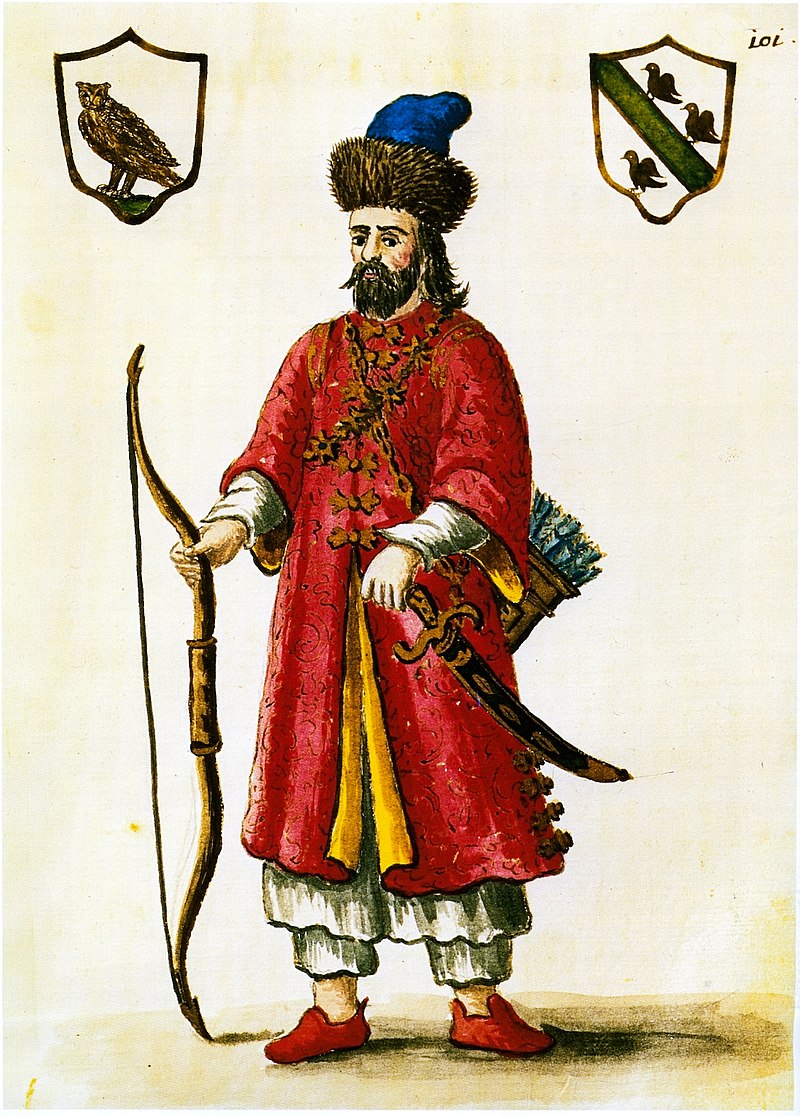
File:Marco_Polo_-_costume_tartare.jpg · Wikimedia Commons · See Wikimedia Commons
Marco Polo
Sign in to saveAlso known as Magebeiluo, Marco Emilio Polo, M. Polo, Polo, Ser Polo
Venetian explorer and merchant who travelled through Asia (1254–1324)
OverviewAI-generated
Marco Polo was a male merchant, diplomat, ambassador, and writer from the Republic of Venice. Born in Venice on September 15, 1254, he was the son of Niccolò Polo. He worked in the fields of travel, commerce, and diplomacy, with significant work locations including the Yuan dynasty and China. His notable work is The Travels of Marco Polo. He spoke and wrote in Venetian and Italian.
Polo was a Catholic who died in Venice on January 8, 1324. He is buried at San Lorenzo, Venice. His life and work are described by sources including the Brockhaus and Efron Encyclopedic Dictionary, The Nuttall Encyclopædia, New History of Yuan, and the Encyclopædia Britannica 11th edition.
Synthesized by Vinony from 22 facts across 3 sources: Wikidata, Open Library, Europeana Sparql. Generated from structured data (not the Wikipedia text) and checked against those facts — may still contain errors.
Person · Open Library
- Works
- 124
Top works
- Greece Marco Polo Guide
- Jordan
- Portugal - Marco Polo Spiral Guide
- New Zealand
- Boston - Marco Polo Spiral Guide
via Open Library + Wikidata
Wikidata facts
- Instance of
- human
- Given name
- Marco
- Gender
- male
- Citizenship
- Republic of Venice
- Place of birth
- Venice
- Place of death
- Venice
- Father
- Niccolò Polo
- Occupation
- memoirist
- Languages spoken
- Italian
- Religion
- Catholicism
- Image
- Marco Polo portrait.jpg
- Work location
- China
- Significant event
- The Travels of Marco Polo
Show 13 more facts
- Commons category
- Marco Polo
- place of burial
- San Lorenzo, Venice
- date of birth
- 1254-00-00
- date of death
- 1324-01-08
- topic's main category
- Category:Marco Polo
- Commons Creator page
- Marco Polo
- name in native language
- Marco Polo
- on focus list of Wikimedia project
- Wikipedia:Vital articles/Level/4
- different from
- Marco Polo
- P13311
- Death Note
- P8168
- Zsadány
- P12749
- Coincya
Sources (9)
via Wikidata · CC0
Works in European collections
36 objects attributed to Marco Polo, held across European museums, libraries & archives · via Europeana
De conditionibus et consuetudinibus orientalium regionum
Untitled

Untitled

Untitled
Untitled
Untitled
Untitled

Untitled
Untitled

Untitled

Untitled

Untitled

Untitled

Untitled

Untitled

Untitled

Untitled

Untitled

Untitled

Untitled

Untitled

Untitled

Untitled

Untitled

Untitled

Untitled

Untitled

Untitled

Untitled

Untitled

Untitled

Untitled

Untitled

Untitled

Untitled

Untitled
~40 min read
Encyclopedic overview
Marco Polo (c. 1254 – 8 January 1324) was a Venetian merchant, explorer, and writer who travelled through Asia along the Silk Road between 1271 and 1295. His travels are recorded in The Travels of Marco Polo (also known as Book of the Marvels of the World and Il Milione, c. 1300), a book that described the then-mysterious culture and inner workings of the Eastern world, including the wealth and great size of the Mongol Empire and China under the Yuan dynasty, giving Europeans their first comprehensive look into China, Persia, India, Japan, and other Asian societies.
Born in Venice, Marco learned the mercantile trade from his father and his uncle, Niccolò and Maffeo, who travelled through Asia and met Kublai Khan. In 1269, they returned to Venice to meet Marco for the first time. The three of them embarked on an epic journey to Asia, exploring many places along the Silk Road until they reached "Cathay". They were received by the royal court of Kublai Khan, who was impressed by Marco's intelligence and humility. Marco was appointed to serve as Kublai's foreign emissary, and he was sent on many diplomatic missions throughout the empire and Southeast Asia, visiting present-day Myanmar, India, Indonesia, Sri Lanka, and Vietnam. As part of this appointment, Marco also travelled extensively inside China, living in the emperor's lands for 17 years and seeing many things previously unknown to Europeans.
Excerpted from Wikipedia’s “Marco Polo” article, available under the CC BY-SA 4.0 licence.
Gallery (12)
Available in 183 languages
- Español
- Français
- Deutsch
- 中文
- 日本語
- Русский
- Português
- Italiano
- العربية
- हिन्दी
- Afrikaans
- Albanian
- Albanian
- Amharic
- Angika
- Aragonese
- Armenian
- Assamese
Show 164 more
- Asturian
- Awadhi
- azb
- Azerbaijani
- Bahasa Indonesia
- Bangla
- Bashkir
- Basque
- bat_smg
- be_x_old
- Belarusian
- Bhojpuri
- Bikol
- Bosnian
- Breton
- btm
- Bulgarian
- Buriat
- Burmese
- Catalan
- cdo
- Central Kurdish
- Chechen
- Chuvash
- Cornish
- Crimean Tatar
- Croatian
- Czech
- Danish
- dty
- Dzongkha
- Egyptian Arabic
- Esperanto
- Estonian
- Fiji Hindi
- Filipino
- Finnish
- fiu_vro
- Friulian
- Galician
- Gan Chinese
- gcr
- Georgian
- Greek
- Guarani
- Gujarati
- Hausa
- Hebrew
- Hungarian
- hyw
- Icelandic
- Ido
- Iloko
- Interlingua
- Irish
- Jamaican Creole English
- Javanese
- Jju
- Kabyle
- Kalmyk
- Kannada
- Kanuri
- Kara-Kalpak
- Kazakh
- kbp
- Kinyarwanda
- Kotava
- Kurdish
- Kyrgyz
- Ladino
- Latin
- Latvian
- Lezghian
- Ligurian
- Limburgish
- Lingua Franca Nova
- Lithuanian
- lld
- Lombard
- Low German
- Luxembourgish
- Macedonian
- Madurese
- Maithili
- Malagasy
- Malay
- Malayalam
- Maltese
- map_bms
- Marathi
- Mazanderani
- Minangkabau
- Mingrelian
- Mirandese
- Mongolian
- Moroccan Arabic
- Nederlands
- Nepali
- Newari
- Northern Frisian
- Norwegian
- Norwegian Nynorsk
- Nyanja
- Obolo
- Occitan
- Odia
- olo
- Ossetic
- Pampanga
- Pangasinan
- Pashto
- Piedmontese
- Polski
- Punjabi
- Quechua
- rki
- Romanian
- Rusyn
- Santali
- Scots
- Scottish Gaelic
- Serbian
- Serbian (Latin)
- Sicilian
- Silesian
- simple
- Sindhi
- Slovak
- Slovenian
- Sundanese
- Svenska
- Swahili
- Tachelhit
- Tajik
- Tamil
- Tatar
- Telugu
- Tibetan
- Tiếng Việt
- Toki Pona
- Türkçe
- Tuvinian
- Ukrainian
- Urdu
- Uzbek
- Venetian
- Veps
- Volapük
- Waray
- Welsh
- Western Frisian
- Western Panjabi
- Wu Chinese
- Yakut
- Yiddish
- Yoruba
- Zaza
- Zeelandic
- zh_classical
- zh_min_nan
- zh_yue
- فارسی
- ไทย
- 한국어
via Wikidata sitelinks · CC0