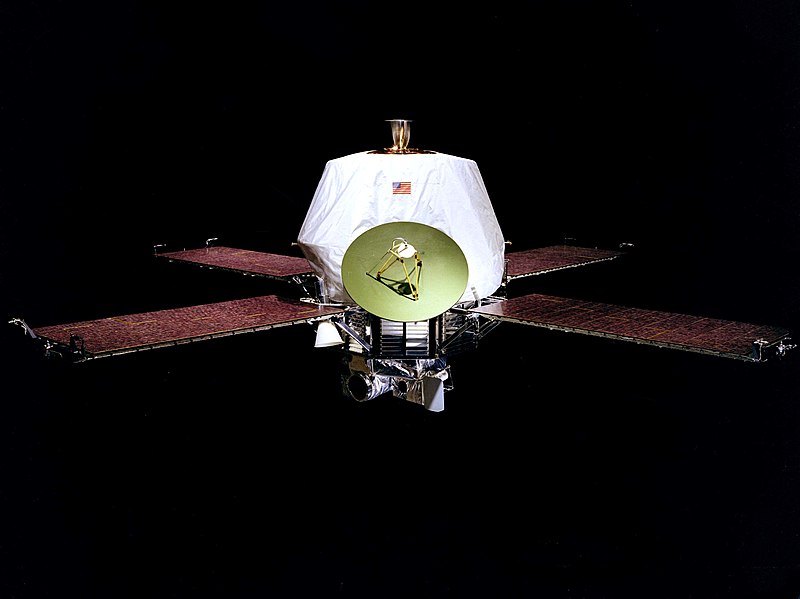
File:Mariner09.jpg · Wikimedia Commons · See Wikimedia Commons
Mariner 9 was a spacecraft that orbited Mars, making it the first spacecraft to successfully orbit another planet. It gathered detailed images and data about Mars's surface and atmosphere that greatly advanced our understanding of the Red Planet.
AI-generated from the Wikipedia summary — may contain errors.
Wikidata facts
- Instance of
- robotic spacecraft
- Part of
- Mariner program
- Named after
- Mariner program
- Operator
- Jet Propulsion Laboratory
- Followed by
- Mariner 10
- Follows
- Mariner 8
- Parent body
- Mars
- Mass
- 558.8
- Orbital period
- 719.47
- Manufacturer
- Jet Propulsion Laboratory
- Image
- Mariner09.jpg
Show 10 more facts
- orbital inclination
- 64.4
- service retirement
- 1972-10-27
- nominal power output
- 500
- UTC date of spacecraft launch
- 1971-05-30
- Commons category
- Mariner 9
- start point
- Cape Canaveral Launch Complex 36
- power consumed
- 500
- orbital eccentricity
- 0.6014
- apoapsis
- 16860
- periapsis
- 1650
via Wikidata · CC0
~15 min read
Encyclopedic overview
Mariner 9 (Mariner Mars '71 / Mariner-I) was a robotic spacecraft that contributed greatly to the exploration of Mars and was part of the NASA Mariner program. Mariner 9 was launched toward Mars on May 30, 1971, from LC-36B at Cape Canaveral Air Force Station, Florida, and reached the planet on November 14 of the same year, becoming the first spacecraft to orbit another planet – only narrowly beating the Soviet probes Mars 2 (launched May 19) and Mars 3 (launched May 28), both of which arrived at Mars only weeks later.
After the occurrence of dust storms on the planet for several months following its arrival, the orbiter managed to send back clear pictures of the surface. Mariner 9 successfully returned 7,329 images, covering 85% of Mars's surface, over the course of its mission, which concluded in October 1972.
Excerpted from Wikipedia’s “Mariner 9” article, available under the CC BY-SA 4.0 licence.