Mark Hatfield
Sign in to saveAlso known as Mark O. Hatfield, Mark Odom Hatfield
American politician, governor of Oregon and U. S. Senator (1922-2011)
Described at
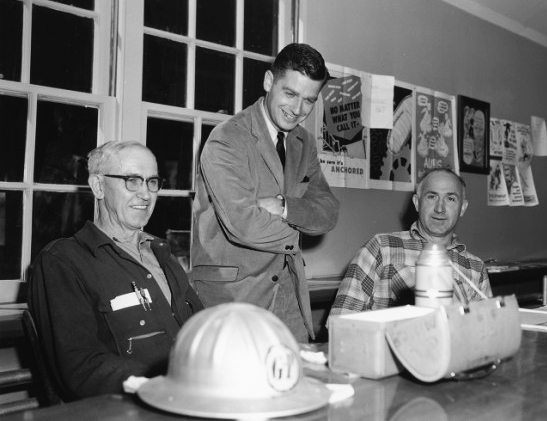
Mark O. Hatfield (1922-2011)
As an Oregon legislator, secretary of state, governor, and United States senator, Mark O. Hatfield played a major role in Oregon and national politics and gove…
oregonencyclopedia.org →As an Oregon legislator, secretary of state, governor, and United States senator, Mark O. Hatfield played a major role in Oregon and national politics and government during the second half of the twentieth century. He was widely recognized for his principled and often controversial stands on many issues, as well as for his ability to work with his colleagues of both parties. With his introduction of a successful measure outlawing racial discrimination in public accommodations in Oregon and his criticism of the anti-communist crusade of Joseph McCarthy , Hatfield established his reputation as a moderate and a maverick Republican. He attracted national attention in 1951 as an early and vocal supporter of the nomination of Dwight Eisenhower for president. He then headed Eisenhower's Oregon campaign organization and was chosen as a delegate to the 1952 Republican National Convention, where he was Oregon's representative on the platform committee. His surprise selection for that post, over the likely candidate, then-Republican Senator Wayne Morse , was an indication of the standing he had achieved very early in his political career. In 1956, Hatfield was elected secretary of state. Two years later, he ran for governor, with a strong grassroots organization. In the course of the campaign, he distanced himself from Republican Party positions on such issues as capital punishment and labor unions, and the national party refused to support him in the primary election. Nevertheless, his strategy turned out to be a significant factor in his victory over incumbent Democratic Governor Robert Holmes. It was a notable success in an election year that was a disaster for the Republican Party across the country. Throughout his career, Hatfield pursued a balance between liberal and conservative political philosophies, while maintaining his evangelical religious beliefs. As governor, he supported aspects of the environmental movement while remaining attentive to the needs of agriculture and the timber industry. Both fit into his concept of protecting and developing Oregon's "livability." He opposed cuts in services to the poor and the elderly but spoke out for individual responsibility and against undue interference by the national government in state and local matters. In 1962, Hatfield won a second term as governor, again running a decidedly independent campaign. He avoided appearances with other Republican candidates and kept the Republican label off his campaign signs. Rumors began to circulate that he would be the party's candidate for the vice presidency in 1964. Despite the party's ongoing uneasiness about his political stands, Hatfield's appeal was such that he was invited to deliver the keynote speech at the 1964 national convention. The convention gave the presidential nomination to the conservative Barry Goldwater, so it is not surprising that Hatfield's moderate speech occasioned bitter criticism from officeholders and rank-and-file Republicans, although others expressed strong support for his stands. During the annual conference of governors in 1965, Hatfield, along with George Romney of Michigan, voted against a motion in support of the war in Vietnam. Romney later changed his mind, but Hatfield's opposition to the war became the centerpiece of his public life. When another motion of support was presented at the 1966 governors' conference, Hatfield cast the lone negative vote. He was convinced that North Vietnam's motive was Vietnamese nationalism rather than communism and believed that nationalism was a force that could not be denied. In 1966, to the surprise of very few observers, Hatfield announced his candidacy for a seat in the U.S. Senate. Although his opposition to the war became an issue in the campaign, he won a close race against his pro-war Democratic rival, Congressman Robert Duncan. Oregonians chose Tom McCall to be Hatfield's successor in the governor's office. Despite their agreement on many issues, the two were
Excerpt from a page describing this subject · 12,809 chars · not written by Vinony
Wikidata facts
- Instance of
- human
- Given name
- Mark
- Gender
- male
- Citizenship
- United States
- Place of birth
- Dallas
- Place of death
- Portland
- Occupation
- political scientist
- Position held
- associate professor
- Educated at
- George Fox University
- Employer
- Willamette University
- Political party
- Republican Party (United States)
- Languages spoken
- English language
- Conflict
- World War II
- Military branch
- United States Navy
- Image
- Mark hatfield.jpg
- Work location
- Washington, D.C.
Show 8 more facts
- Commons category
- Mark Hatfield
- date of birth
- 1922-07-12
- date of death
- 2011-08-07
- described at URL
- www.oregonencyclopedia.org/articles/hatfield_mark_o_1922_
- name in native language
- Mark Hatfield
- P10632
- Mark Hatfield
- National Governors Association biography URL
- www.nga.org/governor/mark-odom-hatfield
- date of burial or cremation
- 2011-08-10
via Wikidata · CC0