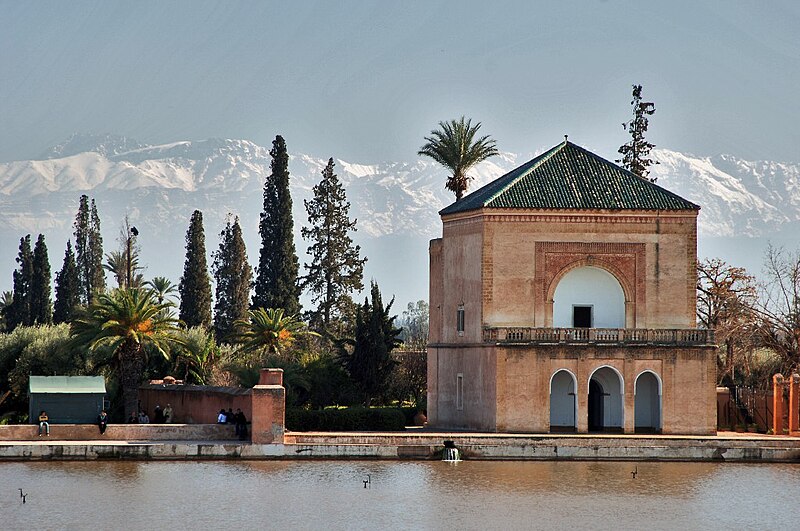
File:Pavillon_Menaragärten.jpg · Wikimedia Commons · See Wikimedia Commons
Marrakesh
Sign in to saveAlso known as Marrakech
Marrakesh or Marrakech (; , ) is the fourth-largest city in Morocco. It is one of the four imperial cities of Morocco and is the capital of the Marrakesh-Safi region. The city lies west of the foothills of the Atlas Mountains.
Marrakesh is the fourth-largest city in Morocco, located west of the Atlas Mountains, and serves as the capital of the Marrakesh-Safi region. It holds the status of one of Morocco's four imperial cities, making it historically and culturally significant to the country.
AI-generated from the Wikipedia summary — may contain errors.
Weather now
cached 16h ago7-day forecast
via Open-Meteo
Place details
- Locality
- Marrakech ⵎⵕⵕⴰⴽⵯⵛ مراكش
- Region
- Marrakech-Safi ⵎⵕⵕⴰⴽⵛ-ⴰⵙⴼⵉ مراكش-أسفي
- Country
- Maroc ⵍⵎⵖⵔⵉⴱ المغرب
- Population
- 995,871
- Timezone
- Africa/Casablanca
via OpenStreetMap · GeoNames
Key facts
- Settlement.name
- Marrakesh
- Settlement.settlement_type
- Prefecture-level city
- Settlement.map_caption
- Map of Marrakesh
- Settlement.pushpin_map
- Morocco#Africa
- Settlement.pushpin_label_position
- left
- Settlement.pushpin_relief
- yes
- Settlement.pushpin_map_caption
- Location of Marrakesh within Morocco
- Settlement.subdivision_type
- Country
- Settlement.subdivision_name
- Morocco
- Settlement.subdivision_type1
- Region
- Settlement.subdivision_name1
- Marrakesh-Safi
- Settlement.subdivision_type2
- Prefecture
- Settlement.subdivision_name2
- Marrakesh
- Settlement.leader_title
- Mayor
- Settlement.leader_name
- Fatima Ezzahra El Mansouri
- Settlement.established_title
- Established
- Settlement.established_date
- 1070
- Settlement.founder
- Abu Bakr ibn Umar
via Wikipedia infobox
Wikidata facts
- Instance of
- big city
- Part of
- Imperial cities of Morocco
- Official name
- مراكش
- Demonym
- Tamrrakcit
- Country
- Almohad Caliphate
- Located in
- Marrakesh Prefecture
- Population
- 1002697
- Area
- 230
- Elevation
- 465
- Time zone
- UTC±00:00
- Head of government
- Fatima Ezzahra El Mansouri
- Capital of
- Marrakesh-Safi
- Founded by
- Abu Bakr ibn Umar
- Official website
- www.ville-marrakech.ma
- Image
- MoroccoMarrakech townfromhill.jpg
- Households
- 268925
Show 18 more facts
- Commons category
- Marrakech
- postal code
- 40000
- topic's main category
- Category:Marrakesh
- twinned administrative body
- Granby
- category for people born here
- Category:Births in Marrakech
- category for people who died here
- Category:Deaths in Marrakech
- category for films shot at this location
- Category:Films shot in Marrakesh
- category of associated people
- Category:People from Marrakesh
- Commons gallery
- Marrakech
- inception
- 1065-00-00
- native label
- Mrrakc
- owner of
- Stade El Harti
- P8168
- Willi Marquardt
- topic has template
- Template:Marrakesh
- present in work
- Civilization V
- P12749
- Augsburg
- maintained by WikiProject
- WikiProject Africa
Sources (10)
via Wikidata · CC0
Travel guide
Understand
thumb|300px|Djemaa El-Fna in the evening
The name Marrakech originates from the Amazigh (Berber) words mur (n) wakush, which means "Land of God". It is the third largest city in Morocco after Casablanca and Rabat, and lies near the foothills of the snow-capped Atlas Mountains and a few hours away from the foot of the Sahara Desert. Its location and contrasting landscape have made it an enviable destination in Morocco.
As the country's main tourist destination, Marrakech is where many Moroccans try to become rich fast by ripping off tourists. This mentality is so widespread that even Moroccans are now ripped off whenever possible so that they call the city "Marrakech, Arnakech" – which rhymes in French and translates to "Marrakech, Scam" (see Touts and scams below).
For further information, you may also visit the
Get around
Once in the medina, everything can be seen on foot, though you'll be doing a lot of walking. Many tourist destinations are signposted by brown, red or green signs affixed to posts or to buildings. Bear in mind that many of these signs don't take the direct route, and some seem to deliberately send tourists via various markets or other places money may be spent.
thumb|The signs used on buildings For exploring more of the city, buses and petits taxis are plentiful.
See
thumb|Wonderful detailed walls in the Dar Si Said Museum thumb|Metal craft area of a market
There is much to see and do in Marrakech. An entire day can be dedicated to wandering around all the different souks, seeking out the best bargains. The city also offers several historical and architectural sites as well as some interesting museums.
thumb|Saadian Tombs thumb|El Badi Palacethumb|Menarathumb|Jewish cemetery
Do
thumb|300px|Shop lamps at Djemaa El-Fna
Football:
Buy
thumb|300px|Spices at a Marrakech market.
Along with the major souk (Arabic for 'market') adjacent to the Djemaa El-Fna, there are a plethora of smaller souks throughout the city, where any number of products can be had. In any of them, you generally need to bargain. Keep an eye out for a wide array of hand-crafted candle-holding lanterns, as well as spectacular displays of local spices.
Most shops sell the same handful of items. But if you wander a little off from El-Fna, you can find small workshops with real craftsmen making handmade goods. You then get to talk to craftsmen of the item you bought. If you buy shoes or clothes, they can also make alterations for you, and there are a few places that make unique products.
Argan oil, produced only in Morocco, is used in Moroccan cooking and beauty treatments. If you enjoy its unique nutty flavour, be sure to pick some up in the souks. It will cost you about 70 dirham per 100 ml at local supermarket for cooking oil or 200 dirham for genuine cosmetic oil.
thumb|Argan oil production at Herboriste De Marrakech
Marrakech is home to a large tanning industry, and leather goods of high quality can be bought here cheaply. Check out camel leather items especially - jackets, round poufs (little ottomans), and handbags.
For the shoes, always check they have no paper inside sole because it is very common. Do not be fooled by demonstration of bending the shoe back and forth; try it yourself by feeling and hearing how the paper bends. F…
Drink
Street vendors offer fresh orange juice (jus d'Orange) by the glass for 4 dirham. Try it with a dash of salt like the locals, but be wary of vendors who try to water the juice down with tap water. Also, pay attention when you buy as they offer 2 types of orange... the blood orange juice costs 10 dirham per glass and a misunderstanding on what you want to drink could occur.
Confirm the price of your orange juice and pay for it before you drink. Unscrupulous vendors will sometimes try to charge you 10 dirham for a 4-dirham glass of jus d'Orange, so don't accept your drink until you've paid the correct amount.
Be wary also, that they do not always clean the glasses very well so it is possible to get an upset stomach from the juice.
There is a very limited selection of places selling alcohol in the Medina.
Outside the Medina.
Sleep
Marrakech has an amazing choice of places to stay ranging from tented camps outside Marrakech to cheap hostels and hotels that can be charming or seedy to luxurious kasbahs in luxurious gardens or the traditional riad (garden courtyard) hotels. Wherever you choose (or can afford) to stay it really is a must to visit one of the riad hotels to see this amazing style of architecture. Most riad managers will be happy to show you around provided that they are not too busy and in some riads you can even book a lunch or dinner without being a resident provided that the riad is not privately rented. For example, see Riad Cinnamon, Riad Laksiba and Riad Papillon.
There are three main zones to sleep: Medina, Guéliz (also known as Ville Nouvelle), and the surroundings of the city. The Medina has the highest concentration of very cheap hotels and riads (small palaces), while Guéliz is much more quiet and most of the hotels are mid price (including showers in the room, breakfast service), but going to the Medina from the Guéliz by taxi costs about 10-15 dirham and can take a long time at busy periods (evenings and weekends).
The surroundings have all the huge tourist hotels, the ones that usually come with what the travel agencies offer. They can be further away from the medina and the rest of the city, but have big swimming pools, restaurants, and many services.
The Medina is packed with Riads and Dars (old grand houses converted into hotels and inns). Traditionally, riads should have…
Stay safe
Marrakech is a generally safe city, with police presence. However, staying alert about your surroundings and taking general safety precautions is always a good idea like everywhere. Here are some tips:
Violent crime is normally not a major problem, but thefts are known to happen. Keep your money close and hidden, and avoid poorly lit streets or alleys at night. Guides offering their services should display an official badge from the local tourist authorities. In the Medina, if someone tells you a street is closed, ignore them, they are lying. It is a scam to lure you into a quiet alley to mug you at worst, and a way to redirect you to a business they are friendly with at best. Be especially careful about being drugged, especially as a solo traveller. The common and easy-to-make drug GHB only lasts three hours and is undetectable in the body after 7 hours, so if you are attacked, take action immediately. Be careful ordering room service if you are a solo traveller, as even older women can be targets for robbery. Don't ask the waiter to enter your room. Get one of the shopkeepers to dress you up with a berber style scarf, for men and women, it will cover your face (leaving only space for your eyes) and you can remain undetected and will definitely not be harassed by the shopkeepers, one or two beggars may catch on that you are still a tourist from the way you are dressed though, so bear that in mind.
Go next
thumb|250px|Ourika Valley thumb|250px|Cascade d'Ouzoud waterfalls Marrakech can make a good base for exploring the High Atlas or for organizing one to four day Sahara treks. The following are towns in the High Atlas that can be seen as part of a day trip: Amizmiz – With one of the largest Berber souks in the High Atlas Mountains every Tuesday, Amizmiz is well worth a trip. This is especially true for those travellers wishing to experience the less urban, less touristy mountain towns of the High Atlas. The souk deals mostly in ordinary household goods; plan your souvenir shopping elsewhere. Asni – A lovely rural village in the Atlas mountains. Essaouira – Charming coastal city. You will pass the goats in the Argan trees on the way there. Oukaimeden – A ski resort with a distinct Moroccan touch. Ski lift at 3268 m. Oukaïmeden and the areas around are some of the greatest in Morocco, with four seasons, and ever changing nature. In summer, few people enter this area — it is probably too well known for winter sports. But staying here a day or two is a real treat. Ourika Valley – Tours involve stopping several times en route to the valley to look in tourist shops, a Berber house, and a collective run for women who make products out of Argan oil. Tours will also include a walk to visit the various different waterfalls. Setti Fatma – The residential part is above the road and is not visited too much. The attractions are the lovely valley scenery and a walk to seven waterfalls - or f…
Travel guide from Wikivoyage (CC BY-SA 4.0)
~61 min read
Encyclopedic overview
45 sectionsContents
- Etymology
- History
- Imperial capital
- Saadi period
- 20th century
- Geography
- Climate
- Climate change
- Water
- Demographics
- Economy
- Tourism
- Politics
- Landmarks
- Jemaa el-Fnaa
- Souks
- City walls and gates
- Gardens
- Palaces and Riads
- Mosques
- Tombs
- Mellah
- Hotels
- Culture
- Museums
- Music, theatre and dance
- Crafts
- Festivals
- Food
- Education
- Ben Youssef Madrasa
- Sport
- Transport
- Bus
- Rail
- Road
- Air
- Healthcare
- International relations
- Notable people
- See also
- References
- Bibliography
- Further reading
- External links
Marrakesh or Marrakech (; , ) is the fourth-largest city in Morocco. It is one of the four imperial cities of Morocco and is the capital of the Marrakesh-Safi region. The city lies west of the foothills of the Atlas Mountains.
The city was founded circa 1070 by Abu Bakr ibn Umar as the capital of the Almoravid dynasty. The Almoravids established the first major structures in the city and shaped its layout for centuries to come. The red walls of the city, built by Ali ibn Yusuf in 1122–1123, and various buildings constructed in red sandstone afterwards, have given the city the nickname of the "Red City" or "Ochre City". Marrakesh grew rapidly and established itself as a cultural, religious, and trading centre for the Maghreb. After a period of decline, Marrakesh regained its status in the early 16th century as the capital of the Saadian dynasty, with sultans Abdallah al-Ghalib and Ahmad al-Mansur embellishing the city with an array of sumptuous monuments. Beginning in the 17th century, the city became popular among Sufi pilgrims for its seven patron saints who are buried here. In 1912, the French Protectorate in Morocco was established and T'hami El Glaoui became Pasha of Marrakesh and generally held this position until the independence of Morocco and the reestablishment of the monarchy in 1956.
Excerpted from Wikipedia’s “Marrakesh” article, available under the CC BY-SA 4.0 licence.
Gallery (52)
On the map
6 mapped locations
Available in 116 languages
- Español
- Français
- Deutsch
- 中文
- 日本語
- Русский
- Português
- Italiano
- العربية
- हिन्दी
- Achinese
- Afrikaans
- Akan
- Albanian
- Aragonese
- Armenian
- Asturian
- azb
Show 97 more
- Azerbaijani
- Bahasa Indonesia
- Bangla
- Bashkir
- Basque
- bat_smg
- be_x_old
- Belarusian
- Bosnian
- Breton
- Bulgarian
- Burmese
- Catalan
- Cebuano
- Chechen
- Chuvash
- Croatian
- Czech
- dag
- Danish
- Egyptian Arabic
- Esperanto
- Estonian
- Finnish
- Galician
- Georgian
- Greek
- Guarani
- Hausa
- Hebrew
- Hungarian
- hyw
- Icelandic
- Ido
- Inari Sami
- Interlingua
- Interlingue
- Kabyle
- Kazakh
- Kurdish
- Kyrgyz
- Ladino
- Latin
- Latvian
- Lithuanian
- Low German
- Macedonian
- Maithili
- Malay
- Malayalam
- Maltese
- Marathi
- Mingrelian
- Moksha
- Moroccan Arabic
- Nederlands
- Nepali
- Northern Frisian
- Norwegian
- Norwegian Nynorsk
- Occitan
- Ossetic
- Pennsylvania German
- Polski
- Punjabi
- Romanian
- Scots
- Serbian
- Serbian (Latin)
- Shona
- Sicilian
- Silesian
- simple
- Slovak
- Slovenian
- Standard Moroccan Tamazight
- Svenska
- Swahili
- Tachelhit
- Tiếng Việt
- Türkçe
- Ukrainian
- Urdu
- Uzbek
- Walloon
- Waray
- Welsh
- West Flemish
- Western Panjabi
- Wu Chinese
- Yiddish
- Zaza
- Zeelandic
- zh_yue
- فارسی
- ไทย
- 한국어
via Wikidata sitelinks · CC0