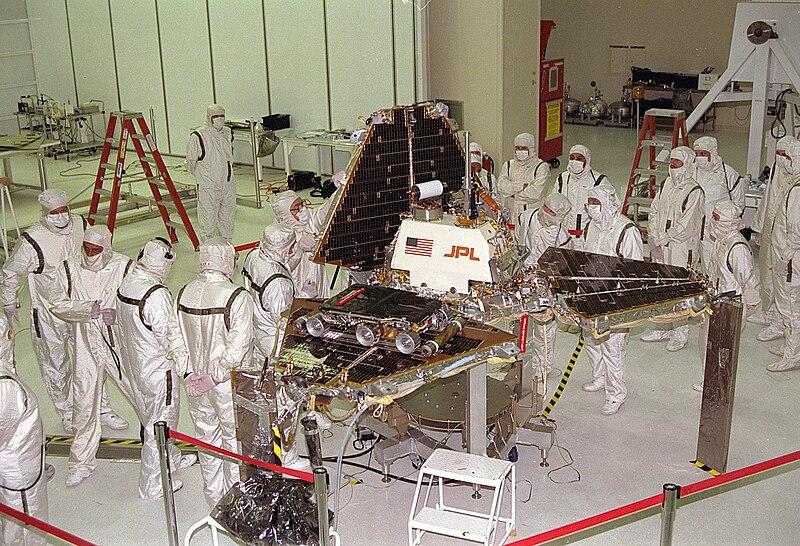
File:Mars_Pathfinder_Lander_preparations.jpg · Wikimedia Commons · See Wikimedia Commons
Mars Pathfinder
Sign in to saveAlso known as MESUR Pathfinder, Carl Sagan Memorial Station, Pathfinder, Sagan Memorial Station
Mars lander
Key facts
- Mission type
- Lander · Rover
- Operator
- NASA · Jet Propulsion Laboratory
- Cospar id
- 1996-068A
- Website
- mars .nasa .gov /MPF /
- Mission duration
- 85 days, Launch to last contact : 9 months, 23 days
- Launch mass
- 890 kg (includes propellant)
- Power
- Pathfinder : 35 W, Sojourner : 13 W
- Launch date
- December 4, 1996 ( 1996-12-04 ) 06:58:07 UTC
- Rocket
- Delta II 7925 (#D240)
- Launch site
- Cape Canaveral SLC-17
- Contractor
- None
- Last contact
- September 27, 1997 ( 1997-09-27 ) 10:23 UTC
- Landing date
- July 4, 1997 ; 28 years ago ( 1997-07-04 ) 16:56:55 UTC , MSD 43905 04:41 AMT
- Landing site
- Ares Vallis , Chryse Planitia , Mars , 19°5′50″N 33°15′14″W / 19.09722°N 33.25389°W / 19.09722; -33.25389 ( Sojourner rover (Mars Pathfinder) )
- Band
- X-Band with high-gain antenna
- Bandwidth
- 6 kb/s to 70 m Deep Space Network , 250 b/s to surface command
via Wikipedia infobox
Wikidata facts
- Instance of
- lander
- Part of
- Discovery Program
- Operator
- NASA
- Location
- Oxia Palus quadrangle
- Mass
- 890
- Official website
- www.jpl.nasa.gov/missions/mars-pathfinder-sojourner-rover
- Image
- Pathfinder01.jpg
Show 11 more facts
- Commons category
- Mars Pathfinder
- location of landing
- Mars
- UTC date of spacecraft launch
- 1996-12-04
- space launch vehicle
- Delta II
- topic's main category
- Category:Mars Pathfinder
- CPU
- RAD6000
- located on astronomical body
- Mars
- nominal power output
- 35
- UTC date of spacecraft landing
- 1997-07-04
- different from
- Pathfinder
- native label
- Mars Pathfinder
via Wikidata · CC0
~22 min read
Encyclopedic overview
Mars Pathfinder was an American robotic spacecraft that landed a base station with a roving probe on Mars in 1997. It consisted of a lander, renamed the Carl Sagan Memorial Station, and a lightweight, 10.6 kg (23 lb) wheeled robotic Mars rover named Sojourner, the first rover to operate outside the Earth–Moon system. The mission terminated in 1998.
Launched on December 4, 1996, by NASA aboard a Delta II booster a month after the Mars Global Surveyor, it landed on July 4, 1997, on Mars's Ares Vallis. The region is called Chryse Planitia, a part of the Oxia Palus quadrangle. The lander carried a series of scientific instruments to analyze the Martian atmosphere, climate, and geology. Analysis of the rocks and soil was a key objective. It was the second project from NASA's Discovery Program, which promotes the use of low-cost spacecraft and frequent launches under the "cheaper, faster, and better" motto promoted by then-administrator Daniel Goldin. The mission was directed by the Jet Propulsion Laboratory (JPL), a division of the California Institute of Technology, responsible for NASA's Mars Exploration Program. The project manager was JPL's Tony Spear.
Excerpted from Wikipedia’s “Mars Pathfinder” article, available under the CC BY-SA 4.0 licence.
Gallery (12)
On the map
2 mapped locations