
File:Martin_Buber_portrait.jpg · Wikimedia Commons · See Wikimedia Commons
Martin Buber
Sign in to saveGerman Jewish Existentialist philosopher and theologian (1878–1965)
OverviewAI-generated
Martin Buber was a philosopher, translator, pedagogue, and writer born in Vienna on 8 February 1878. He held citizenship in Austria, Germany, the Weimar Republic, and Israel. Buber was educated at the University of Vienna, Humboldt-Universität zu Berlin, the University of Zurich, and Leipzig University, earning a Doctor of Philosophy degree. He worked for Goethe University Frankfurt, the Hebrew University of Jerusalem, and Die Welt. His political ideologies included anarchism and humanism.
Buber received the Israel Prize, Bialik Prize, Erasmus Prize, and the Peace Prize of the German Publishers' and Booksellers' Association. He was nominated for the Nobel Prize in Literature and the Nobel Peace Prize. His notable works include *Torat ha-neviʾim*, *A zsidóság megújhodása*, *Die Stunde und die Erkenntnis*, *Das kleine Buch vom grossen Rabbi*, and *Between man and man*. He was a member of the Israel Academy of Sciences and Humanities, the American Academy of Arts and Sciences, the Bavarian Academy of Fine Arts, and Brit Shalom. Buber died in Jerusalem on 13 June 1965 and was buried at Har HaMenuchot.
Synthesized by Vinony from 30 facts across 4 sources: Wikidata, Open Library, Europeana Sparql, Vinony collections. Generated from structured data (not the Wikipedia text) and checked against those facts — may still contain errors.
Person · Open Library
- Born
- 8 February 1878
- Died
- 13 June 1965
- Works
- 543
Top works
- Torat ha-neviʾim
- A zsidóság megújhodása
- Die Stunde und die Erkenntnis
- Das kleine Buch vom grossen Rabbi
- Between man and man
via Open Library + Wikidata
Wikidata facts
- Instance of
- human
- Given name
- Martin
- Gender
- male
- Citizenship
- Cisleithania
- Place of birth
- Vienna
- Place of death
- Jerusalem
- Occupation
- librettist
- Educated at
- Humboldt-Universität zu Berlin
- Employer
- Die Welt
- Languages spoken
- Yiddish
- Academic degree
- Doctor of Philosophy
- Field of work
- educational system
- Movement
- Western philosophy
- Official website
- buber.de
- Image
- Martin Buber portrait.jpg
- Work location
- Heppenheim
- Political ideology
- humanism
Show 13 more facts
- Commons category
- Martin Buber
- date of death
- 1965-06-13
- date of birth
- 1878-02-08
- member of
- Bavarian Academy of Fine Arts
- name in native language
- Martin Buber
- nominated for
- Nobel Peace Prize
- ethnic group
- Jewish people
- place of burial
- Har HaMenuchot
- P8168
- Samadet
- influenced by
- Otto Weininger
- time period
- contemporary philosophy
- IPA transcription
- ˈmaʁtiːn̩ ˈbuːbɐ
- has works in the collection
- Anne Frank House
Sources (8)
via Wikidata · CC0
Works in European collections
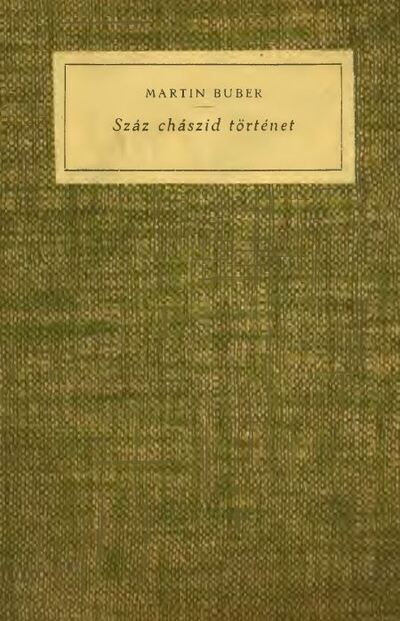
6 objects attributed to Martin Buber, held across European museums, libraries & archives · via Europeana


~37 min read
Encyclopedic overview
Martin Buber ( German: [ˈmaʁtiːn̩ ˈbuːbɐ] ; Hebrew: מרטין בובר; Yiddish: מארטין בובער; 8 February 1878 – 13 June 1965) was an Austrian-Israeli philosopher best known for his philosophy of dialogue, a form of existentialism centered on the distinction between the I–Thou relationship and the I–It relationship.
Born in Vienna, Buber came from a family of observant Jews, but broke with Jewish custom to pursue secular studies in philosophy. He produced writings about Zionism and worked with various bodies within the Zionist movement extensively over a nearly 50-year period spanning his time in Europe and the Near East. In 1923, Buber wrote his famous essay on existence, Ich und Du (later translated into English as I and Thou), and in 1925 he began translating the Hebrew Bible into the German language.
Excerpted from Wikipedia’s “Martin Buber” article, available under the CC BY-SA 4.0 licence.
Gallery (11)
Available in 65 languages
- Español
- Français
- Deutsch
- 中文
- 日本語
- Русский
- Português
- Italiano
- العربية
- हिन्दी
- Afrikaans
- Armenian
- Asturian
- azb
- Azerbaijani
- Bahasa Indonesia
- Basque
- Belarusian
Show 46 more
- Bulgarian
- Catalan
- Central Kurdish
- Croatian
- Czech
- Danish
- Egyptian Arabic
- Esperanto
- Estonian
- Filipino
- Finnish
- Galician
- Georgian
- Greek
- Hebrew
- Hungarian
- Kannada
- Latin
- Latvian
- Lithuanian
- Malagasy
- Nederlands
- Norwegian
- Pashto
- Polski
- Punjabi
- Romanian
- Scots
- Serbian
- Serbian (Latin)
- simple
- Slovak
- Slovenian
- Svenska
- Tiếng Việt
- Türkçe
- Ukrainian
- Urdu
- Waray
- Welsh
- Western Panjabi
- Wu Chinese
- Yiddish
- zh_yue
- فارسی
- 한국어
via Wikidata sitelinks · CC0