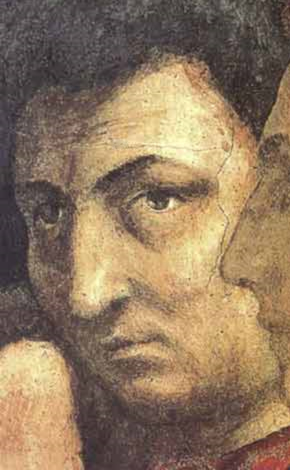
File:Masaccio_Self_Portrait.jpg · Wikimedia Commons · See Wikimedia Commons
Masaccio
Sign in to saveAlso known as Tommaso di Ser Giovanni di Simone, Mazachcho, Mazzacio, Tommaso di Ser Giovanni di Mone Cassai, Massacio, Tommaso Di Giovanni Di Simone Guidi Masaccio, Tommaso di ser Giovanni di Mone Guidi, Tommaso Guidi Masaccio
Masaccio (, ; ; December 21, 1401 – summer 1428), born Tommaso di Ser Giovanni di Simone, was a Florentine artist who is regarded as the first great Italian painter of the Quattrocento period of the Italian Renaissance. According to Vasari, Masaccio was the best painter of his generation because of his skill at imitating nature, recreating lifelike figures and movements as well as a convincing sense of three-dimensionality. He employed nudes and foreshortenings in his figures. This had seldom been done before him.
OverviewAI-generated
Masaccio, born Tommaso (also known as Maso di Ser Giovanni) in San Giovanni Valdarno on 21 December 1401, was an Italian Renaissance painter. He worked in Florence and is associated with the movement of the Italian Renaissance. His notable works include the *Virgin and Child with Saint Anne*, *Madonna and Child*, and *Holy Trinity*. He had a sibling named Giovanni di ser Giovanni Guidi.
Masaccio died in Rome on 1 January 1428. His paintings are held in collections such as the J. Paul Getty Museum, the National Gallery of Art, the Basilica of Santa Maria Novella, and the National Museum of San Matteo. He is described in sources including *Lives of the Most Excellent Painters, Sculptors, and Architects* and *The Catholic Encyclopedia*.
Synthesized by Vinony from 32 facts across 5 sources: Wikidata, Open Library, Last.fm, Europeana Sparql, Vinony graph. Generated from structured data (not the Wikipedia text) and checked against those facts — may still contain errors.
Key facts
- Artist.name
- Masaccio
- Artist.image
- Masaccio_Self_Portrait.jpg
- Artist.caption
- Detail of St. Peter Raising the Son of Theophilus and St. Peter Enthroned as First Bishop of Antioch, Brancacci Chapel, S. Maria del Carmine, Florence
- Artist.birth_name
- Tommaso di Ser Giovanni di Mone (Simone) Cassai
- Artist.birth_place
- San Giovanni Valdarno, Republic of Florence
- Artist.death_date
- latter half of 1428 (aged 26)
- Artist.death_place
- Rome, Papal States
- Artist.field
- Painting, Fresco
- Artist.movement
- Early Renaissance
- Artist.works
- Brancacci Chapel (Expulsion from the Garden of Eden, Tribute Money) Pisa Altarpiece 1426Holy Trinity
- Artist.patrons
- Felice de Michele Brancacci ser Giuliano di Colino degli Scarsi da San Giusto
via Wikipedia infobox
Wikidata facts
- Instance of
- human
- Given name
- Tommaso
- Gender
- male
- Place of birth
- San Giovanni Valdarno
- Place of death
- Rome
- Occupation
- painter
- Languages spoken
- Italian
- Notable work
- Holy Trinity
- Field of work
- painting
- Movement
- Italian Renaissance
- Image
- Masaccio Self Portrait.jpg
- Work location
- Florence
Show 11 more facts
- Commons category
- Masaccio
- date of birth
- 1401-12-21
- date of death
- 1428-01-01
- Commons Creator page
- Masaccio
- described by source
- New International Encyclopedia
- topic's main category
- Category:Masaccio
- Commons gallery
- Masaccio
- name in native language
- Masaccio
- has works in the collection
- Musée des Beaux-Arts de Rennes
- on focus list of Wikimedia project
- Wikipedia:Vital articles/Level/4
- name
- Maso di Ser Giovanni
Sources (3)
via Wikidata · CC0
Works in European collections
36 objects attributed to Masaccio, held across European museums, libraries & archives · via Europeana
Madonna with the Child
Parental murder of Saint Julian; Saint Nicholas giving birth to 3 girls without a poison
Crucifixion
Temple tax
fresco cycle
Weekly chair of a distinguished Florentine woman
The distribution of goods in the Community/Peter distributes alms
The Sermon of Peter
An angel liberating Peter from prison
Expulsion from Paradise
Baptism of Peter
Untitled
Untitled
Untitled
Untitled
Untitled
Untitled
Untitled
Untitled
Untitled
Untitled
Untitled
Untitled
Untitled
Untitled
Untitled
Untitled
Untitled
Untitled
Untitled
Untitled
Untitled

Untitled

Untitled

Untitled

Untitled
~17 min read
Encyclopedic overview
13 sectionsContents
- Early life
- First works
- Maturity
- Brancacci Chapel
- Works of the chapel
- ''Pisa Altarpiece''
- ''Holy Trinity''
- Other paintings
- Legacy
- Main works
- See also
- References
- External links
Masaccio (, ; ; December 21, 1401 – summer 1428), born Tommaso di Ser Giovanni di Simone, was a Florentine artist who is regarded as the first great Italian painter of the Quattrocento period of the Italian Renaissance. According to Vasari, Masaccio was the best painter of his generation because of his skill at imitating nature, recreating lifelike figures and movements as well as a convincing sense of three-dimensionality. He employed nudes and foreshortenings in his figures. This had seldom been done before him.
The name Masaccio is a humorous version of Maso (short for Tommaso), meaning "clumsy" or "messy" Tom. The name may have been created to distinguish him from his principal collaborator, also called Maso, who came to be known as Masolino ("little/delicate Tom").
Excerpted from Wikipedia’s “Masaccio” article, available under the CC BY-SA 4.0 licence.
Gallery (25)
Available in 77 languages
- Español
- Français
- Deutsch
- 中文
- 日本語
- Русский
- Português
- Italiano
- العربية
- हिन्दी
- Afrikaans
- Aragonese
- Armenian
- Asturian
- Azerbaijani
- Bahasa Indonesia
- Bashkir
- Basque
Show 58 more
- be_x_old
- Belarusian
- Bosnian
- Breton
- Bulgarian
- Catalan
- Chuvash
- Croatian
- Czech
- Danish
- Egyptian Arabic
- Esperanto
- Estonian
- Fiji Hindi
- Finnish
- Galician
- Greek
- Hebrew
- Hungarian
- Icelandic
- Ido
- Irish
- Kazakh
- Latin
- Latvian
- Lithuanian
- Malagasy
- Malayalam
- Nederlands
- Newari
- Norwegian
- Norwegian Nynorsk
- Pampanga
- Piedmontese
- Polski
- Punjabi
- Romanian
- Sardinian
- Saterland Frisian
- Serbian
- Serbian (Latin)
- simple
- Slovak
- Slovenian
- Svenska
- Tamil
- Telugu
- Tibetan
- Tiếng Việt
- Türkçe
- Ukrainian
- Uzbek
- Waray
- Wu Chinese
- zh_yue
- فارسی
- ไทย
- 한국어
via Wikidata sitelinks · CC0