Seldon, David S.;Buckley, Thomas R.
Mecodema
Sign in to saveAlso known as New Zealand large carabids
Mecodema is a genus of large flightless ground beetle (Carabidae) endemic to New Zealand. The genus is very diverse in comparison to the other three New Zealand genera (Diglymma, Oregus, Orthoglymma) within the subtribe Nothobroscina (tribe Broscini). Mecodema is geographically widespread across both the North and South Islands, as well as numerous offshore islands, including the Three Kings Is., Poor Knights Is., Aotea (Great Barrier Is.) and Hauturu (Little Barrier Is.), Kapiti Is., Stephens Is., Stewart Is., Chatham Is., Snares Is.
Species
GENUS
- KingdomAnimalia
- PhylumArthropoda
- ClassInsecta
- OrderColeoptera
- FamilyCarabidae
Mecodema is een geslacht van kevers uit de familie van de loopkevers (Carabidae). De wetenschappelijke naam van het geslacht is voor het eerst geldig gepubliceerd in 1853 door Blanchard.
via GBIF
Wikidata facts
- Instance of
- taxon
- Image
- Mecodema oconnori Bruce Park.jpg
Show 5 more facts
- taxon name
- Mecodema
- taxon rank
- genus
- topic's main category
- Category:Mecodema
- Commons category
- Mecodema
- taxon common name
- New Zealand large carabids
Sources (2)
via Wikidata · CC0
~8 min read
Encyclopedic overview
4 sectionsContents
- Genus description
- Species and subspecies (103)
- References
- Further reading
Mecodema is a genus of large flightless ground beetle (Carabidae) endemic to New Zealand. The genus is very diverse in comparison to the other three New Zealand genera (Diglymma, Oregus, Orthoglymma) within the subtribe Nothobroscina (tribe Broscini). Mecodema is geographically widespread across both the North and South Islands, as well as numerous offshore islands, including the Three Kings Is., Poor Knights Is., Aotea (Great Barrier Is.) and Hauturu (Little Barrier Is.), Kapiti Is., Stephens Is., Stewart Is., Chatham Is., Snares Is.
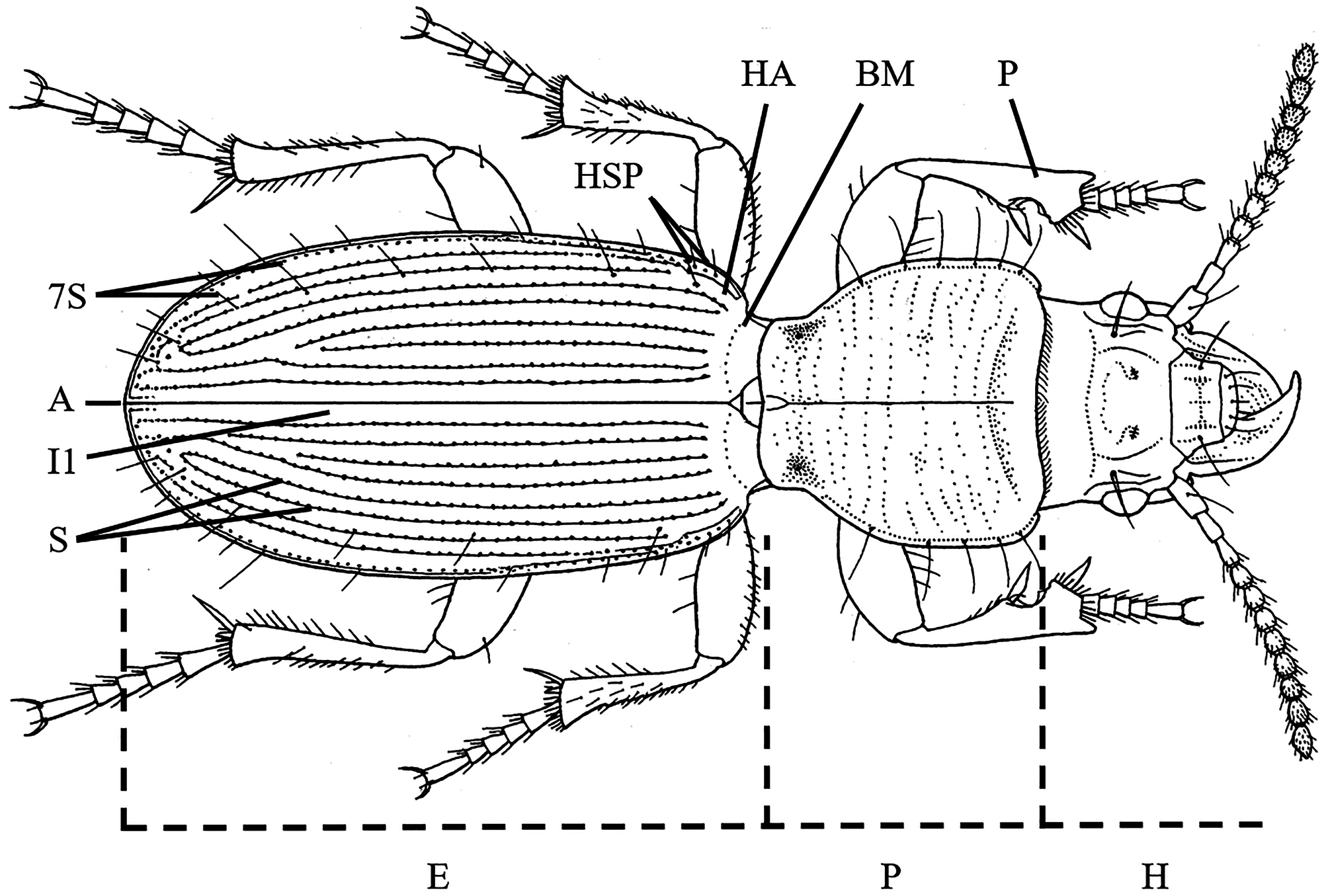
== Genus description == Head, frons and vertex often rugose and / or punctate, microsculpture or macrosculpture absent in some species groups (e.g., curvidens species); eyes prominent, almost hemispherical; a single supraorbital puncture on each side, bearing more than one setae; setose punctures of vertex absent; mandibles large, uniformly narrow to the pointed apex, sharply curved in the apical third, mandibles with a number of dorsal grooves and without a seta in the scrobe; mentum with median process, which is notched to strongly indentate (bifid); usually with 2 setiferous punctures (may be absent) below the process and generally with 4–8 setose (setiferous) punctures along the submentum sclerite; labial palpi with setae on the penultimate segment; terminal segments of all palpi slightly compressed, sub-cylindrical, truncate; ligula chitinous with a median carina, 2 apical setae present; the membranous paraglossae extended well beyond the apex of the ligula; stipes with 2–3 basal setae; antennomeres I–II glabrous, III–V with apical ring, VI–XI setose throughout; antennomeres I–III subcylindrical, IV–VII subglobose and slightly compressed. Prothoracic carina (pronotal lateral margin) distinct with an asymmetrical number of setae along each side, the last never at the posterior lateral sinuation (posterior angle); midline (median groove) and pronotal foveae (laterobasal depressions) always present; pronotal disc often with shallow depressions on each side of apical half. Elytra always striate; fused together along the suture; hind wings absent; a row of setose punctures on the 7th stria and another row (umbilical series) near the lateral carina (elytral margin). Legs slender, the protibia with a pointed apical prolongation on the outer side, greatly distally expanded to distally expanded and shovel-like; male and female tarsi identical, the basal 4 segments of the anterior tarsi are as broad as they are long, usually slightly asymmetrical.
Excerpted from Wikipedia’s “Mecodema” article, available under the CC BY-SA 4.0 licence.
Gallery (3)
Available in 9 languages
via Wikidata sitelinks · CC0