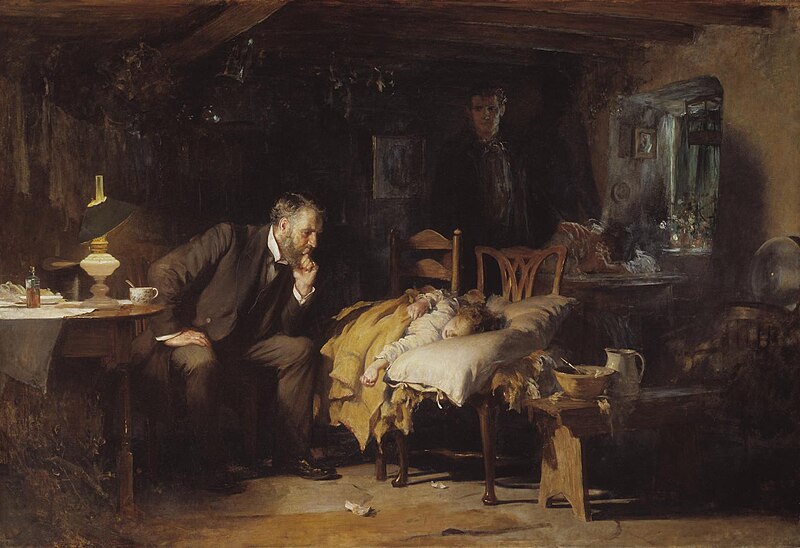
File:The_Doctor_Luke_Fildes_crop.jpg · Wikimedia Commons · See Wikimedia Commons
medicine
Sign in to saveAlso known as medical, medicalism, clinical medicine
thumb|upright=1.6|alt=Oil painting of medicine in the age of colonialism|The Doctor by Sir Luke Fildes (1891) Medicine is the science and practice of caring for patients, managing the diagnosis, prognosis, prevention, treatment and palliation of their injury or disease, while promoting their health. Medicine encompasses a variety of health care practices which evolved to maintain and restore health through the prevention and treatment of illness. Contemporary medicine applies biomedical sciences, biomedical research, genetics, and medical technology to diagnose, treat, and prevent injury and d
OverviewAI-generated
Medicine is an academic discipline and major within the health sciences, forming a part of the life sciences. It is practiced by physicians, physician assistants, and nurse practitioners. The field is distinct from alternative medicine and is associated with the health care industry.
The subject is documented in sources such as the Jewish Encyclopedia of Brockhaus and Efron, the Brockhaus and Efron Encyclopedic Dictionary, the Encyclopædia Britannica 11th edition, and the Gujin Tushu Jicheng. It is referenced by 9,432 other encyclopedia articles and has a PubMed count of 9,980,209. Abbreviations for the topic include tıp., Med, and Med.
Synthesized by Vinony from 22 facts across 3 sources: Wikidata, PubMed, Vinony graph. Generated from structured data (not the Wikipedia text) and checked against those facts — may still contain errors.
Research
9,980,209 papers- Long COVID and Medicine's Two Cultures.ReviewThe American journal of medicine · 2022Horwitz RI, Conroy AH, Cullen MR et al.DOI: 10.1016/j.amjmed.2022.03.020
- Family medicine's stress test.Canadian family physician Medecin de famille canadien · 2022Pimlott NDOI: 10.46747/cfp.6811793
- Medicine's magicians.Minnesota medicine · 2010Meyer CR
- Aviation medicine's role in safeguarding aviation safety.ReviewSingapore medical journal · 2025Soh FW, Woo JHA, Low JW et al.DOI: 10.4103/singaporemedj.SMJ-2025-064
- Medicine's blind spot.ReviewFamily medicine · 1999Miller CS
- Medicine's core values.BMJ (Clinical research ed.) · 1994Smith RDOI: 10.1136/bmj.309.6964.1247
- Will COVID-19 be evidence-based medicine's nemesis?PLoS medicine · 2020Greenhalgh TDOI: 10.1371/journal.pmed.1003266
- Celebrating Annals of Emergency Medicine's 50th Anniversary.Annals of emergency medicine · 2022Callaham ML, Milling TJ JrDOI: 10.1016/j.annemergmed.2021.11.013
via PubMed
Wikidata facts
- Instance of
- academic major
- Subclass of
- health sciences
- Part of
- life sciences
- Industry
- health care industry
- Image
- Parasagittal MRI of human head in patient with benign familial macrocephaly prior to brain injury (ANIMATED).gif
Show 13 more facts
- Commons category
- Medicine
- topic's main category
- Category:Medicine
- topic's main Wikimedia portal
- Portal:Medicine
- Commons gallery
- Medicine
- topic has template
- Template:Medicine navs
- on focus list of Wikimedia project
- Wikipedia:List of articles all languages should have
- Wikimedia outline
- outline of medicine
- history of topic
- history of medicine
- WordLift URL
- data.thenextweb.com/tnw/entity/medicine
- P8168
- René König
- opposite of
- alternative medicine
- Mastodon instance URL
- med-mastodon.com
- entry in abbreviations table
- Med
Sources (10)
via Wikidata · CC0
~59 min read
Encyclopedic overview
22 sectionsContents
- Etymology
- Clinical practice
- Institutions
- Delivery
- Branches
- Basic sciences
- Specialties
- Surgical specialty
- Internal medicine specialty
- Diagnostic specialties
- Other major specialties
- Education and legal controls
- Medical ethics
- History
- Ancient world
- Middle Ages
- Modern
- Quality, efficiency, and access
- Telemedicine
- See also
- Notes
- References
thumb|upright=1.6|alt=Oil painting of medicine in the age of colonialism|The Doctor by Sir Luke Fildes (1891) Medicine is the science and practice of caring for patients, managing the diagnosis, prognosis, prevention, treatment and palliation of their injury or disease, while promoting their health. Medicine encompasses a variety of health care practices which evolved to maintain and restore health through the prevention and treatment of illness. Contemporary medicine applies biomedical sciences, biomedical research, genetics, and medical technology to diagnose, treat, and prevent injury and disease, typically through various pharmaceuticals or surgery, but also through therapies such as psychotherapy, external splints and traction, medical devices, biologics, and ionizing radiation, amongst others.
Medicine has been practiced since prehistoric times, and for most of this time it was an art (an area of creativity and skill), frequently having connections to the religious and philosophical beliefs of local culture. For example, a medicine man would apply herbs and say prayers for healing, or an ancient philosopher and physician would apply bloodletting according to the theories of humorism, or the four humors. In recent centuries, since the advent of modern science, most medicine has become a combination of art and science (both basic and applied, under the umbrella of medical science). For example, while stitching technique for sutures is an art learned through practice, knowledge of what happens at the cellular and molecular level in the tissues being stitched arises through science.
Excerpted from Wikipedia’s “medicine” article, available under the CC BY-SA 4.0 licence.
Gallery (50)
Available in 194 languages
- Español
- Français
- Deutsch
- 中文
- 日本語
- Русский
- Português
- Italiano
- العربية
- हिन्दी
- abstract
- Afrikaans
- Albanian
- Albanian
- Amharic
- Aragonese
- Aramaic
- Armenian
Show 175 more
- Arpitan
- Assamese
- Asturian
- Avaric
- Aymara
- azb
- Azerbaijani
- Bahasa Indonesia
- Bambara
- Bangla
- Bashkir
- Basque
- bat_smg
- be_x_old
- Belarusian
- Bhojpuri
- Bikol
- Bishnupriya
- Bislama
- Bosnian
- Breton
- Bulgarian
- Buriat
- Burmese
- Catalan
- cdo
- Cebuano
- Central Kurdish
- Chechen
- Cherokee
- Chuvash
- Cornish
- Corsican
- Croatian
- Czech
- Danish
- Egyptian Arabic
- Esperanto
- Estonian
- Extremaduran
- Faroese
- Fiji Hindi
- Filipino
- Finnish
- fiu_vro
- Friulian
- Galician
- gcr
- Georgian
- Gorontalo
- Greek
- Guarani
- Haitian Creole
- Hakka Chinese
- Hebrew
- Hungarian
- hyw
- Icelandic
- Ido
- Iloko
- Ingush
- Interlingua
- Interlingue
- Inuktitut
- Irish
- Jamaican Creole English
- Javanese
- Kabyle
- Kannada
- Kara-Kalpak
- Kashmiri
- Kashubian
- Kazakh
- Kinyarwanda
- Kurdish
- Kyrgyz
- Ladino
- Lao
- Latin
- Latvian
- Ligurian
- Limburgish
- Lingua Franca Nova
- Lithuanian
- Low German
- Luxembourgish
- Macedonian
- Malay
- Malayalam
- Maltese
- Manipuri
- Manx
- Marathi
- Mari
- Minangkabau
- Mingrelian
- Mirandese
- Mongolian
- Moroccan Arabic
- nds_nl
- Neapolitan
- Nederlands
- Nepali
- Norwegian
- Norwegian Nynorsk
- Novial
- Occitan
- Odia
- Oromo
- Ossetic
- Pali
- Pashto
- Picard
- Piedmontese
- Polski
- Punjabi
- Quechua
- Romanian
- Romansh
- Rusyn
- Sanskrit
- Santali
- Sardinian
- Saterland Frisian
- Scots
- Scottish Gaelic
- Serbian
- Serbian (Latin)
- Shona
- Sicilian
- simple
- Sindhi
- Sinhala
- Slovak
- Slovenian
- Somali
- Sundanese
- Svenska
- Swahili
- Tachelhit
- Tajik
- Talysh
- Tamil
- Tatar
- Telugu
- Tibetan
- Tiếng Việt
- Tigrinya
- Toki Pona
- Tsonga
- Tumbuka
- Türkçe
- Ukrainian
- Urdu
- Uzbek
- Venetian
- Veps
- Volapük
- Walloon
- Waray
- Welsh
- Western Frisian
- Western Panjabi
- Wolof
- Wu Chinese
- Yakut
- Yiddish
- Zaza
- zh_min_nan
- zh_yue
- Zhuang
- Zulu
- فارسی
- ไทย
- 한국어
via Wikidata sitelinks · CC0