File:Ngorongoro_Crater,_Tanzania_(2288421918).jpg · Wikimedia Commons · See Wikimedia Commons
megafauna
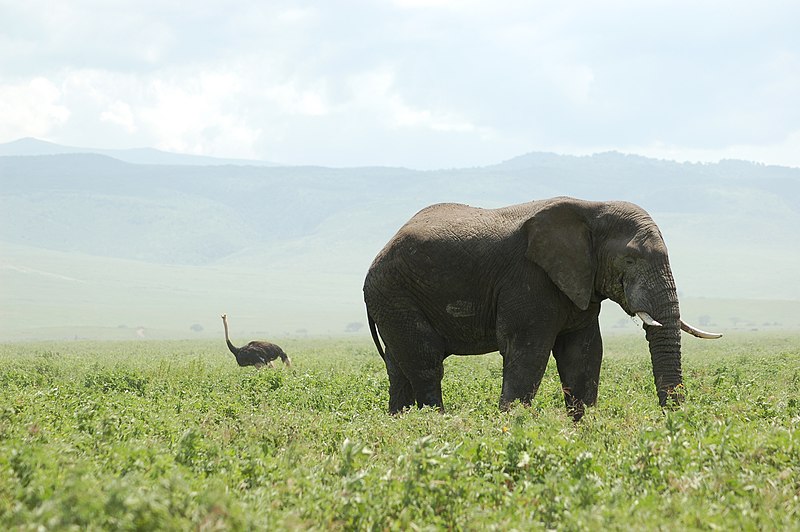
Sign in to savethumb|320px|The African bush elephant (foreground), Earth's largest extant land animal, and the [[Masai ostrich (background), one of Earth's largest extant birds]] In zoology, megafauna (from Greek 'large' and Neo-Latin 'animal life') are large animals. The precise definition of the term varies widely, though a common threshold is approximately , this lower end being centered on humans, with other thresholds being more relative to the sizes of animals in an ecosystem, the spectrum of lower-end thresholds ranging from to , the latter largely restricted to megaherbivores. Large body size is gene
Wikidata facts
- Subclass of
- fauna
- Follows
- macrofauna
Show 1 more fact
- topic's main category
- Category:Megafauna
Sources (2)
via Wikidata · CC0
~33 min read
Encyclopedic overview
25 sectionsContents
- History
- Definition
- Keystone megafauna
- Functional megafauna
- Apex megafauna
- Ecological strategy
- Evolution of large body size
- In terrestrial mammals
- In marine mammals
- In flightless birds
- In giant turtles
- Megafaunal mass extinctions
- Timing and possible causes
- Consequences of depletion of megafauna
- Effect on nutrient transport
- Effect on methane emissions
- Current studies
- Gallery
- Pleistocene extinct megafauna
- Other extinct Cenozoic megafauna
- Extant
- See also
- Notes
- References
- External links
thumb|320px|The African bush elephant (foreground), Earth's largest extant land animal, and the [[Masai ostrich (background), one of Earth's largest extant birds]] In zoology, megafauna (from Greek 'large' and Neo-Latin 'animal life') are large animals. The precise definition of the term varies widely, though a common threshold is approximately , this lower end being centered on humans, with other thresholds being more relative to the sizes of animals in an ecosystem, the spectrum of lower-end thresholds ranging from to , the latter largely restricted to megaherbivores. Large body size is generally associated with other traits, such as having a slow rate of reproduction and, in large herbivores, reduced or negligible adult mortality from predation.
Megafauna species have considerable effects on their local environment, including the suppression of the growth of woody vegetation and a consequent reduction in wildfire frequency. Megafauna also play a role in regulating and stabilizing the abundance of smaller animals.
Excerpted from Wikipedia’s “megafauna” article, available under the CC BY-SA 4.0 licence.