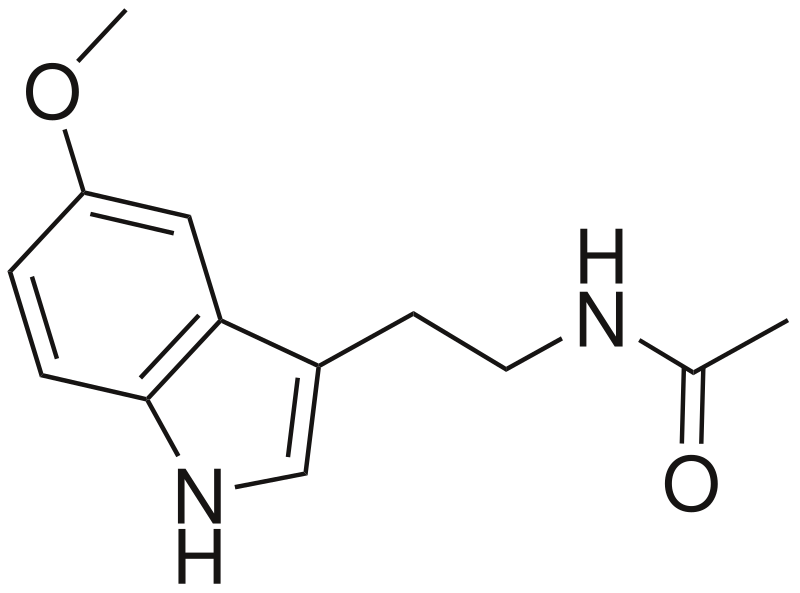
File:Melatonin.svg · Wikimedia Commons · See Wikimedia Commons
melatonin
Sign in to saveAlso known as MLT, N-[2-(5-methoxyindol-3-yl)ethyl]acetamide, 5-methoxy-N-acetyltryptamine, Melovine, {N-[2-(5-methoxy-1H-indol-3-yl)ethyl]-} Acetamide, N-(2-(5-Methoxyindol-3-yl)ethyl)-Acetamide, N-Acetyl-5-methoxy-tryptamine, N-[2-(5-Methoxyindol-3-yl)ethyl]-Acetamide
Melatonin, an indoleamine, is a natural compound produced by various organisms, including bacteria and eukaryotes. Its discovery in 1958 by Aaron B. Lerner and colleagues stemmed from the isolation of a substance from the pineal gland of cows that could induce skin lightening in common frogs. This compound was later identified as a hormone secreted in the brain during the night, playing a crucial role in regulating the sleep-wake cycle, also known as the circadian rhythm, in vertebrates.
OverviewAI-generated
Melatonin is a chemical compound with the formula C₁₃H₁₆N₂O₂. Its IUPAC name is N-[2-(5-methoxy-1H-indol-3-yl)ethyl]acetamide. The substance has a mass of 232.121 and a weight of 232.28. It carries a charge of 0 and features two hydrogen bond donors and two hydrogen bond acceptors. The calculated xlogp value is 0.8, while the topological polar surface area (TPSA) is 54.1.
The defined daily dose for melatonin is 2.0. The compound is associated with a PubMed query count of 37218. It is referenced by 1,555 other encyclopedia articles.
Synthesized by Vinony from 20 facts across 4 sources: Wikidata, PubChem, PubMed, Vinony graph. Generated from structured data (not the Wikipedia text) and checked against those facts — may still contain errors.
Chemical data
- Formula
- C13H16N2O2
- Molecular weight
- 232.28 g/mol
- IUPAC name
- N-[2-(5-methoxy-1H-indol-3-yl)ethyl]acetamide
- SMILES
- CC(=O)NCCC1=CNC2=C1C=C(C=C2)OC
- InChIKey
- DRLFMBDRBRZALE-UHFFFAOYSA-N
- XLogP
- 0.8
- Polar surface area
- 54.1 Ų
- H-bond donors
- 2
- H-bond acceptors
- 2
- Formal charge
- 0
via PubChem
Drug data · ChEMBL
- Max clinical phase
- Approved
- Molecule type
- Small molecule
- First approval
- 2007
- Admin. routes
- oral
- Indications
- sunburn, substance withdrawal syndrome, aortic aneurysm, metabolic syndrome
via ChEMBL · EBI
Research
37,218 papersvia PubMed
Wikidata facts
- Subclass of
- hormone
- Has part
- carbon
- Mass
- 232.121
- Has use
- medication
Show 11 more facts
- medical condition treated
- jet lag
- Commons category
- Melatonin
- found in taxon
- Trigonella foenum-graecum
- chemical formula
- C₁₃H₁₆N₂O₂
- topic's main category
- Category:Melatonin
- canonical SMILES
- CC(=O)NCCC1=CNC2=C1C=C(C=C2)OC
- isomeric SMILES
- C/C(=N\CCC1=CNC2=C1C=C(C=C2)OC)/O
- defined daily dose
- 2.0
- subject has role
- primary metabolite
- different from
- melanin
Sources (11)
via Wikidata · CC0
~25 min read
Encyclopedic overview
29 sectionsContents
- Biological activity
- Biological functions
- Circadian rhythm
- Immune system
- Weight regulation
- Biochemistry
- Biosynthesis
- Mechanism
- Regulation
- Metabolism
- Measurement
- Use as a medication and supplement
- Insomnia
- Circadian rhythm sleep disorders
- REM sleep behavior disorder
- Dementia
- Available forms
- History
- Discovery
- Etymology
- Occurrence
- Animals and Humans
- Plants
- Fungi
- Bacteria
- Archaea
- Food products
- References
- External links
Melatonin, an indoleamine, is a natural compound produced by various organisms, including bacteria and eukaryotes. Its discovery in 1958 by Aaron B. Lerner and colleagues stemmed from the isolation of a substance from the pineal gland of cows that could induce skin lightening in common frogs. This compound was later identified as a hormone secreted in the brain during the night, playing a crucial role in regulating the sleep-wake cycle, also known as the circadian rhythm, in vertebrates.
In vertebrates, melatonin's functions extend to synchronizing sleep-wake cycles, encompassing sleep-wake timing and blood pressure regulation, as well as controlling seasonal rhythmicity (circannual cycle), which includes reproduction, fattening, molting, and hibernation. Its effects are mediated through the activation of melatonin receptors and its role as an antioxidant. In plants and bacteria, it serves as a defense mechanism against oxidative stress, indicating its evolutionary significance. Mitochondria, key organelles, are the main producers of melatonin, underscoring its "ancient origins" and its fundamental role in protecting the earliest cells from reactive oxygen species.
Excerpted from Wikipedia’s “melatonin” article, available under the CC BY-SA 4.0 licence.
Gallery (15)
Available in 72 languages
- Español
- Français
- Deutsch
- 中文
- 日本語
- Русский
- Português
- Italiano
- العربية
- हिन्दी
- Armenian
- azb
- Azerbaijani
- Bahasa Indonesia
- Basque
- be_x_old
- Belarusian
- Bosnian
Show 53 more
- Bulgarian
- Burmese
- Catalan
- Central Kurdish
- Croatian
- Czech
- Danish
- Divehi
- Esperanto
- Estonian
- Extremaduran
- Finnish
- Galician
- Georgian
- Greek
- Gujarati
- Hebrew
- Hungarian
- Icelandic
- Irish
- Latin
- Latvian
- Lithuanian
- Macedonian
- Malay
- Malayalam
- Mongolian
- Nederlands
- Norwegian
- Norwegian Nynorsk
- Occitan
- Odia
- Polski
- Romanian
- Serbian
- Serbian (Latin)
- simple
- Slovak
- Slovenian
- Svenska
- Tajik
- Tamil
- Telugu
- Tiếng Việt
- Türkçe
- Ukrainian
- Urdu
- Uzbek
- Welsh
- Wu Chinese
- فارسی
- ไทย
- 한국어
via Wikidata sitelinks · CC0