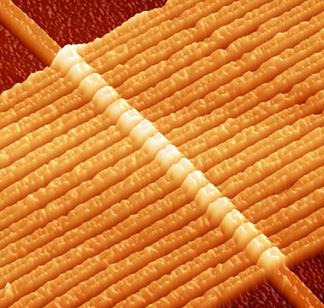
File:Memristor.jpg · Wikimedia Commons · See Wikimedia Commons
memristor
Sign in to saveA memristor (; a portmanteau of memory resistor) is a non-linear two-terminal electrical component relating electric charge and magnetic flux linkage. It was described and named in 1971 by Leon Chua, completing a theoretical quartet of fundamental electrical components which also comprises the resistor, capacitor and inductor.
Key facts
- Electronic component.component
- Memristor
- Electronic component.photo
- Memristor (50665029093) (cropped).jpg
- Electronic component.photo_caption
- Memristor developed by the University of Illinois at Urbana-Champaign and National Energy Technology Laboratory
- Electronic component.inventor
- Leon Chua
- Electronic component.working_principle
- Relating electric charge and magnetic flux linkage
- Electronic component.symbol
- File:Memristor-Symbol.svg
- Electronic component.terminal_number
- 2
- Electronic component.is_Linear
- No
- Electronic component.invention_Year
- 1971
via Wikipedia infobox
Wikidata facts
- Instance of
- electrical element
- Part of
- electronic circuit
- Image
- Memristor-Symbol.svg
Show 5 more facts
- Commons category
- Memristors
- discoverer or inventor
- Leon O. Chua
- publication date
- 1971-00-00
- working title
- memristance
- different from
- Memistor
via Wikidata · CC0
~56 min read
Encyclopedic overview
45 sectionsContents
- As a fundamental electrical component
- Derivation and characteristics
- Modelling and validation
- Superconducting memristor component
- Memristor circuits
- Criticisms
- Experimental tests
- Theory
- Operation as a switch
- Memristive systems
- Pinched hysteresis
- Memristive networks and mathematical models of circuit interactions
- Extended systems
- Implementation of hysteretic current-voltage memristors
- Titanium dioxide memristor
- Silicon dioxide memristor
- Polymeric memristor
- Layered memristor
- Atomristor
- Ferroelectric memristor
- Carbon nanotube memristor
- Biomolecular memristor
- Spin memristive systems
- Spintronic memristor
- Memristance in a magnetic tunnel junction
- Extrinsic mechanism
- Intrinsic mechanism
- Spin memristive system
- Self-directed channel memristor
- Implementation of hysteretic flux-charge memristors
- Time-integrated Formingfree memristor
- Potential applications
- Derivative devices
- Memistor and memtransistor
- Memcapacitors and meminductors
- Memfractance and memfractor, 2nd- and 3rd-order memristor, memcapacitor and meminductor
- History
- Precursors
- Theoretical description
- Twenty-first century
- See also
- Footnotes
- References
- Further reading
- External links
A memristor (; a portmanteau of memory resistor) is a non-linear two-terminal electrical component relating electric charge and magnetic flux linkage. It was described and named in 1971 by Leon Chua, completing a theoretical quartet of fundamental electrical components which also comprises the resistor, capacitor and inductor.
Chua and Kang later generalized the concept to memristive systems. Such a system comprises a circuit, of multiple conventional components, which mimics key properties of the ideal memristor component and is also commonly referred to as a memristor. Several such memristor system technologies have been developed, notably ReRAM.
Excerpted from Wikipedia’s “memristor” article, available under the CC BY-SA 4.0 licence.