File:FourMetricInstruments.JPG · Wikimedia Commons · See Wikimedia Commons
metric system
Sign in to saveAlso known as metric
decimal system of units that uses the metre as the basis for its unit of length
The metric system is a way of measuring things based on the metre as the unit of length, organized around powers of 10 to make calculations straightforward. It matters because this decimal structure makes it easier to convert between different sizes of measurements compared to older systems with irregular conversions.
AI-generated from the Wikipedia summary — may contain errors.
Research
9,243 papers- METRIC system.British medical journal · 1953Nixon WCW, Whittet TD
- The Metric System.The Dental register · 1890
- The metric system.Applied optics · 1966
- The Metric System.Atlanta journal-record of medicine · 1899
- The Metric System.The Chicago medical journal and examiner · 1880
- METRIC system.British medical journal · 1953
- Metric System.The Southern medical record · 1879
- Metric System.Science (New York, N.Y.) · 1965Gressitt JLDOI: 10.1126/science.149.3686.814-a
via PubMed
Wikidata facts
- Subclass of
- system of units
- Image
- FourMetricInstruments.JPG
Show 5 more facts
- history of topic
- history of the metric system
- topic's main category
- Category:Metric system
- Commons category
- International System of Units
- uses
- decimal
- on focus list of Wikimedia project
- Wikipedia:Vital articles/Level/4
Sources (3)
via Wikidata · CC0
~23 min read
Encyclopedic overview
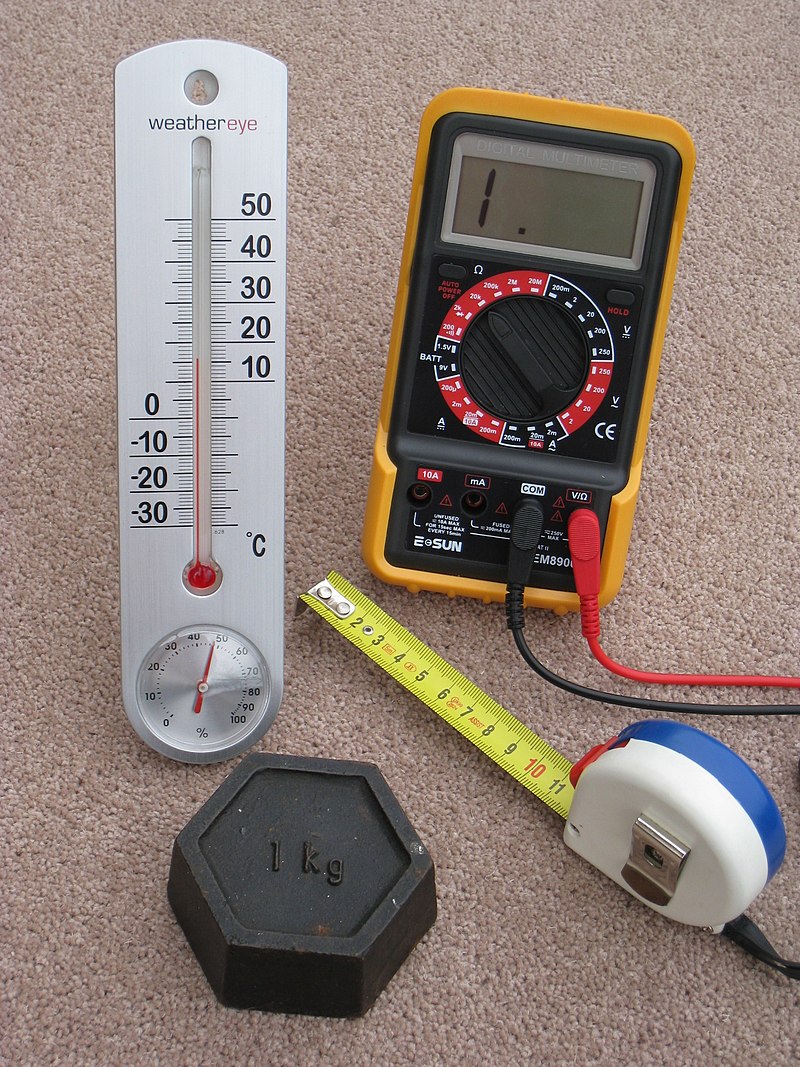
A kilogram mass and three metric measuring devices: a tape measure in centimetres, a thermometer in degrees Celsius, and a multimeter that measures potential in volts, current in amperes and resistance in ohms.
The metric system is a system of measurement that standardises a set of base units and a nomenclature for describing relatively large and small quantities using decimal-based multiplicative unit prefixes. Though the rules governing the metric system have changed over time, the modern definition, the International System of Units (SI), defines the metric prefixes and seven base units: metre (m), kilogram (kg), second (s), ampere (A), kelvin (K), mole (mol), and candela (cd).
Excerpted from Wikipedia’s “metric system” article, available under the CC BY-SA 4.0 licence.
Gallery (5)
Available in 84 languages
- Español
- Français
- Deutsch
- 中文
- 日本語
- Русский
- Português
- العربية
- हिन्दी
- Albanian
- Aragonese
- Armenian
- Asturian
- Azerbaijani
- Bahasa Indonesia
- Bangla
- Basque
- be_x_old
Show 65 more
- Belarusian
- Bikol
- Bosnian
- Burmese
- Catalan
- Central Kurdish
- Chuvash
- Croatian
- Czech
- Esperanto
- Estonian
- Filipino
- Finnish
- Galician
- Gan Chinese
- Greek
- Gujarati
- Hausa
- Hebrew
- Icelandic
- Irish
- Jamaican Creole English
- Javanese
- Kannada
- Karachay-Balkar
- Kazakh
- Kyrgyz
- Latin
- Latvian
- Lingua Franca Nova
- Lithuanian
- Low German
- Malay
- Malayalam
- Marathi
- Mongolian
- Moroccan Arabic
- Nederlands
- Norwegian Nynorsk
- Polski
- Romanian
- Serbian
- Serbian (Latin)
- simple
- Sindhi
- Slovak
- Slovenian
- Svenska
- Tamil
- Telugu
- Tiếng Việt
- Türkçe
- Ukrainian
- Urdu
- Uzbek
- Waray
- Welsh
- Western Frisian
- Wu Chinese
- Yakut
- Yiddish
- Yoruba
- zh_yue
- فارسی
- 한국어
via Wikidata sitelinks · CC0