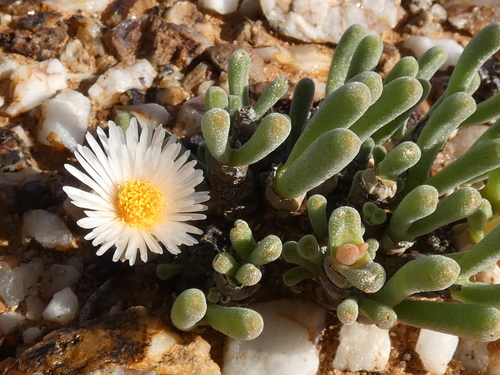
(c) Ronald Flipphi, some rights reserved (CC BY-NC), uploaded by Ronald Flipphi · cc-by-nc
Mitrophyllum
Sign in to saveMitrophyllum is a genus of succulent plants of the family Aizoaceae, indigenous to the arid Richtersveld region, in the Northern Cape province of northwestern South Africa near the border with Namibia.
Species
Necklace Pearlfig
GENUS
- KingdomPlantae
- PhylumTracheophyta
- ClassMagnoliopsida
- OrderCaryophyllales
- FamilyAizoaceae
Mitrophyllum là chi thực vật có hoa trong họ Aizoaceae.[1] Hình ảnh Chú thích ^ “Mitrophyllum”. The Plant List. Truy cập ngày 16 tháng 6 năm 2013. Tham khảo Phương tiện liên quan tới Mitrophyllum tại Wikimedia Commons Dữ liệu liên quan tới Mitrophyllum tại Wikispecies Bài viết liên quan đến phân họ cẩm chướng Ruschioideae này vẫn còn sơ khai. Bạn có thể giúp Wikipedia bằng cách mở rộng nội dung để bài được hoàn chỉnh hơn. x t s
via GBIF · Kew POWO
Museum specimens
- Specimen records
- 4
- Family
- Aizoaceae
- Collections
- BOLUSHERB
- Recorded in
- South Africa
Wikidata facts
Show 7 more facts
- taxon rank
- genus
- taxon name
- Mitrophyllum
- Commons category
- Mitrophyllum
- topic's main category
- Category:Mitrophyllum
- taxonomic type
- Mitrophyllum mitratum
- taxon common name
- 奇鸟菊属
Sources (1)
via Wikidata · CC0
~4 min read
Encyclopedic overview
4 sectionsContents
- Description
- Cultivation
- Species
- References
Mitrophyllum is a genus of succulent plants of the family Aizoaceae, indigenous to the arid Richtersveld region, in the Northern Cape province of northwestern South Africa near the border with Namibia.
==Description== thumb|left|Mitrophyllum mitratum showing the papery sheath in which the new pairs of leaves are held before rains. thumb|left|Mitrophyllum clivorum. thumb|left|Mitrophyllum grande. The species generally grow stems, at the top of which two succulent leaves appear. Similar to the closely related genera of Monilaria and Meyerophytum, these leaf-pairs alternate consecutively between two different types of leaf-growth (heterophylly) and during the exceptionally hot summer they remain inactive in a dry sheath. When fused together into a cone-shaped corpuscle, this leaf pair is referred to as the plant's "mitre", and this is the origin of the genus name. The two separate leaves of the free leaf-pair are rounded-triangular to tongue-shaped. The fused leaf-pair forms a cone-shaped to cylindrical corpuscle, which bears two smaller ear-like anthers at the top. This fused corpuscle dries out in the plant's dormancy period, eventually becoming a papery sheath in which the new (separate) leaf-pair forms.
Excerpted from Wikipedia’s “Mitrophyllum” article, available under the CC BY-SA 4.0 licence.
Gallery (6)
Available in 13 languages
- Español
- Français
- Deutsch
- Русский
- Português
- Afrikaans
- Cebuano
- Egyptian Arabic
- Nederlands
- Svenska
- Tiếng Việt
- Waray
via Wikidata sitelinks · CC0