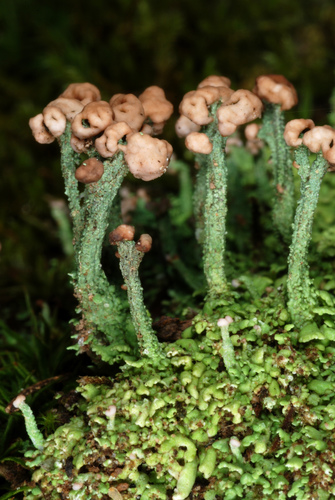
(c) Douglas Goldman, some rights reserved (CC BY-SA), uploaded by Douglas Goldman · cc-by-sa
Mitrula
Sign in to saveMitrula is a genus of fungi in the family Sclerotiniaceae first described by Elias Magnus Fries, in his Systema Mycologicum (1821).
Species
turban cup lichen
Genus
- PhylumAscomycota
- ClassLeotiomycetes
- OrderHelotiales
- FamilySclerotiniaceae
Mitrula es un género de hongos en la familia Sclerotiniaceae.[1] Se le suele denominar "faro de pantano" en referencia a su estípite blanca coronada por un esporocarpo amarillo. El género se caracteriza por crecer en vegetación en descomposición en aguas poco profundas.[2] Referencias ↑ Lumbsch TH, Huhndorf SM. (December 2007). «Outline of Ascomycota – 2007». Myconet (Chicago, USA: The Field Museum, Department of Botany) 13: 1-58. ↑ Redhead, Scott A. (1977). «The genus Mitrula in North America». Canadian Journal of Botany 55: 307-325. doi:10.1139/b77-042. Datos: Q6882948 Multimedia:
via
Museum specimens
- Specimen records
- 105
- With media
- 52
- Family
- Helotiaceae
- Collections
- NCU, CUP, BPI, NY, LSUM, MEL
- Recorded in
- United States, Peru, Canada, Australia, Sweden
Wikidata facts
- Instance of
- taxon
- Parent taxon
- Sclerotiniaceae
- Image
- Mitrula paludosa - Lindsey.jpg
Show 6 more facts
- taxon name
- Mitrula
- taxon rank
- genus
- Commons category
- Mitrula
- topic's main category
- Category:Mitrula
- taxonomic type
- Mitrula paludosa
- taxon author citation
- Fr.
Sources (2)
via Wikidata · CC0
~2 min read
Encyclopedic overview
1 sectionsContents
- References
Mitrula is a genus of fungi in the family Sclerotiniaceae first described by Elias Magnus Fries, in his Systema Mycologicum (1821).
The common name for the matchstick-like fungus is either swamp beacon (US) or bog beacon (GB) refers to the white stipe with yellow fruiting cap. The genus is notable for growing on decaying vegetation in shallow water.
Excerpted from Wikipedia’s “Mitrula” article, available under the CC BY-SA 4.0 licence.