Don E. Wilson;Russell A. Mittermeier
Moschidae
Sign in to saveAlso known as Musk deers
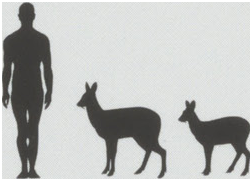
Moschidae is a family of pecoran even-toed ungulates, containing the musk deer (Moschus) and its extinct relatives. They are characterized by long "saber teeth" instead of horns, antlers or ossicones, modest size (Moschus only reaches ; other taxa were even smaller) and a lack of facial glands. While various Oligocene and Miocene pecorans were previously assigned to this family, recent studies find that most should be assigned to their own clades, although further research would need to confirm these traits. As a result, Micromeryx, Hispanomeryx, and Moschus are the only undisputed moschid mem
OverviewAI-generated
Moschidae is a family of mammals within the order Artiodactyla. It belongs to the class Mammalia, phylum Chordata, and kingdom Animalia. The family is part of the superfamily Cervoidea, with Moschus serving as its taxonomic type. This taxon was described in the source Gujin Tushu Jicheng.
Records for this family are held by institutions such as UF, with occurrences documented in Panama and the United States. The subject is associated with 3,721 occurrence records and 173 specific records.
Synthesized by Vinony from 22 facts across 5 sources: Wikidata, GBIF, Gbif Occ, iDigBio, Vinony graph. Generated from structured data (not the Wikipedia text) and checked against those facts — may still contain errors.
Species
FAMILY
- KingdomAnimalia
- PhylumChordata
- ClassMammalia
- OrderArtiodactyla
- FamilyMoschidae
As quatro espécies de cervo-almiscarado que formam a família Moschidae são mais primitivas que os cervos verdadeiros. Os mosquídeos, como também são chamados, não possuem galhadas ou glândulas faciais. Têm apenas um par de mamas. Apresentam vesícula biliar e uma glândula caudal que produz o almíscar. Família moschidae Subfamília Moschinae Pomelomeryx † Pomelomeryx gracilis † - Mioceno Inferior (MN2), St-Gérand-le-Puy, França Pomelomeryx boulangeri † - Mioceno Inferior (MN2), St-Gérand-le-Puy, França Hydropotopsis † Hydropotopsis lemanensis † - Mioceno Inferior (MN2), St-Gérand-le-Puy, França Amphitragulus † Amphitragulus elegans † - Mioceno Inferior (MN2), St-Gérand-le-Puy, França Dremotherium † Dremotherium cetinensis † - Mioceno Inferior, Cetina de Aragón, Espanha Dremotherium feignouxi † - Mioceno Inferior (MN2), St-Gérand-le-Puy, França Blastomeryx † Hispanomeryx † Longirostromeryx † Machaeromeryx † Micromeryx † Moschus Cervo-almiscarado-himalaio, Moschus chrysogaster Cervo-almiscarado-siberiano, Moschus moschiferus Cervo-almiscarado-anão, Moschus brezovskii Cervo-almiscarado-preto, Moschus fuscus Subfamília Hydropotinae Gênero Hydropotes Hydropotes inermis Bibliografia Costeur
via GBIF
Museum specimens
- Specimen records
- 173
- Family
- Moschidae
- Collections
- UF
- Recorded in
- Panama, United States
Wikidata facts
Show 6 more facts
- Commons category
- Moschidae
- taxon name
- Moschidae
- taxon rank
- family
- topic's main category
- Category:Musk deer
- described by source
- Gujin Tushu Jicheng
- taxonomic type
- Moschus
Sources (2)
via Wikidata · CC0
~2 min read
Encyclopedic overview
2 sectionsContents
- Taxonomy and classification
- References
Moschidae is a family of pecoran even-toed ungulates, containing the musk deer (Moschus) and its extinct relatives. They are characterized by long "saber teeth" instead of horns, antlers or ossicones, modest size (Moschus only reaches ; other taxa were even smaller) and a lack of facial glands. While various Oligocene and Miocene pecorans were previously assigned to this family, recent studies find that most should be assigned to their own clades, although further research would need to confirm these traits. As a result, Micromeryx, Hispanomeryx, and Moschus are the only undisputed moschid members, making them known from at least 18 Ma. The group was abundant across Eurasia and North America during the Miocene, but afterwards declined to only the extant genus Moschus by the early Pleistocene.
==Taxonomy and classification== Until the early 21st century, it was believed that the musk deer (family Moschidae) were an adjacent, sister-group to the "true deer" of the family Cervidae (caribou, moose, elk, and roughly 40–50 other species); however, a 2003 phylogenetic study by Alexandre Hassanin (of the National Museum of Natural History, France) and co., based on mitochondrial and nuclear analyses, revealed that Moschidae and Bovidae (antelope, cattle, goats, sheep), together, form a sister-clade to Cervidae. According to the study, the Cervidae diverged from the Bovidae-Moschidae clade roughly 27–28 million years ago. The following cladogram is based on this 2003 study:
Excerpted from Wikipedia’s “Moschidae” article, available under the CC BY-SA 4.0 licence.