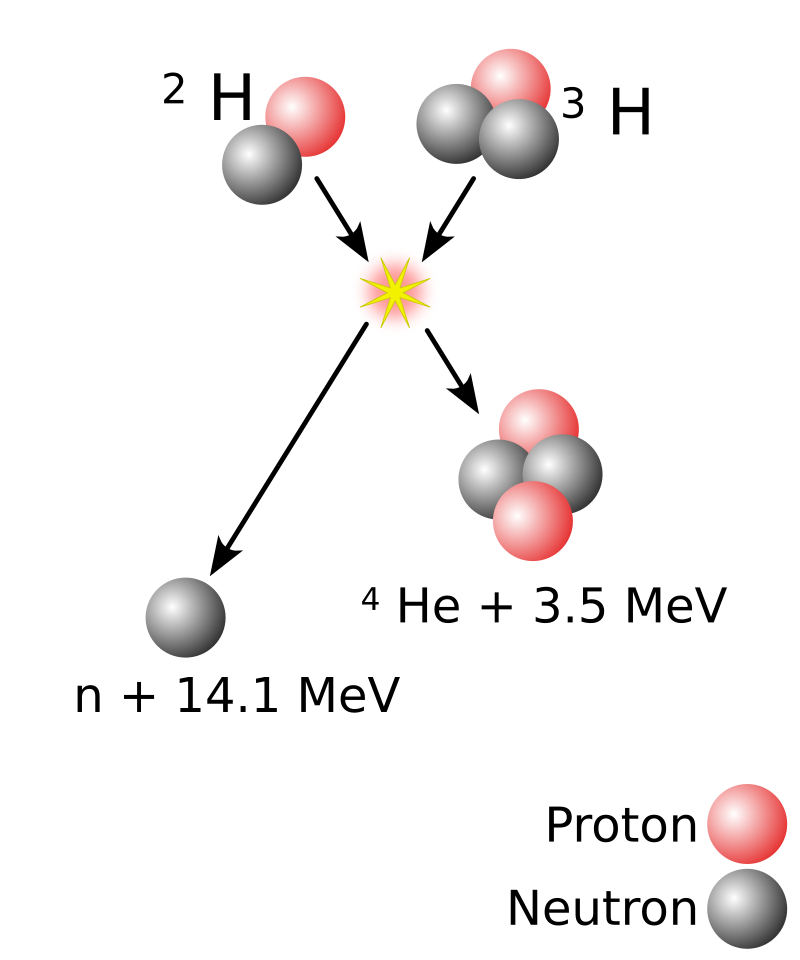
File:Deuterium-tritium_fusion.svg · Wikimedia Commons · See Wikimedia Commons
moscovium
Sign in to saveAlso known as Mc, eka-bismuth, element 115, ununpentium, Uup
Moscovium is a synthetic chemical element; it has symbol Mc and atomic number 115. It was first synthesized in 2003 by a joint team of Russian and American scientists at the Joint Institute for Nuclear Research (JINR) in Dubna, Russia. In December 2015, it was recognized as one of four new elements by the Joint Working Party of international scientific bodies IUPAC and IUPAP. On 28 November 2016, it was officially named after the Moscow Oblast, in which the JINR is situated.
Moscovium is a synthetic element (symbol Mc, atomic number 115) that was first created in 2003 by Russian and American scientists and officially named in 2016 after the Moscow region where it was discovered. Because moscovium is artificially created and exists only in laboratories, it helps scientists understand the structure of matter and the limits of the periodic table, though it has no practical applications in everyday life.
AI-generated from the Wikipedia summary — may contain errors.
Wikidata facts
- Instance of
- synthetic element
- Part of
- group 15
- Named after
- Moscow Oblast
Show 11 more facts
- discoverer or inventor
- Joint Institute for Nuclear Research
- time of discovery or invention
- 2003-08-00
- element symbol
- Uup
- topic's main category
- Category:Moscovium
- atomic number
- 115
- location of discovery
- Joint Institute for Nuclear Research
- Commons gallery
- Moscovium
- Commons category
- Moscovium
- Unicode character
- 鏌
- different from
- Moscovian
- on focus list of Wikimedia project
- Wikipedia:Vital articles/Level/4
via Wikidata · CC0
~22 min read
Encyclopedic overview
16 sectionsContents
- Introduction
- History
- Discovery
- Road to confirmation
- Naming
- Other routes of synthesis
- Predicted properties
- Nuclear stability and isotopes
- Physical and atomic
- Chemical
- Experimental chemistry
- See also
- Notes
- References
- Bibliography
- External links
Moscovium is a synthetic chemical element; it has symbol Mc and atomic number 115. It was first synthesized in 2003 by a joint team of Russian and American scientists at the Joint Institute for Nuclear Research (JINR) in Dubna, Russia. In December 2015, it was recognized as one of four new elements by the Joint Working Party of international scientific bodies IUPAC and IUPAP. On 28 November 2016, it was officially named after the Moscow Oblast, in which the JINR is situated.
Moscovium is an extremely radioactive element: its most stable known isotope, moscovium-290, has a half-life of only 0.65 seconds. In the periodic table, it is a p-block transactinide element. It is a member of the 7th period and is placed in group 15 as the heaviest pnictogen. Moscovium is calculated to have some properties similar to its lighter homologues, nitrogen, phosphorus, arsenic, antimony, and bismuth, and to be a post-transition metal, although it should also show several major differences from them. In particular, moscovium should also have significant similarities to thallium, as both have one rather loosely bound electron outside a quasi-closed shell. Chemical experimentation on single atoms has confirmed theoretical expectations that moscovium is less reactive than its lighter homologue bismuth. Over a hundred atoms of moscovium have been observed to date, all of which have been shown to have mass numbers from 286 to 290.
Excerpted from Wikipedia’s “moscovium” article, available under the CC BY-SA 4.0 licence.
Gallery (8)
Available in 127 languages
- Español
- Français
- Deutsch
- 中文
- 日本語
- Русский
- Português
- Italiano
- العربية
- हिन्दी
- Afrikaans
- Albanian
- Amharic
- Angika
- Aragonese
- Armenian
- Asturian
- Azerbaijani
Show 108 more
- Bahasa Indonesia
- Balinese
- Bangla
- Bashkir
- Basque
- be_x_old
- Belarusian
- Bhojpuri
- Bosnian
- Breton
- Bulgarian
- Burmese
- Catalan
- cdo
- Cebuano
- Central Kurdish
- Chuvash
- Cornish
- Corsican
- Croatian
- Czech
- Danish
- Egyptian Arabic
- Erzya
- Esperanto
- Estonian
- Faroese
- Fiji Hindi
- Filipino
- Finnish
- Friulian
- Galician
- Georgian
- Greek
- Hakka Chinese
- Hebrew
- Hungarian
- Icelandic
- Ido
- Interlingua
- Irish
- Javanese
- Kalmyk
- Kannada
- Kazakh
- kbp
- Komi
- Kurdish
- Latin
- Latvian
- Ligurian
- Limburgish
- Lithuanian
- Low German
- Luxembourgish
- Macedonian
- Malay
- Malayalam
- Manx
- Marathi
- Mongolian
- Nederlands
- Northern Frisian
- Norwegian
- Norwegian Nynorsk
- Novial
- Occitan
- Ossetic
- Pashto
- Polski
- Quechua
- roa_rup
- Romanian
- Sardinian
- Scottish Gaelic
- Serbian
- Serbian (Latin)
- Sicilian
- simple
- Slovak
- Slovenian
- Somali
- Svenska
- Swahili
- Tajik
- Tamil
- Tatar
- Telugu
- Tiếng Việt
- Türkçe
- Ukrainian
- Urdu
- Uyghur
- Uzbek
- Veps
- Volapük
- Waray
- Welsh
- Western Mari
- Wu Chinese
- Yoruba
- zh_classical
- zh_min_nan
- zh_yue
- Zulu
- فارسی
- ไทย
- 한국어
via Wikidata sitelinks · CC0