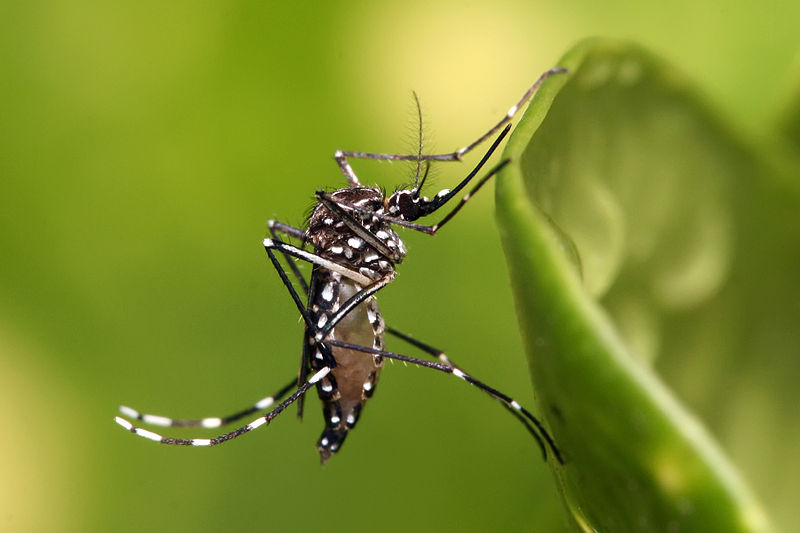
File:Aedes_aegypti.jpg · Wikimedia Commons · See Wikimedia Commons
Mosquito
Sign in to saveAlso known as mosquitoes, mosquito family, Culicidae
Mosquitoes, the Culicidae, are a family of small flies consisting of 3,600 species. The word mosquito (formed by mosca and diminutive -ito) is Spanish and Portuguese for little fly. Mosquitoes have a slender, segmented body, one pair of wings, three pairs of long hair-like legs, and specialized, highly elongated, piercing-sucking mouthparts. All mosquitoes drink nectar from flowers; females of many species have adapted to also drink blood. The group diversified during the Cretaceous period. Evolutionary biologists view mosquitoes as micropredators, small animals that parasitise larger ones by
OverviewAI-generated
Culicidae is a family within the taxon Culicidae, classified as a family under the parent taxon Culicoidea and the subclass Animalia. The taxon is an instance of a taxon and is also recognized in the order Diptera, class Insecta, and phylum Arthropoda. Common names for this group include mosquitoes, steekmuggen, moustiques, and mosquitos. The family is described in sources such as the Brockhaus and Efron Encyclopedic Dictionary, Gujin Tushu Jicheng, and the Encyclopædia Britannica 11th edition.
The habitat of Culicidae includes marine, brackish, and freshwater environments. The status of the family is accepted. The topic has a start time of about 99 million years ago. It is referenced by 2,256 other encyclopedia articles and has a PubMed count of 78954 for the query "Mosquito." The Unicode character 🦟 represents the subject.
Synthesized by Vinony from 25 facts across 4 sources: Wikidata, PubMed, WoRMS, Vinony graph. Generated from structured data (not the Wikipedia text) and checked against those facts — may still contain errors.
Species
mosquitos
Family
- PhylumArthropoda
- ClassInsecta
- OrderDiptera
- FamilyCulicidae
蚊科(学名:Culicidae)是昆蟲綱雙翅目之下的一個科。該科生物通常被稱為蚊或蚊子,是一種具有刺吸式口器的纖小飛蟲。绝大多数蚊子中,雄蚊以植物汁液为食,雌蚊则外寄生于人体表面,使用刺吸式口器刺穿宿主的皮肤以吸取血液。其宿主成千上万,主要为脊椎动物,如哺乳动物、鸟类、爬行动物、两栖动物、鱼类等。有些种类的蚊子还会寄生于节肢动物。吸食血液对宿主一般不会有太大影响,但在吸食过程中,蚊子的唾液会使宿主出现皮疹等症状。蚊子是许多种疾病的传播媒介,蚊子会以吸食血液的方式,将疾病从一个宿主体内传播到另一个宿主体内,登革熱、瘧疾、黃熱病、寨卡病毒、絲蟲病(英语:Filariasis)、日本腦炎、西尼罗河病毒、基孔肯雅热等虫媒病毒(英语:arbovirus)可以通过这种方式快速传播,因此,蚊子被蚊蟲控制協會(英文:Mosquito Control Association)評為世界上最危險的動物之一。目前除南極洲外,各大洲皆有蚊子的廣泛分布。
via
Research
78,954 papers- Arbovirus lifecycle in mosquito: acquisition, propagation and transmission.ReviewExpert reviews in molecular medicine · 2019Wu P, Yu X, Wang P et al.DOI: 10.1017/erm.2018.6
- When Is a Plasmodium-Infected Mosquito an Infectious Mosquito?ReviewTrends in parasitology · 2020Graumans W, Jacobs E, Bousema T et al.DOI: 10.1016/j.pt.2020.05.011
- Mosquito antiviral defense mechanisms: a delicate balance between innate immunity and persistent viral infection.ReviewParasites & vectors · 2019Lee WS, Webster JA, Madzokere ET et al.DOI: 10.1186/s13071-019-3433-8
- Mosquito immune defenses against Plasmodium infection.ReviewDevelopmental and comparative immunology · 2010Cirimotich CM, Dong Y, Garver LS et al.DOI: 10.1016/j.dci.2009.12.005
- Mosquito-borne pathogens … Now Rickettsias?Revista Argentina de microbiologia · 2025Goenaga S, Boaglio ER, Martinez LV et al.DOI: 10.1016/j.ram.2025.03.002
- Dissecting vectorial capacity for mosquito-borne viruses.ReviewCurrent opinion in virology · 2015Kramer LD, Ciota ATDOI: 10.1016/j.coviro.2015.10.003
- Surfactants alter mosquito's flight and physical condition.Scientific reports · 2023Kato-Namba A, Iida T, Ohta K et al.DOI: 10.1038/s41598-023-29455-6
- The chemosensory world of mosquitoes: olfactory receptors and their role in blocking mosquito-borne disease transmission.ReviewParasites & vectors · 2025Xiong S, Liang J, Gao S et al.DOI: 10.1186/s13071-025-06954-1
via PubMed
Wikidata facts
- Instance of
- taxon
- Parent taxon
- Culicomorpha
- Image
- Mosquito on human skin.jpg
Show 10 more facts
- Commons category
- Culicidae
- taxon name
- Culicidae
- taxon rank
- family
- topic's main category
- Category:Culicidae
- Commons gallery
- Culicidae
- taxon common name
- komarji
- permanent duplicated item
- mosquito
- on focus list of Wikimedia project
- Wikipedia:Vital articles/Level/4
- Unicode character
- 🦟
- start time
- 99000000-0
via Wikidata · CC0
~31 min read
Encyclopedic overview
37 sectionsContents
- Description and life cycle
- Adult
- Eggs
- Larva
- Pupa
- Feeding by adults
- Diet
- Host animals
- Finding hosts
- Mouthparts
- Saliva
- Egg development and blood digestion
- Distribution
- Cosmopolitan
- Effect of climate change
- Ecology
- Predators and parasites
- Pollination
- Parasitism
- Evolution
- Fossil record
- Taxonomy
- Phylogeny
- External
- Internal
- Interactions with humans
- Vectors of disease
- Control
- Repellents
- Bites
- In human culture
- Greek mythology
- Origin myths
- Modern era
- References
- Further reading
- External links
Mosquitoes, the Culicidae, are a family of small flies consisting of 3,600 species. The word mosquito (formed by mosca and diminutive -ito) is Spanish and Portuguese for little fly. Mosquitoes have a slender, segmented body, one pair of wings, three pairs of long hair-like legs, and specialized, highly elongated, piercing-sucking mouthparts. All mosquitoes drink nectar from flowers; females of many species have adapted to also drink blood. The group diversified during the Cretaceous period. Evolutionary biologists view mosquitoes as micropredators, small animals that parasitise larger ones by drinking their blood without immediately killing them. Medical parasitologists view mosquitoes as vectors of disease, carrying protozoan parasites or bacterial or viral pathogens from one host to another.
The mosquito lifecycle consists of four stages: egg, larva, pupa, and adult. Eggs are laid on the water surface; they hatch into motile larvae that feed on aquatic algae and organic material. These larvae are important food sources for many freshwater animals, such as dragonfly nymphs, many fish, and some birds. Adult females of many species have mouthparts adapted to pierce the skin of a host and feed on blood of a wide range of vertebrate hosts, and some invertebrates, primarily other arthropods. Some species only produce eggs after a blood meal.
Excerpted from Wikipedia’s “Mosquito” article, available under the CC BY-SA 4.0 licence.
Gallery (53)
Available in 170 languages
- Español
- Français
- Deutsch
- 中文
- 日本語
- Русский
- Português
- Italiano
- العربية
- हिन्दी
- Afrikaans
- Albanian
- Albanian
- Amharic
- Aragonese
- Aramaic
- Armenian
- Assamese
Show 151 more
- Asturian
- Atikamekw
- Aymara
- azb
- Azerbaijani
- Bahasa Indonesia
- Balinese
- Bangla
- Banjar
- Bashkir
- Basque
- bat_smg
- Bavarian
- be_x_old
- Belarusian
- Bhojpuri
- Bikol
- Bosnian
- Breton
- Bulgarian
- Buriat
- Burmese
- Catalan
- cdo
- Cebuano
- Central Dusun
- Central Kurdish
- Chechen
- Chuvash
- Cornish
- Croatian
- Czech
- dag
- Danish
- Egyptian Arabic
- eml
- Esperanto
- Estonian
- Fiji Hindi
- Filipino
- Finnish
- Galician
- Georgian
- Gorontalo
- Greek
- Guarani
- Hakka Chinese
- Hausa
- Hebrew
- Hungarian
- Icelandic
- Ido
- Iloko
- Ingush
- Interlingua
- Inupiaq
- Irish
- Javanese
- Kabyle
- Kannada
- Kanuri
- Kashmiri
- Kashubian
- Kazakh
- kge
- Kinyarwanda
- Komi
- Kongo
- Kurdish
- Kyrgyz
- Lao
- Latin
- Latvian
- Lingala
- Lithuanian
- Low German
- Luxembourgish
- Macedonian
- Madurese
- Malagasy
- Malay
- Malayalam
- Manipuri
- Marathi
- Mari
- Mazanderani
- Moroccan Arabic
- Navajo
- Nederlands
- Nepali
- Northern Frisian
- Norwegian
- Norwegian Nynorsk
- Obolo
- Occitan
- olo
- Ossetic
- Palatine German
- Pampanga
- Pennsylvania German
- Polski
- Punjabi
- Quechua
- Romanian
- Santali
- Sardinian
- Scots
- Serbian
- Serbian (Latin)
- Shona
- Silesian
- simple
- Sindhi
- Sinhala
- Slovak
- Slovenian
- Somali
- Sundanese
- Svenska
- syl
- szy
- Tajik
- Tamil
- Tatar
- tay
- tdd
- Telugu
- Tiếng Việt
- Tulu
- Tumbuka
- Türkçe
- Tuvinian
- Ukrainian
- Urdu
- Uzbek
- Venetian
- Veps
- Walloon
- Waray
- Welsh
- Western Panjabi
- Wu Chinese
- Yakut
- Yiddish
- Yoruba
- zh_min_nan
- zh_yue
- Zhuang
- فارسی
- ไทย
- 한국어
via Wikidata sitelinks · CC0