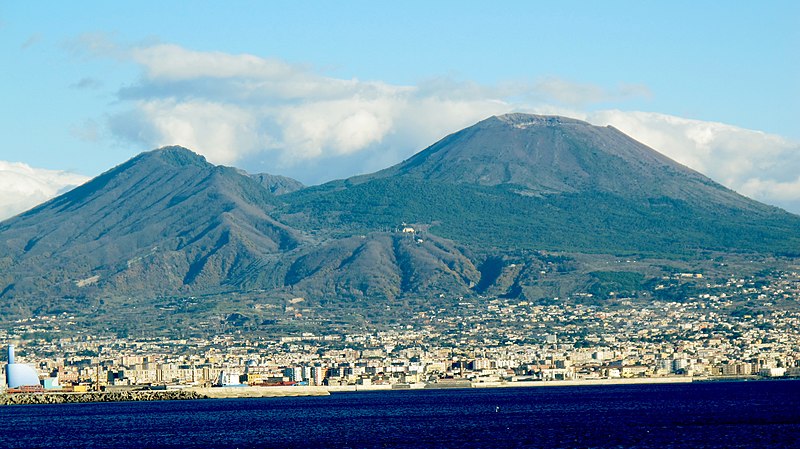
File:Il_cratere_del_Vulcano_-_panoramio.jpg · Wikimedia Commons · See Wikimedia Commons
Mount Vesuvius
Sign in to saveAlso known as Vesuvius
active stratovolcano in the Gulf of Naples, Italy
Mount Vesuvius is an active volcano located near Naples, Italy, in the Gulf of Naples. It matters because it is a stratovolcano—a type of volcano known for powerful eruptions—and remains active today, making it a significant natural hazard for the millions of people living in the densely populated region around it.
AI-generated from the Wikipedia summary — may contain errors.
Wikidata facts
- Instance of
- mountain
- Country
- Italy
- Located in
- Province of Naples
- Elevation
- 1297
- Material used
- tephrite
- Image
- Il cratere del Vulcano - panoramio.jpg
- Significant event
- eruption of Mount Vesuvius in 1944
Show 9 more facts
- Commons category
- Mount Vesuvius
- Commons gallery
- Vesuvio
- topic's main category
- Category:Mount Vesuvius
- native label
- Monte Vesuvio
- volcano observatory
- Vesuvius Observatory
- located in protected area
- Vesuvius National Park
- topographic prominence
- 1232
- on focus list of Wikimedia project
- Wikipedia:Vital articles/Level/4
- P12749
- Catalpa speciosa
Sources (3)
via Wikidata · CC0
~38 min read
Encyclopedic overview
Mount Vesuvius (/vəˈsuːviəs/ və-SOO-vee-əs) is a somma–stratovolcano located on the Gulf of Naples in Campania, Italy, about 9 km (5.6 mi) east of Naples and a short distance from the shore. It is one of several volcanoes forming the Campanian volcanic arc. Vesuvius consists of a large cone partially encircled by the steep rim of a summit caldera, resulting from the collapse of an earlier, much higher structure.
The eruption of Mount Vesuvius in 79 AD destroyed the Roman cities of Pompeii, Herculaneum, Oplontis, Stabiae and other settlements. The eruption ejected a cloud of stones, ash and volcanic gases to a height of 33 km (21 mi), erupting molten rock and pulverized pumice at the rate of 6×10 cubic metres (7.8×10 yd) per second. More than 1,000 people are thought to have died in the eruption, though the exact toll is unknown. The only surviving witness account consists of two letters by Pliny the Younger to the historian Tacitus.
Excerpted from Wikipedia’s “Mount Vesuvius” article, available under the CC BY-SA 4.0 licence.
Gallery (12)
On the map
Available in 123 languages
- Español
- Français
- Deutsch
- 中文
- 日本語
- Русский
- Português
- Italiano
- العربية
- हिन्दी
- Afrikaans
- Albanian
- Amharic
- Aragonese
- Armenian
- Arpitan
- Asturian
- Azerbaijani
Show 104 more
- Bahasa Indonesia
- Balinese
- Bangla
- Bashkir
- Basque
- be_x_old
- Belarusian
- Betawi
- Bhojpuri
- Bikol
- Bosnian
- Breton
- Bulgarian
- Burmese
- Catalan
- Cebuano
- Chuvash
- Colognian
- Croatian
- Czech
- Danish
- Esperanto
- Estonian
- Faroese
- Filipino
- Finnish
- Friulian
- Galician
- Georgian
- Greek
- Hebrew
- Hungarian
- hyw
- Icelandic
- Ido
- Interlingua
- Irish
- Javanese
- Kazakh
- Kyrgyz
- Lao
- Latin
- Latvian
- Limburgish
- Lithuanian
- Lombard
- Luxembourgish
- Macedonian
- Malagasy
- Malay
- Malayalam
- Maltese
- Marathi
- Mari
- Mingrelian
- Mongolian
- Moroccan Arabic
- nds_nl
- Neapolitan
- Nederlands
- Nepali
- Norwegian
- Norwegian Nynorsk
- nrm
- Occitan
- Old English
- Pampanga
- Picard
- Polski
- Romanian
- Romansh
- Sardinian
- Scots
- Serbian
- Serbian (Latin)
- Sicilian
- simple
- skr
- Slovak
- Slovenian
- Svenska
- Swahili
- Tajik
- Tamil
- Telugu
- Tibetan
- Tiếng Việt
- Toki Pona
- Türkçe
- Ukrainian
- Urdu
- Uyghur
- Uzbek
- Venetian
- Waray
- Welsh
- Western Frisian
- Western Panjabi
- Wu Chinese
- Yiddish
- zh_yue
- فارسی
- ไทย
- 한국어
via Wikidata sitelinks · CC0