File:Multiplexer2.svg · Wikimedia Commons · See Wikimedia Commons
multiplexer
Sign in to saveAlso known as mux, data selector
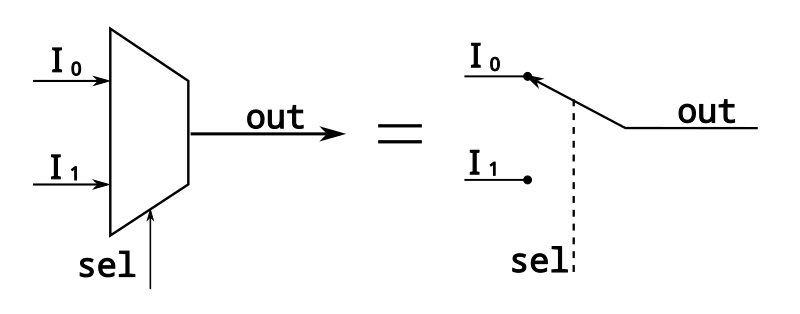
thumb|300px|Schematic of a 2-to-1 multiplexer. It can be equated to a controlled switch. thumb|270px|Schematic of a 1-to-2 demultiplexer. Like a multiplexer, it can be equated to a controlled switch.
Wikidata facts
- Subclass of
- electronic circuit
Show 1 more fact
- Commons category
- Multiplexers
Sources (3)
via Wikidata · CC0
~12 min read
Encyclopedic overview
13 sectionsContents
- Applications
- Digital multiplexers
- Chaining multiplexers and mux trees
- List of ICs which provide multiplexing
- Digital demultiplexers
- List of ICs which provide demultiplexing
- Bi-directional multiplexers
- Multiplexers as PLDs
- Unconventional use of multiplexers for arithmetic
- See also
- References
- Further reading
- External links
thumb|300px|Schematic of a 2-to-1 multiplexer. It can be equated to a controlled switch. thumb|270px|Schematic of a 1-to-2 demultiplexer. Like a multiplexer, it can be equated to a controlled switch.
In electronics, a multiplexer (or mux; spelled sometimes as multiplexor), also known as a data selector, is a device that selects between several analog or digital input signals and forwards the selected input to a single output line. The selection is directed by a separate set of digital inputs known as select lines. A multiplexer of 2^n inputs has n select lines, which are used to select which input line to send to the output.
Excerpted from Wikipedia’s “multiplexer” article, available under the CC BY-SA 4.0 licence.