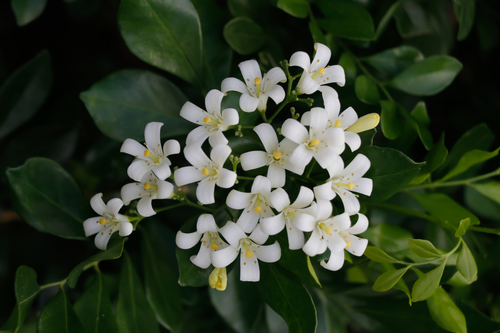
(c) jinze, some rights reserved (CC BY-NC), uploaded by jinze · cc-by-nc
Murraya
Sign in to saveMurraya () is a genus of flowering plants in the citrus family, Rutaceae. It is distributed in Asia, Australia, and the Pacific Islands. The center of diversity is in southern China and Southeast Asia. When broadly circumscribed, the genus has about 17 species. A narrower circumscription contains only eight species, others being placed in Bergera and Merrillia.
Species
Orange Jasmine
Genus
- PhylumTracheophyta
- ClassMagnoliopsida
- OrderSapindales
- FamilyRutaceae
General: and New Caledonia. Two species in New Guinea: Murraya crenulate
via · Kew POWO
Museum specimens
- Specimen records
- 182
- With media
- 123
- Family
- Rutaceae
- Collections
- INECOL, IBUNAM, MEL, F, MO, A
- Recorded in
- Mexico, India, Colombia, Vietnam, Honduras, Vanuatu, China, Australia
Research
634 papers- Murraya koenigii (L.) Spreng. as a Natural Intervention for Diabesity: A Review.Current pharmaceutical design · 2024
- Phytochemistry and Biological Activities of Murraya Species.Molecules (Basel, Switzerland) · 2023
- Multi-Target Approach of Murraya koenigii Leaves in Treating Neurodegenerative Diseases.Pharmaceuticals (Basel, Switzerland) · 2022
- A Brief Review on Murraya paniculata (Orange Jasmine): pharmacognosy, phytochemistry and ethanomedicinal uses.Journal of pharmacopuncture · 2023
- Diversity in Phytochemical Composition and Medicinal Value of Murraya paniculata.Chemistry & biodiversity · 2023
via PubMed
Wikidata facts
Show 7 more facts
- taxon rank
- genus
- Commons category
- Murraya
- topic's main category
- Category:Murraya
- taxon common name
- 九里香属
- has fruit type
- berry
- taxon name
- Murraya
via Wikidata · CC0
~5 min read
Encyclopedic overview
7 sectionsContents
- Description
- Taxonomy
- Species list
- Uses
- Chemistry
- Spelling competition
- References
Murraya () is a genus of flowering plants in the citrus family, Rutaceae. It is distributed in Asia, Australia, and the Pacific Islands. The center of diversity is in southern China and Southeast Asia. When broadly circumscribed, the genus has about 17 species. A narrower circumscription contains only eight species, others being placed in Bergera and Merrillia.
==Description== Plants in the genus Murraya are shrubs or trees with pinnate leaves arranged alternately, usually glandular, aromatic, and leathery to membranous in texture. The leaflets vary in shape and have smooth or toothed edges. The inflorescence is a panicle, cyme, or small raceme of flowers growing at the ends of branches or in the leaf axils; some flowers are solitary. The fragrant flowers have 4 or 5 sepals and white petals and up to 10 straight stamens. The fruit is a fleshy berry with pulp but without the juice vesicles present in some related fruits. It is up to long and orange, red, or black.
Excerpted from Wikipedia’s “Murraya” article, available under the CC BY-SA 4.0 licence.