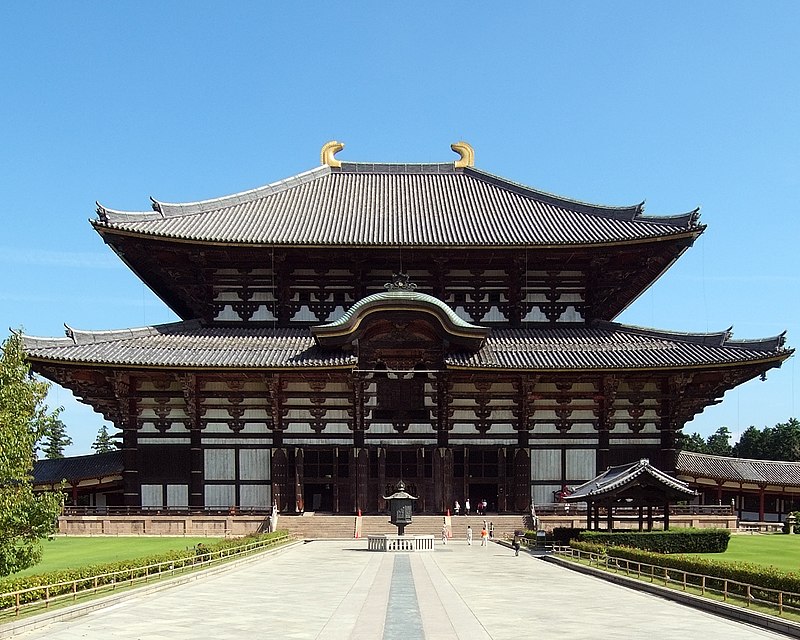
File:Tōdai-ji_Kon-dō.jpg · Wikimedia Commons · See Wikimedia Commons
Nara is a city in Nara prefecture, Japan, located near the country's ancient capital. It is known as a major cultural and historical site, home to significant temples, shrines, and deer parks that attract visitors interested in traditional Japanese heritage.
AI-generated from the Wikipedia summary — may contain errors.
Wikidata facts
- Official name
- 奈良町
- Country
- Japan
- Located in
- Soekami district
- Population
- 366591
- Area
- 276.84
- Time zone
- UTC+09:00
- Body of water
- Yamato River
- Capital of
- Nara Prefecture
- Shares border with
- Yamazoe
- Official website
- www.city.nara.lg.jp
- Image
- Sika deer in Nara 05.jpg
- Dialing code
- 742
- Significant event
- Siege of Nara
Show 19 more facts
- twinned administrative body
- Gyeongju
- Commons category
- Nara, Nara
- postal code
- 630-8580
- category for people born here
- Category:Births in Nara
- topic's main category
- Category:Nara, Nara
- Commons gallery
- 奈良市
- native label
- 奈良市
- category of associated people
- Category:People from Nara, Nara
- category for people who died here
- Category:Deaths in Nara
- name in kana
- ならし
- inception
- 1889-04-01
- owner of
- Nara Centennial Hall
- social media followers
- 13996
- official symbol
- Horornis diphone
- pseudonym
- 南都
- hashtag
- 奈良市
- associated electoral district
- Nara 2nd district
- P12749
- Al Swearengen
Sources (13)
via Wikidata · CC0
~21 min read
Encyclopedic overview
Nara (奈良市, Nara-shi; Japanese pronunciation: [naꜜ.ɾa, na.ɾaꜜ.ɕi] ) is the capital city of Nara Prefecture, Japan. As of 2022, Nara has an estimated population of 367,353 according to World Population Review, making it the largest city in Nara Prefecture and sixth-largest in the Kansai region of Honshu. Nara is a core city located in the northern part of Nara Prefecture bordering the Kyoto Prefecture.
Nara was the capital of Japan during the Nara period from 710 to 784 as the seat of the Emperor before the capital was moved to Nagaoka-kyō, except for the years 740 to 745, when the capital was placed in Kuni-kyō, Naniwa-kyō and Shigaraki Palace. Nara is home to eight major historic temples, shrines, and heritage sites, specifically Tōdai-ji, Saidai-ji, Kōfuku-ji, Kasuga Shrine, Gangō-ji, Yakushi-ji, Tōshōdai-ji, and the Heijō Palace, together with Kasugayama Primeval Forest, collectively form the Historic Monuments of Ancient Nara, a UNESCO World Heritage Site.
Excerpted from Wikipedia’s “Nara” article, available under the CC BY-SA 4.0 licence.
Gallery (12)
On the map
Available in 82 languages
- Español
- Français
- Deutsch
- 中文
- 日本語
- Русский
- Português
- Italiano
- العربية
- Afrikaans
- Aragonese
- Armenian
- azb
- Azerbaijani
- Bahasa Indonesia
- Balinese
- Bashkir
- Basque
Show 63 more
- Belarusian
- Bulgarian
- Catalan
- Cebuano
- Chechen
- Croatian
- Czech
- Egyptian Arabic
- Esperanto
- Estonian
- Filipino
- Finnish
- Galician
- Georgian
- Greek
- Hakka Chinese
- Hebrew
- Hungarian
- Ido
- Irish
- Kyrgyz
- Latin
- Latvian
- Lithuanian
- Macedonian
- Madurese
- Malay
- Mazanderani
- Minangkabau
- Mongolian
- Nederlands
- Norwegian
- Polski
- Romanian
- Sardinian
- Serbian
- Serbian (Latin)
- Silesian
- simple
- Sindhi
- Sinhala
- Slovak
- Slovenian
- Svenska
- Swahili
- Tajik
- Tatar
- Tiếng Việt
- Toki Pona
- Tumbuka
- Türkçe
- Ukrainian
- Urdu
- Uzbek
- Waray
- Welsh
- Wu Chinese
- zh_classical
- zh_min_nan
- zh_yue
- فارسی
- ไทย
- 한국어
via Wikidata sitelinks · CC0