File:Map-alexander-empire.png · Wikimedia Commons · See Wikimedia Commons
Nearchus
Sign in to saveAlso known as Nearchos
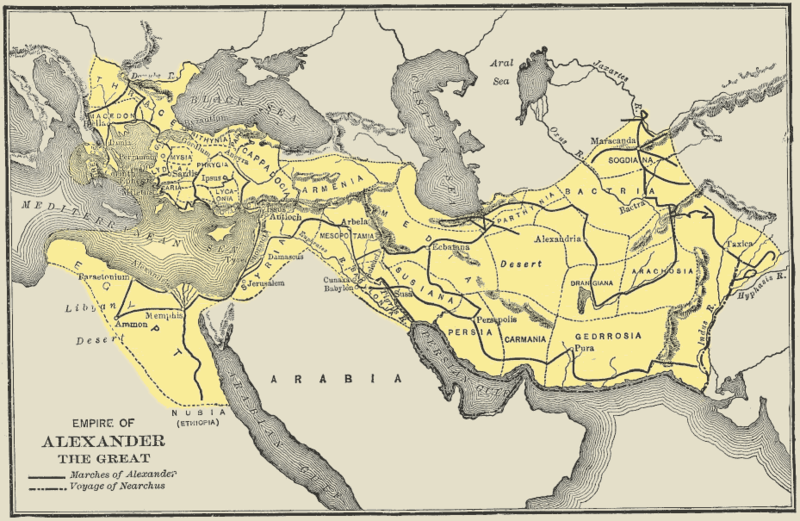
Nearchus or Nearchos (; – 300 BC) was one of the Greek officers, a navarch, in the army of Alexander the Great. He is known for his celebrated expeditionary voyage starting from the Indus River, through the Persian Gulf and ending at the mouth of the Tigris River following the Indian campaign of Alexander the Great, in 326–324 BC.
Person · Open Library
- Works
- 3
Top works
- From notes on passing events
- On the prevention of shipwrecks
- On the prevention of losses at sea
via Open Library + Wikidata
Wikidata facts
- Instance of
- human
- Gender
- male
- Citizenship
- Macedonia
- Place of birth
- Lato
- Occupation
- military personnel
- Position held
- strategos
- Languages spoken
- Ancient Greek
- Military branch
- Ancient Macedonian army
- Military rank
- admiral
- Image
- The wounded Alexander passing through his fleet in India by Andre Castaigne (1898-1899).jpg
Show 7 more facts
- date of birth
- 0356-01-01
- date of death
- 0300-01-01
- Commons category
- Nearchus
- described by source
- Pauly–Wissowa
- writing language
- Ancient Greek
- name in native language
- Νέαρχος
- relative
- Barsine
via Wikidata · CC0
~13 min read
Encyclopedic overview
9 sectionsContents
- Early life
- Conquests of Alexander the Great
- Indus River Voyage
- Persian Gulf Voyage
- Later life
- Legacy
- References
- Further reading
- External links
Nearchus or Nearchos (; – 300 BC) was one of the Greek officers, a navarch, in the army of Alexander the Great. He is known for his celebrated expeditionary voyage starting from the Indus River, through the Persian Gulf and ending at the mouth of the Tigris River following the Indian campaign of Alexander the Great, in 326–324 BC.
==Early life== A native of Lato in Crete and son of Androtimus, his family settled at Amphipolis in Macedonia at some point during Philip II's reign (we must assume after Philip took the city in 357 BC), at which point Nearchus was probably a young boy. He was almost certainly older than Alexander, as were Ptolemy, Erigyius, and the others of the ‘boyhood friends’; so depending on when Androtimus came to Macedonia Nearchus was quite possibly born in Crete. Nearchus, along with Ptolemy, Erigyius and Laomedon, and Harpalus, was one of Alexander's ‘mentors’ – and he was exiled by Philip as a result of the Pixodarus affair (A 3.6.5; P 10.3). It is not known where the exiles went, but they were recalled only after Philip's death, on Alexander's accession.
Excerpted from Wikipedia’s “Nearchus” article, available under the CC BY-SA 4.0 licence.