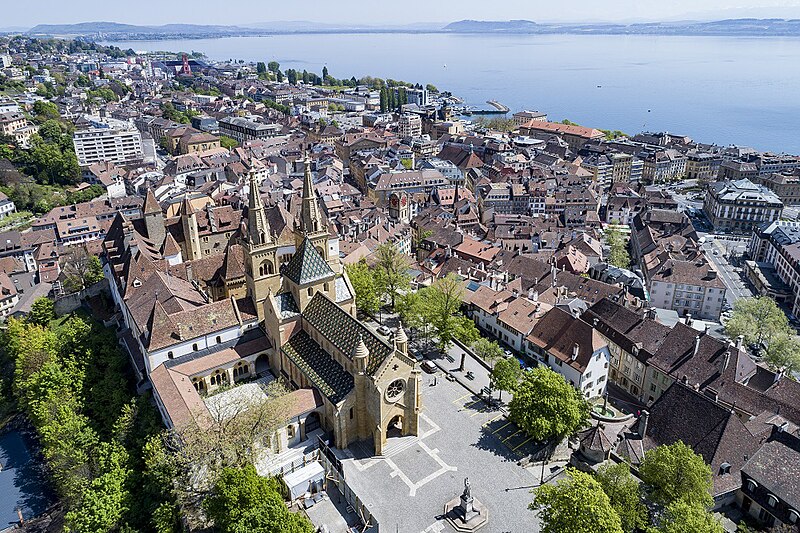
File:Vuevilledeneuchatel.jpg · Wikimedia Commons · See Wikimedia Commons
Neuchâtel
Sign in to saveAlso known as Neuchatel, Neuchâtel, NE, Neuenburg, Neuchatel, NE, Newcastle, Neuch'
Neuchâtel (, ; ; ) is a town, a municipality, and the capital of the Swiss canton of Neuchâtel on Lake Neuchâtel. Since the fusion in 2021 of the municipalities of Neuchâtel, Corcelles-Cormondrèche, Peseux, and Valangin, the city has approximately 45,000 inhabitants (86,000 in the metropolitan area). The city is sometimes referred to historically by the German name ; both the French and German names mean 'New Castle'.
Neuchâtel is a town and the capital of the Swiss canton of Neuchâtel, located on Lake Neuchâtel, with approximately 45,000 inhabitants following a 2021 municipal merger. The city's name, which means "New Castle" in both French and German, reflects its historical significance as a regional center in Switzerland.
AI-generated from the Wikipedia summary — may contain errors.
Key facts
- Swiss town.subject_name
- Neuchâtel
- Swiss town.image_photo
- Vuevilledeneuchatel.jpg
- Swiss town.municipality_type
- municipality and city
- Swiss town.imagepath_flag
- Neuchâtel-Commune.svg
- Swiss town.imagepath_coa
- Neuchatel city coat of arms.svg
- Swiss town.canton
- Neuchâtel
- Swiss town.iso code region
- CH-NE
- Swiss town.postal_code
- 2000
- Swiss town.municipality_code
- 6458
- Swiss town.area
- 18.05
- Swiss town.elevation
- 479
- Swiss town.elevation_description
- railway station
- Swiss town.highest
- Grand Chaumont
- Swiss town.highest_m
- 1177
- Swiss town.lowest
- Port
- Swiss town.lowest_m
- 434
- Swiss town.website
- neuchatelville.ch
- Swiss town.mayor
- Fabio Bongiovanni
via Wikipedia infobox
Wikidata facts
- Part of
- Romandy
- Has part
- Valangin
- Official name
- Neuchâtel
- Demonym
- Neocastellani
- Country
- Switzerland
- Located in
- Canton of Neuchâtel
- Official language
- French
- Population
- 45309
- Area
- 18.06
- Elevation
- 444
- Body of water
- Lake Neuchâtel
- Capital of
- Neuchâtel District
- Official website
- www.neuchatelville.ch
- Image
- Vuevilledeneuchatel.jpg
- Dialing code
- 032
- Licence plate code
- NE
Show 14 more facts
- category for people born here
- Category:Births in Neuchâtel
- category for people who died here
- Category:Deaths in Neuchâtel
- Commons category
- Neuchâtel
- twinned administrative body
- Sansepolcro
- topic's main category
- Category:Neuchâtel
- postal code
- 2000
- category of associated people
- Category:People from Neuchâtel
- Commons gallery
- Neuchâtel
- inception
- 1011-00-00
- owner of
- Stade de la Maladière
- external data available at URL
- geo.ld.admin.ch/boundaries/municipality/6458
- replaces
- Valangin
- located in the statistical territorial entity
- Littoral region
Sources (11)
via Wikidata · CC0
~43 min read
Encyclopedic overview
41 sectionsContents
- {{anchor|Names of Neuchâtel}}Names and etymology
- Historic names
- History
- Prehistory
- Antiquity
- Middle Ages
- Early modern era
- Modern Neuchâtel
- Geography
- Climate
- Politics
- Coat of arms
- Administrative divisions
- Government
- Parliament
- Elections
- National Council
- International relations
- Twin towns – Sister cities
- Namesakes
- Demographics
- Population
- Historical population
- Language
- Religion
- Crime
- Economy
- Education
- Transport
- Sights
- Heritage sites of national significance
- Architecture
- Museums
- Culture
- Sport
- Notable people
- See also
- Explanatory notes
- References
- Further reading
- External links
Neuchâtel (, ; ; ) is a town, a municipality, and the capital of the Swiss canton of Neuchâtel on Lake Neuchâtel. Since the fusion in 2021 of the municipalities of Neuchâtel, Corcelles-Cormondrèche, Peseux, and Valangin, the city has approximately 45,000 inhabitants (86,000 in the metropolitan area). The city is sometimes referred to historically by the German name ; both the French and German names mean 'New Castle'.
The castle after which the city is named was built by Rudolph III of Burgundy and completed in 1011. Originally part of the Kingdom of Burgundy, the city was absorbed into the Holy Roman Empire in 1033. The domain of the counts of Neuchâtel was first referred to as a city in 1214. The city came under Prussian control from 1707 until 1848, with an interruption during the Napoleonic Wars from 1806 to 1814. In 1848, Neuchâtel became a republic and a canton of Switzerland.
Excerpted from Wikipedia’s “Neuchâtel” article, available under the CC BY-SA 4.0 licence.
Gallery (38)
On the map
3 mapped locations
Available in 80 languages
- Español
- Français
- Deutsch
- 中文
- 日本語
- Русский
- Português
- Italiano
- العربية
- Albanian
- Albanian
- Armenian
- Arpitan
- azb
- Bahasa Indonesia
- Basque
- be_x_old
- Belarusian
Show 61 more
- Breton
- Bulgarian
- Catalan
- Cebuano
- Chechen
- Chuvash
- Corsican
- Croatian
- Czech
- Danish
- Egyptian Arabic
- Esperanto
- Estonian
- Finnish
- Galician
- Greek
- Hebrew
- Hungarian
- Icelandic
- Irish
- Kurdish
- Latin
- Latvian
- Lithuanian
- Lombard
- Luxembourgish
- Marathi
- Nederlands
- Northern Frisian
- Norwegian
- Norwegian Nynorsk
- Ossetic
- Piedmontese
- Polski
- Romanian
- Romansh
- Rusyn
- Scottish Gaelic
- Serbian
- Serbian (Latin)
- Sicilian
- Silesian
- simple
- Slovak
- Svenska
- Tatar
- Tiếng Việt
- Türkçe
- Ukrainian
- Urdu
- Venetian
- Volapük
- Waray
- Welsh
- West Flemish
- Western Panjabi
- Wu Chinese
- zh_min_nan
- فارسی
- ไทย
- 한국어
via Wikidata sitelinks · CC0