
Nigeria
Sign in to saveAlso known as Federal Republic of Nigeria, Naija
OverviewAI-generated
Nigeria, officially the Federal Republic of Nigeria, is a sovereign state and federal republic located in Western Africa. It shares borders with Benin, Niger, Chad, and Cameroon. The country’s capital is Abuja, and its highest point is Chappal Waddi. Nigeria is named after the Niger River and follows the Federation of Nigeria. Its official motto is "Unity and Faith, Peace and Progress," with translations including "Good people, great nation."
The population is approximately 223,800,000 to 232,679,478. The head of government and head of state holds the office of President of Nigeria, currently Bola Ahmed Tinubu. The country uses the telephone country code +234 and the top-level Internet domain .ng. Languages used include Mburku, Pa'a, Abureni, and Bete-Bendi. Nigeria maintains diplomatic relations with Brazil, Australia, Germany, and Israel.
Geographically, Nigeria covers an area of 923,768 square kilometers. It contains administrative entities such as Abia State, Adamawa State, Akwa Ibom State, and Anambra State. The nation operates in the UTC+01:00 time zone, also known as West Africa Time. The emergency phone number is 112, and the marriageable age is 18.
Synthesized by Vinony from 68 facts across 9 sources: Wikidata, Openweathermap, Open Meteo, REST Countries, World Bank, OpenStreetMap, PubMed, Vinony graph, Geo. Generated from structured data (not the Wikipedia text) and checked against those facts — may still contain errors.
Weather now
cached 129h ago7-day forecast
via Open-Meteo
Country

- Capital
- Abuja
- Population
- 223,800,000
- Region
- Africa · Western Africa
- Demonym
- Nigerian
- Currencies
- NGN (₦)
- Languages
- English
- Calling code
- +234
- Drives on
- Right
- Gini
- 35.1 (2018)
- FIFA code
- NGA
- TLD
- .ng
- Timezones
- UTC+01:00
- Borders
- BEN, CMR, TCD, NER
via REST Countries
Indicators · World Bank
- GDP
- $252.3B(2024)
- Population
- 232,679,478(2024)
- Life expectancy
- 54.6 yrs(2024)
- Unemployment
- 3.1 %(2025)
- Urban population
- 63 %(2024)
- Internet users
- 41.2 %(2024)
- Forest area
- 23.2 %(2023)
- Renewable energy
- 80.3 %(2021)
via World Bank Open Data · CC BY 4.0
Wikipedia views (30d)
225,100 totalvia Wikimedia Pageviews API
Key facts
- Country.conventional_long_name
- Federal Republic of Nigeria
- Country.common_name
- Nigeria
- Country.image_flag
- Flag of Nigeria.svg
- Country.flag_size
- 130
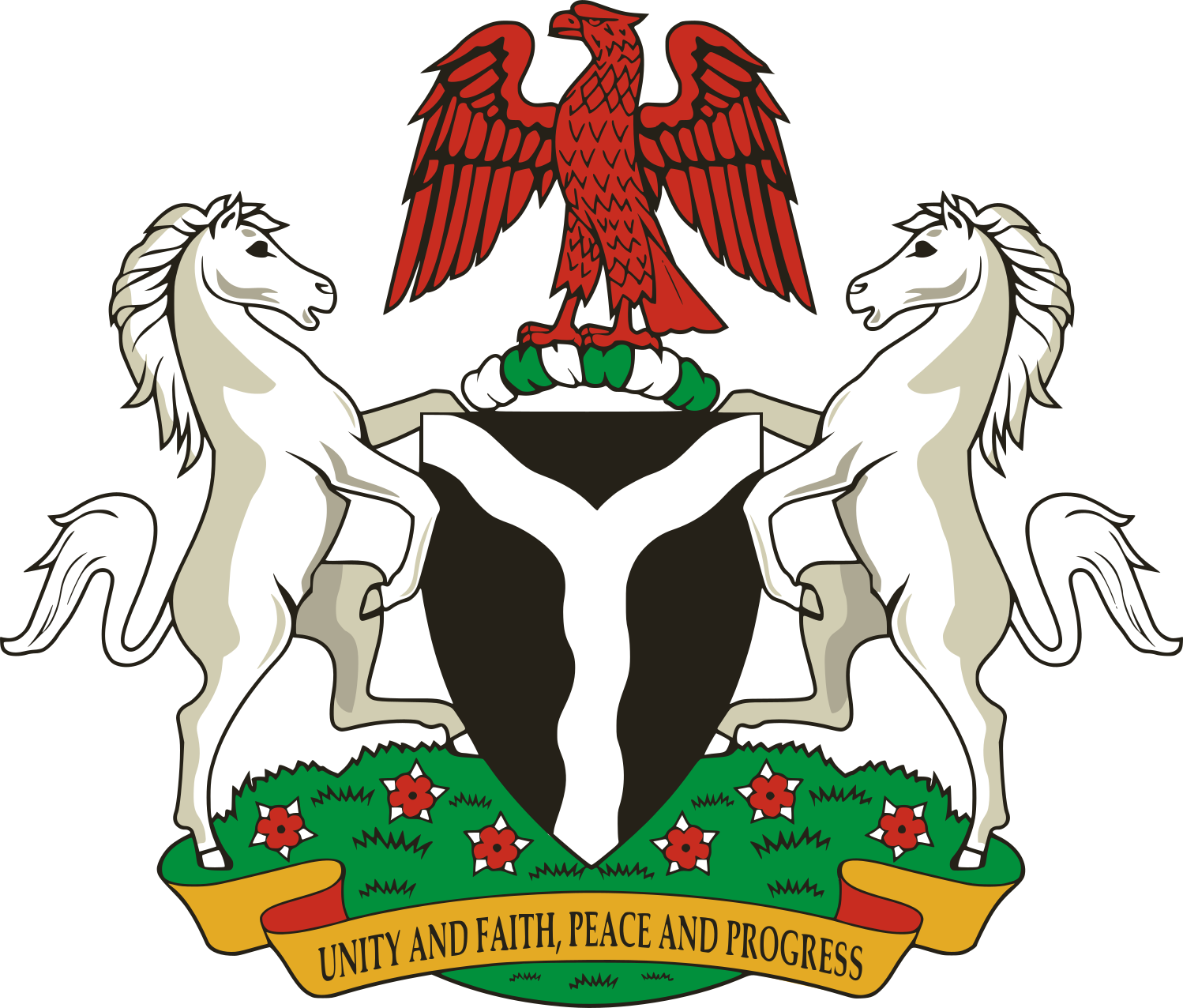
- Country.image_coat
- Coat of arms of Nigeria.svg
- Country.coa_size
- 90
- Country.national_motto
- "Unity and Faith, Peace and Progress"
- Country.national_anthem
- "Nigeria, We Hail Thee" File:Nigeria, We Hail Thee - Banda do Batalhão da Guarda Presidencial, 2025.ogg
- Country.capital
- Abuja
- Country.largest_city
- Lagos
- Country.official_languages
- English
- Country.languages_type
- Recognised languages
- Country.languages2_type
- Regional languages
- Country.languages2
- Over 525 languages
- Country.demonym
- Nigerian
- Country.government_type
- Federal presidential republic
- Country.leader_title1
- President
- Country.leader_name1
- Bola Tinubu
via Wikipedia infobox
Research
97,797 papers- Cytopathology Practice in Nigeria.ReviewDiagnostic cytopathology · 2025Folaranmi OO, Olayiwola OI, Ibiyeye KM et al.DOI: 10.1002/dc.25441
- Healthcare Financing in Nigeria: A Policy Review.ReviewInternational journal of social determinants of health and health services · 2023Madu AC, Osborne KDOI: 10.1177/27551938231173611
- Current epidemiology of histoplasmosis in Nigeria: A systematic review and meta-analysis.The Nigerian postgraduate medical journal · 2023Ekeng BE, Davies AA, Osaigbovo II et al.DOI: 10.4103/npmj.npmj_311_22
- Nigeria's battle with diphtheria.The Lancet. Respiratory medicine · 2024Makoni MDOI: 10.1016/S2213-2600(23)00462-9
- Nigeria's race to zero COVID-19 cases: True disease burden or testing failure?ReviewJournal of global health · 2021Al-Mustapha AI, Tijani AA, Oyewo M et al.DOI: 10.7189/jogh.11.03094
- Academic Neurosurgery in Nigeria- Past, Present, and Future: A Review.ReviewWorld neurosurgery · 2024Anand A, Ajayi AO, Ansari A et al.DOI: 10.1016/j.wneu.2024.05.168
- Nigeria's marathon struggle against counterfeit medicines.BMJ (Clinical research ed.) · 2023Adeshokan O, Ro CDOI: 10.1136/bmj.p1082
- An assessment of Nigeria's health systems response to COVID-19.ReviewGhana medical journal · 2022Okeke C, Uzochukwu B, Onyedinma C et al.DOI: 10.4314/gmj.v56i3s.9
via PubMed
Travel guide
Get in
thumb|375px|A map showing the visa requirements of Nigeria
Get around
thumb|Okada with two passengers If you're located in a major city like Lagos or Abuja, taking ride-sharing services Bolt and Uber is usually the easiest way to get around.
However, if you're traveling outside major cities you'll most likely want to hire a car and driver. The road systems in Nigeria are relatively poor compared with North America or Europe, but often still passable. The "okada" (motorcycle) is not for the faint-hearted (there used to be no helmets but as a law the rider is required to have two helmets for himself and a passenger, although very few okada riders adhere to this rule.) and should only be used for short distance journeys. "Okadas" will get you to where you want to go quickly and you will get there in one piece. In Lagos, there are lots of buses and taxis. There are two main types of buses, the molue (an old 911 Mercedes Benz truck turned into school-like bus and the danfo (a Volkswagen Kombi bus turned into an eight-seater minibus). Most smaller cities have more taxis than buses, and they are quite affordable.
For travelling from one city to another, you go to the "motor park", find the taxi that's going to your destination, and wait until it "fills up". The price is fixed, you don't have to negotiate. Some drivers may have a risky driving style however - practically this means that the only rule consistently adhered to (by cars, not necessarily motorcycles), is keeping to the right.
See
thumb|Enugu landscape thumb|New Gate to the palace of the Emir of [[Zaria]] Lagos: There are different beach fronts, like Oniru Beach, Landmark Beach, Badagry Beach, Tarkwa bay Beach. Lekki (suburb of Lagos): Lekki Conservation Center - a nice little fenced-off and interesting tropical rainforest reserve with wooden walkways, located on the outskirts of the city on the Lekki Express Way, just before the second toll gate. Lekki Beach, Eleko Beach Plateau: Hiking and sightseeing the Riyom rocks. Enugu: Hiking the old coal mines, and cultural events, e.g. New yam and atilogwu dancers. Calabar: Harbour where you can get boat rides, a nice cinema, sit-out parks and slave monuments in the Marina Resort located in Calabar; also there is Tinapa, a little drive outside the city. Obudu: Small town a few hours to the north from Calabar very close to the Cameroon border - rent a car from Calabar airport (comes with driver) and ask the driver to take you there via Tinapa. This is a cool mountain escape with a nice resort (Obudu Mountain Resort) on the mountain (the president also has a weekend home there). They have some forest walks, hiking, one of the longest cable cars in the world and very nice pristine swimming pools with fountains available. Imo: Igbo Ukwu Shrine, if you are interested in Nigerian art. The old walled cities of Kano, Katsina and Zaria. Oyo: Palace of Alaafin, traditional markets and Calabash carvers. Taraba: Tourist attractions like Mambilla plateau (highest point in…
Do
Nollywood is a huge film industry based in Nigeria. By the early 2010s, Nigeria was producing more films than any country other than India, and the value of production was third after the U.S. and India. Nollywood films are enjoyed around the world. With diverse cultures in Nigeria, the Nigerian film industry isn't language biased: movies are shot in English, Yoruba, Igbo, Hausa, Edo, and 300 other Nigerian languages. There are cinemas in most cities and large towns where you can experience this important side of Nigerian culture.
Eat
thumb|Afang soup
There are many types of traditional cuisine to enjoy. For example: afang soup, okra soup, owo soup and starch in the Niger Delta, plantain (fried, boiled, roasted), pepper soup, amala, eba, efo, pounded yam (iyan - Yoruba for "pounded yam", pronounced " ee-yarn" ), jollof rice, ground nut soup, ogbono soup, isi ewu (goat's head stew), egusi soup, suya (kebab), moin moin, ewedu, gbegiri soup (beans soup), edikangikong, ground-rice, puff-puff, chin chin, ikokore, owerri soup (ofe owerri), which is the most expensive African soup in Nigeria. Not to forget 404 pepper soup - it will make you act like "Oliver Twist." You must realise that 404 means "dog meat." And yes, it can only be found in certain parts of the country because in the west it is seen as barbaric.
For the less adventurous traveller, there are loads of "foreign" restaurants in Lagos, e.g. Sky Bar and the grill at Eco Hotel, Churasco's, Lagoon and Fusion all three next to each other (all-you-can-eat Brazilian grill, Indian and Sushi respectively) with a nice view of the lagoon, Piccolo Mondo, Manuella's Residence (great Italian Pizza from Manuella the Italian lady), Bungalow (close to Coschari's BMW in VI) - good sports bar, grill and Sushi, great Sunday buffet at Radisson Blu. Chocolate Royal is a nice family restaurant with excellent ice cream selection (including ice cream cakes) and pastries in VI. Inside Chocolate Royal is an Oriental restaurant called Métisse. Bottles in VI is a grill and Mex…
Drink
Nigeria is one of the places where Guinness is brewed outside of Ireland. And they do it pretty well, although it's not the same product. The Guinness brand (with logo and copyrights where they should be) is also used to brew both an alcohol-free malt version of the black stuff, and an extra strong (about 7.5%) version of Guinness in Kenya (in the case of the latter) and Tanzania (in the case of the former). Beer is a big business in Nigeria, although the move toward evangelism and Islamic law is making its mark. Lagos is relatively unaffected due to its cosmopolitan nature. Heineken, Star, Harp, Gulder and other international beers are available. Malt beverages (non alcoholic) are very common in Nigeria. The other cheap drink of choice is gin, which is locally made. It may contain toxic methanol due to lack of quality control, so steer clear.
Other drinks to consider include: palm wine, wine, zobo (red soft drink, is a tea of dried roselle flowers), kunun, kai kai (also called ogogoro).
The northern states have implemented Sharia (Islamic) law, which means that alcohol is prohibited. Ironically, the only places where you can drink a beer in these states are the police staff bars and the army barracks, because these are institutions under federal law. Beer is available in Kano, in restaurants managed by foreign or Christian people, Chinese restaurants, and/or French cafes.
For a real night out, go to the Sabongari area of the old town. Plenty of bars around that stay open …
Sleep
Almost all hotels in Nigeria require you to pay before you get your key. This applies even to the Sheraton and the Hilton. Typically you are requested to pay 125% of the room rate and you will be refunded when settling the bill at your departure. If you stay more than one night you need to keep the credit up. However, paying this deposit by credit card can leave you open to subsequent fraudulent use of your details.
Stay safe
Nigerian crime levels are fairly high, particularly in Lagos. The far north eastern regions of Nigeria are troubled by the Boko Haram jihadist group which is known for its attacks on non-Muslims and taking the law into their own hands. This Islamist group is also known for its harsh interpretation of sharia law, which includes flogging. Boko Haram attacks Christians and proselytizers, so avoid travelling to the north east in large groups. The US State Department and the UK Foreign and Commonwealth Office advise against travel to this area, while Global Affairs Canada recommends against non-essential travel to Nigeria (other than Abuja, Calabar and Lagos) because of the risks of terrorism, and recommends practising special health precautions because of the risk of contracting malaria.
The Niger Delta area is unsafe for tourists. There is continual low-level violence between government and militant groups, and there have been several kidnappings of foreign oil workers.
Stay healthy
Travellers to Nigeria are required to vaccinate themselves against yellow fever, preferably 10 days before arrival in Nigeria. As malaria is prevalent, malaria pills and mosquito nets are also recommended. Polio vaccination in Nigeria is intermittent and there is a high rate of infection in the North.
Water is sold in different sizes (sachet and bottle). The bottled water and other soft drinks are safe. It is approx ₦200 for a small bottle and ₦400 for a big bottle (June 2024). The satchet/pure water is sold at ₦30 per one and ₦50 for two. The cheap "pure water" sold in plastic bags is cheaper but not as "pure" as Eva water, a brand by Coca Cola Company, or Nestle water by Nestle Nigeria. Do not buy water that does not have NAFDAC registration printed on the bottle. It is advisable to purchase bottled water from convenience stores rather than by the roadside. These upscale convenience stores usually purchase their supplies directly from the suppliers.
For the latest traveller's health information pertaining to Nigeria, including advisories and recommendations, visit the Centers for Disease Control and Prevention Nigeria destination website.
Respect
Respect for elders is a part of Nigerian culture. If someone in a position of authority (policeman, teacher, someone older than you, and the like) tells you to do something, respect them and do it. There's absolutely nothing wrong with disagreeing with someone older than you so long as you do it respectfully and tactfully.
Some of the country's languages have different ways for someone to address someone older than themselves. Handing things over to people, especially adults and people older than you, with your left hand is considered an insult.
You don't cross or jump over someone's legs if they are sitting with the legs extended out. It's considered bad luck.
Avoid shaking hands with elders and older people in non-Igbo villages. It's disrespectful to do that. Bowing down a little and kneeling or genuflecting for women or prostrating by men (especially among the Yoruba) is the normal thing to do. You may not need to do it either, but just show some form of respect when greeting older people. You can get away with not doing that in big cities or urban areas; they are less traditional there.
When entering a house in the predominantly Muslim north, you have to let them know in advance that you are visiting so that the women can prepare (cover themselves up). Some Islamic customs require women to cover their hair and bodies to other men and this is practised in the North. Knock on the door and wait to be answered before going in. They will ask you to wait while the women ar…
Travel guide from Wikivoyage (CC BY-SA 4.0)
~40 min read
Encyclopedic overview
54 sectionsContents
- Etymology
- History
- Prehistory
- Early history
- Pre-colonial era
- British colonisation and independence
- Early republic and civil war
- Military dictatorship and coups
- 1999–present
- Geography
- Hydrology
- Vegetation
- Environmental issues
- Politics
- Government
- Administrative divisions
- Law
- Foreign relations
- Military
- Communal conflicts
- Economy
- Agriculture
- Oil and natural gas
- Energy
- Electricity
- Manufacturing and technology
- Internet and telecommunications
- Tourism
- Transport
- Roads
- Rail transport
- Air transport
- Demographics
- Languages
- Religion
- Health
- Education
- Crime
- Poverty
- Human rights
- Culture
- Literature
- Music
- Cinema
- Festival
- Cuisine
- Fashion
- Sports
- See also
- Notes
- References
- Bibliography
- Further reading
- External links
Flag
Coat of arms
Excerpted from Wikipedia’s “Nigeria” article, available under the CC BY-SA 4.0 licence.
Gallery (59)
On the map
6 mapped locations
Available in 286 languages
- Español
- Français
- Deutsch
- 中文
- 日本語
- Русский
- Português
- Italiano
- العربية
- हिन्दी
- Abkhazian
- abstract
- Acehnese
- Adyghe
- Afrikaans
- Akan
- Albanian
- Albanian
Show 267 more
- Amharic
- ami
- Angika
- Aragonese
- Armenian
- Arpitan
- Assamese
- Asturian
- Awadhi
- Aymara
- azb
- Azerbaijani
- Bahasa Indonesia
- Balinese
- Bambara
- Bangla
- Banjar
- Bashkir
- Basque
- bat_smg
- Batak Toba
- Bavarian
- be_x_old
- Belarusian
- Betawi
- Bhojpuri
- Bikol
- Bishnupriya
- Bislama
- Bosnian
- Breton
- btm
- Bulgarian
- Buriat
- Burmese
- Catalan
- cbk_zam
- cdo
- Cebuano
- Central Kurdish
- Chechen
- Cherokee
- Chuvash
- Cornish
- Corsican
- Crimean Tatar
- Croatian
- Czech
- dag
- Danish
- Dinka
- Divehi
- dty
- Egyptian Arabic
- Erzya
- Esperanto
- Estonian
- Ewe
- Extremaduran
- Faroese
- Fiji Hindi
- Filipino
- Finnish
- fiu_vro
- Fon
- Frafra
- Fula
- Gagauz
- Galician
- Gan Chinese
- Ganda
- gcr
- Georgian
- Gilaki
- gpe
- Greek
- Guarani
- Gujarati
- guw
- Haitian Creole
- Hakka Chinese
- Hausa
- Hawaiian
- Hebrew
- Hungarian
- hyw
- Iban
- Icelandic
- Ido
- Igbo
- Iloko
- Inari Sami
- Ingush
- Interlingua
- Interlingue
- Inupiaq
- Irish
- Jamaican Creole English
- Javanese
- Jju
- Kabyle
- kai
- Kannada
- Kanuri
- Kara-Kalpak
- Karachay-Balkar
- Kashmiri
- Kashubian
- Kazakh
- kbp
- kge
- Khmer
- Kikuyu
- Kinyarwanda
- Kongo
- Kotava
- Kurdish
- Kyrgyz
- Ladino
- Latgalian
- Latin
- Latvian
- Lezghian
- Ligurian
- Limburgish
- Lingala
- Lingua Franca Nova
- Lithuanian
- lld
- Lojban
- Lombard
- Low German
- Lower Sorbian
- Luxembourgish
- Macedonian
- Madurese
- Malagasy
- Malay
- Malayalam
- Maltese
- Manipuri
- Manx
- Māori
- map_bms
- Marathi
- Mazanderani
- Minangkabau
- Mingrelian
- Mirandese
- Moksha
- Mongolian
- Moroccan Arabic
- Mossi
- Navajo
- nds_nl
- Nederlands
- Nepali
- Newari
- Nigerian Pidgin
- Northern Frisian
- Northern Sami
- Northern Sotho
- Norwegian
- Norwegian Nynorsk
- Novial
- nup
- Obolo
- Occitan
- Old English
- olo
- Oromo
- Ossetic
- Palatine German
- Pampanga
- Papiamento
- Pashto
- Piedmontese
- Polski
- Punjabi
- pwn
- Quechua
- rki
- roa_tara
- Romanian
- Rusyn
- Samoan
- Sango
- Sanskrit
- Santali
- Sardinian
- Saterland Frisian
- Scots
- Scottish Gaelic
- Serbian
- Serbian (Latin)
- Shan
- Shona
- Sicilian
- Silesian
- simple
- Sindhi
- Sinhala
- Slovak
- Slovenian
- Somali
- South Ndebele
- Southern Sotho
- Sranan Tongo
- Standard Moroccan Tamazight
- Sundanese
- Svenska
- Swahili
- Swati
- syl
- szy
- Tachelhit
- Tajik
- Talysh
- Tamil
- Taroko
- Tatar
- tay
- Telugu
- Tetum
- Tibetan
- Tiếng Việt
- Tigrinya
- Tok Pisin
- Toki Pona
- Tsonga
- Tswana
- Tumbuka
- Türkçe
- Turkmen
- Tyap
- Udmurt
- Ukrainian
- Upper Sorbian
- Urdu
- Uyghur
- Uzbek
- Venetian
- Veps
- Volapük
- Walloon
- Waray
- Welsh
- West Flemish
- Western Frisian
- Western Mari
- Western Panjabi
- Wolof
- Wu Chinese
- Xhosa
- Yakut
- Yiddish
- Yoruba
- Zaza
- Zeelandic
- zh_classical
- zh_min_nan
- zh_yue
- Zhuang
- Zulu
- فارسی
- ไทย
- 한국어
via Wikidata sitelinks · CC0