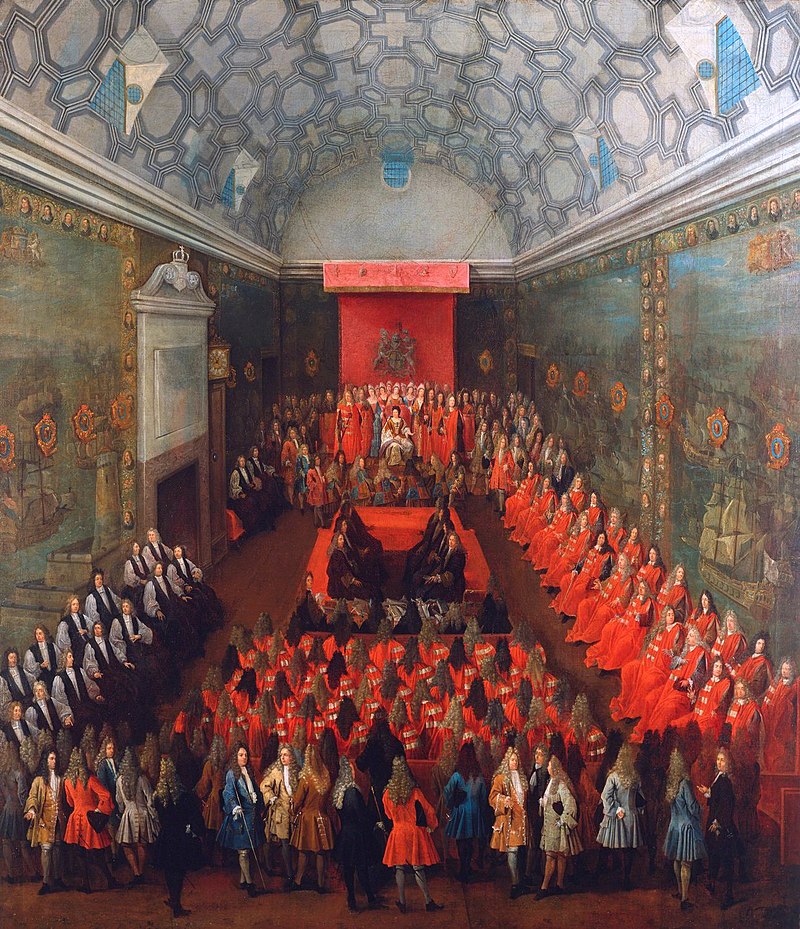
File:Queen_Anne_in_the_House_of_Lords.jpg · Wikimedia Commons · See Wikimedia Commons
nobility
Sign in to saveAlso known as second estate of the realm
thumb|286x286px|The House of Lords is the upper legislature of the [[Parliament of the United Kingdom and is filled with members that are selected from the aristocracy (both hereditary titleholders and those ennobled only for their individual lives).]] Nobility is a social class found in many societies that have an aristocracy. It is normally appointed by and ranked immediately below royalty. Nobility has often been an estate of the realm with many exclusive functions and characteristics. The characteristics associated with nobility may constitute substantial advantages over or relative to non
Nobility is a social class found in many societies, typically ranked just below royalty and often appointed by the crown, with members holding exclusive functions and characteristics that can provide them substantial advantages over non-noble people. Throughout history, nobility has frequently served as an estate of the realm—a formal tier of society—as seen in examples like the British House of Lords, which includes both hereditary aristocrats and those ennobled during their lifetimes.
AI-generated from the Wikipedia summary — may contain errors.
Wikidata facts
- Subclass of
- social group
- Has part
- noble women
- Image
- Cayetana Álvarez de Toledo 2011 (cropped).jpg
Show 7 more facts
- topic's main category
- Category:Nobility
- Commons category
- Nobility
- different from
- Third Estate
- on focus list of Wikimedia project
- Wikipedia:Vital articles/Level/4
- P8168
- Lixhausen
- partially coincident with
- aristocracy
- maintained by WikiProject
- WikiProject Sociology
via Wikidata · CC0
~52 min read
Encyclopedic overview
34 sectionsContents
- History
- Privileges
- Ennoblement
- Ranks
- Other terms
- Africa
- Angola
- Ethiopia
- Madagascar
- Nigeria
- Asia
- Indian subcontinent
- China
- Korea
- Japan
- Islamic world
- Philippines
- Recognition by the Spanish Crown
- Filipino nobles during the Spanish era
- Current ''status questionis''
- Europe
- Latin America
- Bolivia
- Brazil
- Mexico
- By nation
- Africa
- Americas
- Asia
- Europe
- Oceania
- See also
- References
- External links
thumb|286x286px|The House of Lords is the upper legislature of the [[Parliament of the United Kingdom and is filled with members that are selected from the aristocracy (both hereditary titleholders and those ennobled only for their individual lives).]] Nobility is a social class found in many societies that have an aristocracy. It is normally appointed by and ranked immediately below royalty. Nobility has often been an estate of the realm with many exclusive functions and characteristics. The characteristics associated with nobility may constitute substantial advantages over or relative to non-nobles or simply formal functions (e.g., precedence), and vary by country and by era. Membership in the nobility, including rights and responsibilities, is typically hereditary and patrilineal.
Membership in the nobility has historically been granted by a monarch or government, and acquisition of sufficient power, wealth, ownerships, or royal favour has occasionally enabled commoners to ascend into the nobility.
Excerpted from Wikipedia’s “nobility” article, available under the CC BY-SA 4.0 licence.
Gallery (32)
Available in 93 languages
- Español
- Français
- Deutsch
- 中文
- 日本語
- Русский
- Português
- Italiano
- العربية
- हिन्दी
- Abkhazian
- Afrikaans
- Albanian
- Albanian
- Armenian
- Asturian
- Azerbaijani
- Bahasa Indonesia
Show 74 more
- Banjar
- Bashkir
- Basque
- be_x_old
- Belarusian
- Bosnian
- Breton
- Bulgarian
- Catalan
- Central Kurdish
- Chuvash
- Croatian
- Czech
- Danish
- Erzya
- Esperanto
- Estonian
- Filipino
- Finnish
- Galician
- Gan Chinese
- Georgian
- Greek
- Hebrew
- Hungarian
- Icelandic
- Ido
- Igbo
- Ingush
- Interlingua
- Irish
- Javanese
- Kurdish
- Latin
- Latvian
- Lithuanian
- Lombard
- Luxembourgish
- Macedonian
- Malay
- Marathi
- Mazanderani
- Minangkabau
- nds_nl
- Nederlands
- Nepali
- Northern Frisian
- Norwegian
- Norwegian Nynorsk
- Occitan
- Pashto
- Polski
- Punjabi
- Romanian
- Serbian
- Serbian (Latin)
- simple
- Slovak
- Slovenian
- Svenska
- Tatar
- Tiếng Việt
- Türkçe
- Ukrainian
- Uzbek
- Venetian
- Western Frisian
- Wu Chinese
- zh_min_nan
- zh_yue
- Zhuang
- فارسی
- ไทย
- 한국어
via Wikidata sitelinks · CC0