(c) Ansel Oommen, some rights reserved (CC BY-NC), uploaded by Ansel Oommen · cc-by-nc
Nocardia
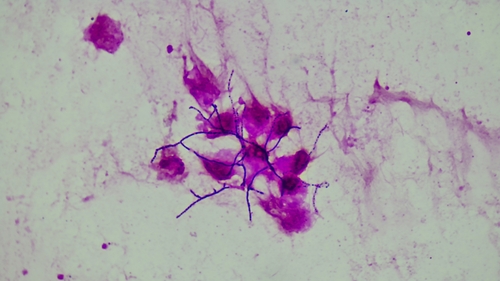
Sign in to savethumb|Nocardia as found on a brain biopsy. Nocardia is a genus of weakly staining Gram-positive, catalase-positive, rod-shaped bacteria. It forms partially acid-fast beaded branching filaments (appearing similar to fungi, but being truly bacteria). It contains a total of 85 species. Some species are nonpathogenic, while others are responsible for nocardiosis. Nocardia species are found worldwide in soil rich in organic matter. In addition, they are oral microflora found in healthy human gingiva, as well as periodontal pockets. Most Nocardia infections are acquired by inhalation of the bacteria
Species
GENUS
- KingdomBacteria
- PhylumActinobacteriota
- ClassActinomycetia
- OrderMycobacteriales
- FamilyMycobacteriaceae
ノカルディア属 Nocardia asteroides(真ん中) 分類 ドメ イン : 細菌 Bacteria 門 : 放線菌門 Actinobacteria 綱 : 放線菌綱 Actinobacteria 目 : コリネバクテリウム目 Corynebacteriales 科 : ノカルディア科 Nocardiaceae 属 : ノカルディア属 Nocardia 学名 Nocardia Trevisan 1889 下位分類(種) N. abscessus N. acidivorans N. africana N. alba N. altamirensis N. amamiensis N. amarae N. amikacinitolerans N. anaemiae N. aobensis N. araoensis N. artemisiae N. arthritidis N. asiatica N. asteroides N. autotrophica N. beijingensis N. bhagyanarayanae N. blacklockiae N. brasiliensis N. brevicatena N. caishijiensis N. calcarea N. callitridis N. carnea N. cellulans N. cerradoensis N. coeliaca N. concava N. corynebacterioides N. coubleae N. crassostreae N. cummidelens N. cyriacigeorgica N. elegans N. endophytica N. exalbida N. farcinica N. flavorosea N. fluminea N. gamkensis N. globerula N. goodfellowii N. grenadensis N. harenae N. higoensis N. hydrocarbonoxydans N. ignorata N. inohanensis N. iowensis N. jejuensis N. jiangxiensis N. jinanensis N. kroppenstedtii N. kruczakiae N. lijiangensis N. mediterranei N. mexicana N. mikamii N. miyunensis N. neocaledoniensis N. niigatensis N. ninae N. niwae N. nova N. orientalis N. otitidiscaviarum N. paucivorans N. petroleophila N. p
via GBIF
Museum specimens
- Specimen records
- 733
- Family
- Nocardiaceae
- Collections
- UFPE
- Recorded in
- Brasil, Venezuela, ?, United States
Research
8,515 papers- Clinical and laboratory features of the Nocardia spp. based on current molecular taxonomy.Clinical microbiology reviews · 2006
- Epidemiology and Antimicrobial Resistance Profiles of the Nocardia Species in China, 2009 to 2021.Microbiology spectrum · 2022
- Pathogenic Nocardia: A diverse genus of emerging pathogens or just poorly recognized?PLoS pathogens · 2020
- Nocardia, nocardiosis and mycetoma.Medical mycology · 1998
- Nocardia species: host-parasite relationships.Clinical microbiology reviews · 1994
via PubMed
Wikidata facts
- Instance of
- taxon
- Parent taxon
- Nocardiaceae
- Named after
- Edmond Nocard
- Image
- Actinomycetes sp 01.png
Show 6 more facts
- taxon rank
- genus
- taxon name
- Nocardia
- Commons category
- Nocardia
- Gram staining
- gram-positive bacteria
- LPSN URL
- www.bacterio.net/nocardia.html
- taxonomic type
- Nocardia asteroides
via Wikidata · CC0
~12 min read
Encyclopedic overview
10 sectionsContents
- Culture and staining
- Virulence
- Clinical disease and microbiological diagnosis
- Treatment
- Genetics
- Species
- Nomenclature
- References
- Further reading
- External links
thumb|Nocardia as found on a brain biopsy. Nocardia is a genus of weakly staining Gram-positive, catalase-positive, rod-shaped bacteria. It forms partially acid-fast beaded branching filaments (appearing similar to fungi, but being truly bacteria). It contains a total of 85 species. Some species are nonpathogenic, while others are responsible for nocardiosis. Nocardia species are found worldwide in soil rich in organic matter. In addition, they are oral microflora found in healthy human gingiva, as well as periodontal pockets. Most Nocardia infections are acquired by inhalation of the bacteria or through traumatic introduction through openings in epithelial barriers.
== Culture and staining == Nocardia colonies have a variable appearance, but most species appear to have aerial hyphae when viewed with a dissecting microscope, particularly when they have been grown on nutritionally limiting media. Nocardia grow slowly on nonselective culture media, and are strict aerobes with the ability to grow in a wide temperature range. Some species are partially acid-fast (meaning a less concentrated solution of sulfuric or hydrochloric acid should be used during the staining procedure) due to the presence of intermediate-length mycolic acids in their cell wall. Majority of strains possess the cord factor (trehalose 6-6' dimycolate), an important virulence factor. thumb|Four different Nocardia species on sheep blood agar demonstrating different colouring They are catalase positive and can grow easily on the most commonly used media with colonies becoming evident in 3–5 days. However, prolonged incubation periods (2–3 weeks) are sometimes needed. thumb|Nocardia asteroides
Excerpted from Wikipedia’s “Nocardia” article, available under the CC BY-SA 4.0 licence.