File:Nonmetals_in_the_periodic_table.png · Wikimedia Commons · See Wikimedia Commons
nonmetal
Sign in to saveAlso known as non-metal, nonmetal element, nonmetal elements, non-metal element, non-metal elements, nonmetallic element, nonmetallic elements, non-metallic element
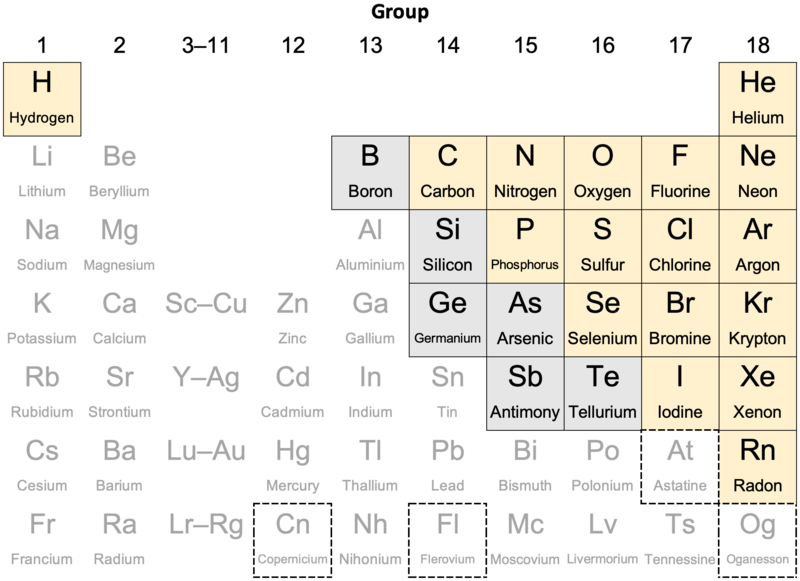
{| style="float:right; margin-left:2.5em; margin-bottom:1.2em; font-size:95%; max-width: 450px; border:1px solid grey" | style=text-align:center|A periodic table extract |- | 450px| alt=A grid with 7 rows labeled periods "1" to "7" and 10 columns labeled as groups "1", "2", "3–11", and "12" to "18". ¶ Most cells represent one chemical element and are labeled with its 1 or 2 letter symbol in a large font above its name. Cells in column 3 (labeled "3–11") represent a series of elements and are labeled with the first and last element's symbol. ¶ Row 1 has cells in the first and last columns, wi
A nonmetal is a chemical element that lacks the properties of metals, such as conductivity and shininess, and is typically found on the right side of the periodic table. Nonmetals are important because they make up much of the matter in living organisms and play essential roles in chemical reactions that sustain life and drive natural processes.
AI-generated from the Wikipedia summary — may contain errors.
Wikidata facts
- Subclass of
- main group
- Image
- Bromine vial in acrylic cube.jpg
Show 4 more facts
- topic's main category
- Category:Nonmetals
- Commons category
- Nonmetals
- on focus list of Wikimedia project
- Wikipedia:Vital articles/Level/4
- studied by
- chemistry
Sources (3)
via Wikidata · CC0
~96 min read
Encyclopedic overview
36 sectionsContents
- Definition and applicable elements
- General properties
- Physical
- Allotropes
- Chemical
- Complications
- First-row anomaly
- Secondary periodicity
- Higher oxidation states
- Multiple bond formation
- Property overlaps
- Types {{anchor|Classes}}
- Noble gases
- Halogen nonmetals
- Unclassified nonmetals
- Abundance, extraction, and uses
- Abundance
- Extraction
- Uses
- Taxonomical history
- Background
- Organization of elements by types
- Development of types
- Nonmetals as terminology
- Structure, quantum mechanics and band structure
- Comparison of selected properties
- Physical properties by element type
- Chemical properties by element type
- See also
- Notes
- References
- Citations
- Bibliography
- =
- =
- External links
{| style="float:right; margin-left:2.5em; margin-bottom:1.2em; font-size:95%; max-width: 450px; border:1px solid grey" | style=text-align:center|A periodic table extract |- | 450px| alt=A grid with 7 rows labeled periods "1" to "7" and 10 columns labeled as groups "1", "2", "3–11", and "12" to "18". ¶ Most cells represent one chemical element and are labeled with its 1 or 2 letter symbol in a large font above its name. Cells in column 3 (labeled "3–11") represent a series of elements and are labeled with the first and last element's symbol. ¶ Row 1 has cells in the first and last columns, with an empty gap between. Rows 2–3 have 8 cells, with a gap between the first 2 and last 6 columns. Rows 4–7 have cells in all 10 columns. ¶ A bold falling staircase line separates the rightmost 6/5/4/3/2/1 cells in rows 2–7. ¶ 17 cells above and right of the staircase are tan-colored: both cells row 1 and all cells to its right except the first one. ¶ 9 cells along the staircase are specially colored: gray in rows 2–5 and brown in rows 6-7: the first cell after it in rows 2–7 and first cell before in rows 4/5/7. ¶ The rest of the cells have light gray letters on a white background. |- | |- | style="padding-left:5px; font-size:95%;"|always/usually considered nonmetals |- | style="padding-left:5px; font-size:95%;"|metalloids, sometimes considered nonmetals |- | style="padding-left:5px; font-size:95%;"|status as nonmetal or metal unconfirmed |- |}
In the context of the periodic table, a nonmetal is a chemical element that mostly lacks distinctive metallic properties. They range from colorless gases like hydrogen to shiny crystals like iodine. Physically, they are usually lighter (less dense) than elements that form metals and are often poor conductors of heat and electricity. Chemically, nonmetals have relatively high electronegativity or usually attract electrons in a chemical bond with another element, and their oxides tend to be acidic.
Excerpted from Wikipedia’s “nonmetal” article, available under the CC BY-SA 4.0 licence.
Gallery (32)
Available in 100 languages
- Español
- Français
- Deutsch
- 中文
- 日本語
- Русский
- Português
- Italiano
- العربية
- हिन्दी
- Afrikaans
- Albanian
- Angika
- Aragonese
- Armenian
- Asturian
- Azerbaijani
- Bahasa Indonesia
Show 81 more
- Bangla
- Basque
- be_x_old
- Belarusian
- blk
- Bosnian
- Bulgarian
- Burmese
- Catalan
- cdo
- Chuvash
- Croatian
- Czech
- Danish
- Esperanto
- Estonian
- Fiji Hindi
- Finnish
- Galician
- Georgian
- Greek
- Guarani
- Hakka Chinese
- Hebrew
- Hungarian
- Icelandic
- Interlingua
- Javanese
- Kabyle
- Kannada
- Kazakh
- Latin
- Latvian
- Lithuanian
- Lombard
- Low German
- Luxembourgish
- Macedonian
- Malay
- Malayalam
- Marathi
- Mongolian
- Moroccan Arabic
- Nederlands
- Northern Frisian
- Norwegian
- Norwegian Nynorsk
- Oromo
- Polski
- Punjabi
- Quechua
- Romanian
- Rusyn
- Serbian
- Serbian (Latin)
- Sicilian
- simple
- Sinhala
- Slovak
- Slovenian
- Somali
- Svenska
- Swahili
- Tajik
- Tamil
- Telugu
- Tiếng Việt
- Türkçe
- Ukrainian
- Uzbek
- Welsh
- Wu Chinese
- Xhosa
- Yiddish
- Yoruba
- zh_classical
- zh_min_nan
- zh_yue
- فارسی
- ไทย
- 한국어
via Wikidata sitelinks · CC0