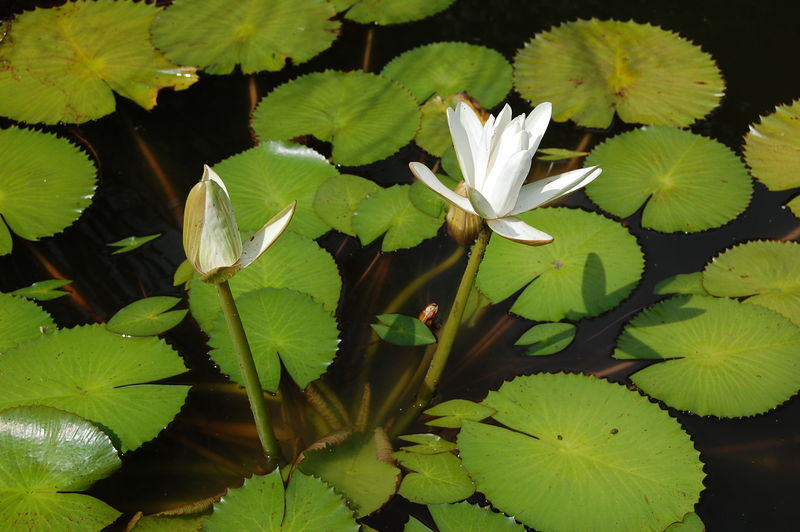
File:2007_nymphaea_lotus.jpg · Wikimedia Commons · See Wikimedia Commons
Nymphaeales
Sign in to saveThe Nymphaeales are an order of flowering plants, consisting of three families of aquatic plants, the Hydatellaceae, the Cabombaceae, and the Nymphaeaceae (water lilies). It is one of the three orders of basal angiosperms, an early-diverging grade of flowering plants. At least 10 morphological characters unite the Nymphaeales. One of the traits is the absence of a vascular cambium, which is required to produce both xylem (wood) and phloem, which therefore are missing. Molecular synapomorphies are also known.
OverviewAI-generated
Nymphaeales is an order within the class Magnoliopsida and phylum Tracheophyta of the kingdom Plantae. The taxon has an accepted status and is associated with brackish and freshwater habitats. Its lineage dates back to about 130 million years ago.
Records of this order are held by institutions including UAM and UF, with occurrences documented in the United States and Panama. A total of 7 records are associated with these institutions, though no media files are included. The order is referenced by 732 other encyclopedia articles.
Synthesized by Vinony from 21 facts across 6 sources: Wikidata, GBIF, Gbif Occ, WoRMS, iDigBio, Vinony graph. Generated from structured data (not the Wikipedia text) and checked against those facts — may still contain errors.
Species
ORDER
- KingdomPlantae
- PhylumTracheophyta
- ClassMagnoliopsida
- OrderNymphaeales
睡蓮目(学名:Nymphaeales)是被子植物的一个目,包含了睡莲、莼菜等多种水生草本植物。 依据化石记录,睡莲目至少在一亿三千万年前的白垩纪早白垩世就已经出现,是被子植物里相当古老的一个分支。 目录 1 分类 1.1 沿革 1.2 种系发生学 2 参考资料 3 外部链接 分类 在2009年的APG III分类法[1],睡莲目直接置于被子植物分支之下,是继无油樟目之后较早和其它被子植物分开演化的支系之一。其下包括了三科: 睡莲目 Nymphaeales Salisb. ex Bercht. & J.Presl (1820) 莼菜科 Cabombaceae Rich. ex A.Rich. (1822), nom. cons. 独蕊草科 Hydatellaceae U.Hamann (1976) 睡莲科 Nymphaeaceae Salisb. (1805), nom. cons. 沿革 在1981年的克朗奎斯特分类法里,睡蓮目属于木兰纲(即双子叶植物),置于木兰亚纲之下,该分类法的睡蓮目下有5個科: 睡蓮科 Nymphaeaceae 蓴菜科 Cabombaceae 蓮科 Nelumbonaceae 合瓣莲科 Barclayaceae(后来被并入睡莲科) 金魚藻科 Ceratophyllaceae 在1989年Dahlgren分类法里,睡莲目属于木兰纲木兰亚纲之下的睡莲总目(Nymphaeanae),莲科已被独立划为木兰总目之下的莲目(Nelumbonales)(后来1998年APG分类法中,莲科被归类为山龙眼目),因而睡莲目只包括三个科: 睡莲科 Nymphaeaceae 莼菜科 Cabombaceae 金魚藻科 Ceratophyllaceae 在1992年Thorne分类法中,睡莲目属于木兰纲木兰亚纲睡莲总目,金魚藻科则被独立划分为木兰总目之下的金魚藻目(金魚藻科1998年被AGP独立分出,2003年被APG II列为真双子叶植物分支的旁系群),睡莲目只剩两科: 睡莲科 Nymphaeaceae 莼菜科 Cabombaceae 在1998年APG分类法及2003年APG II分类法,被子植物种系发生学组(APG)根据遗传学资料,将睡莲科直接置于被子植物之下,并建议将莼菜科与睡莲科合并。 2007年以来的研究发现,原先被归类为禾本目的独蕊草科是睡莲科及莼菜科的近亲,并拥有形态学及胚胎学证据的支持[1]。 另外,虽然睡莲科及莼菜科之间的差异很小,但依然可以明确将两者区分,因而在2009年的APG III分类法之中,两者继续分开并列,和独蕊草科一起列在睡莲目之下[1]。 种系发生学 睡莲目以下各分支和其它被子植物的演化亲缘关系如下[1]: 被子植物 核心被子植物 真双子叶植物 金鱼藻目 单子叶植物 木兰类植物 金粟兰目 木兰藤目 睡莲目 睡莲科 莼菜
via GBIF
Wikidata facts
- Instance of
- taxon
- Image
- Victoria amazonica full view.jpg
Show 7 more facts
- topic's main category
- Category:Nymphaeales
- taxon rank
- order
- Commons category
- Nymphaeales
- start time
- 130000000-
- taxon name
- Nymphaeales
- taxon common name
- 睡莲目
- taxonomic type
- Nymphaeaceae
Sources (1)
via Wikidata · CC0
~7 min read
Encyclopedic overview
8 sectionsContents
- Description
- Vegetative characteristics
- Generative characteristics
- Fossils
- Classification
- References
- Further reading
- External links
The Nymphaeales are an order of flowering plants, consisting of three families of aquatic plants, the Hydatellaceae, the Cabombaceae, and the Nymphaeaceae (water lilies). It is one of the three orders of basal angiosperms, an early-diverging grade of flowering plants. At least 10 morphological characters unite the Nymphaeales. One of the traits is the absence of a vascular cambium, which is required to produce both xylem (wood) and phloem, which therefore are missing. Molecular synapomorphies are also known.
The Plant List, created by the Royal Botanic Gardens, Kew and Missouri Botanical Garden recognizes about 70 species in 11 genera within the order, but a phylogenetic study of the genus Nymphaea implies that the number of species could be more than 90. The difference in species numbers is due almost entirely to the difficulty of delineating species in the genus Nymphaea.
Excerpted from Wikipedia’s “Nymphaeales” article, available under the CC BY-SA 4.0 licence.