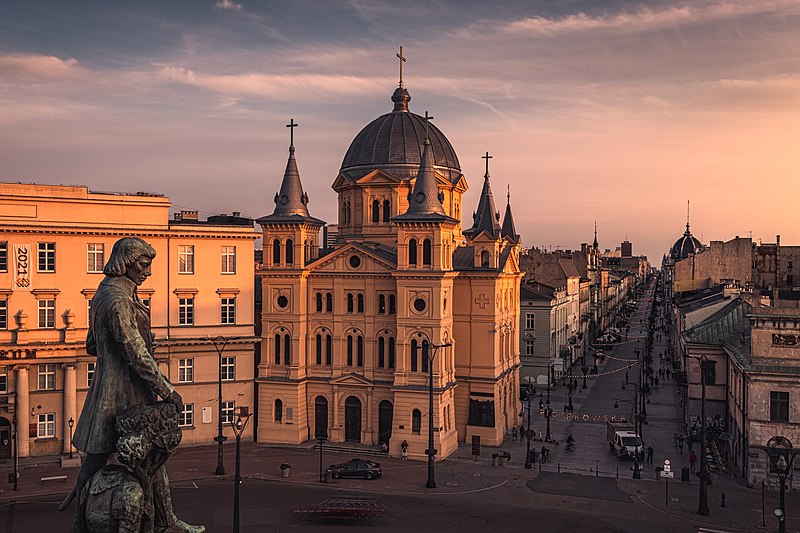
File:Kościół_Zesłania_Ducha_Świętego.jpg · Wikimedia Commons · See Wikimedia Commons
Łódź
Sign in to saveAlso known as Lodz, Łodzi, Lodzh, Lodsch, Litzmannstadt, Lodž, Lodz'
Łódź is a city in central Poland and a former industrial centre. It is the capital of Łódź Voivodeship, and is located south-west of Warsaw. Łódź has a population of 645,693, making it the country's fourth largest city.
Łódź is Poland's fourth largest city, located in central Poland southwest of Warsaw, with a population of about 645,700 people. Once a major industrial hub, it now serves as the capital of Łódź Voivodeship and remains an important urban center in the country.
AI-generated from the Wikipedia summary — may contain errors.
Key facts
- Settlement.name
- Łódź
- Settlement.settlement_type
- City county
- Settlement.nickname
- ('The Promised Land')
- Settlement.motto
- ('From a boat a ship')
- Settlement.anthem
- by Stanisław Moniuszko
- Settlement.image_blank_emblem
- Logo of Łódź 05.svg
- Settlement.blank_emblem_type
- Wordmark
- Settlement.blank_emblem_alt
- ('Łódź Creates')
- Settlement.image_flag
- POL Łódź flag.svg
- Settlement.image_shield
- 75px
- Settlement.pushpin_map
- Poland
- Settlement.pushpin_label_position
- bottom
- Settlement.pushpin_label
- Łódź
- Settlement.subdivision_type
- Country
- Settlement.subdivision_type1
- Voivodeship
- Settlement.subdivision_type2
- County
- Settlement.subdivision_name2
- city county
- Settlement.leader_title
- City mayor
via Wikipedia infobox
Wikidata facts
- Instance of
- city
- Official name
- Łódź
- Demonym
- lodzano
- Country
- Kingdom of Poland
- Located in
- Łódź Voivodeship
- Continent
- Europe
- Population
- 648711
- Area
- 293.25
- Elevation
- 219
- Time zone
- UTC+02:00
- Head of government
- Hanna Zdanowska
- Capital of
- Łódź Voivodeship
- Shares border with
- Pabianice County
- Official website
- uml.lodz.pl
- Image
- Łódź Fabryczna, 2017.jpg
- Dialing code
- 42
- Licence plate code
- EL • ED
- Motto
- Z łódeczki łódź
- Coat of arms
- Łódź coat of arms
Show 20 more facts
- P6482
- Łódź
- twinned administrative body
- Guangzhou
- category of associated people
- Category:People from Łódź
- Commons category
- Łódź
- topic's main category
- Category:Łódź
- category for people born here
- Category:Births in Łódź
- category for people who died here
- Category:Deaths in Łódź
- postal code
- 90-001–94-413
- Commons gallery
- Łódź
- category for people buried here
- Q7976740
- inception
- 1423-07-29
- native label
- Łódź
- P8168
- Johannes Brandt
- member of
- Creative Cities Network
- social media followers
- 11221
- category for honorary citizens of entity
- Category:Honorary citizens of Łódź
- male population
- 305533
- female population
- 365109
- P12749
- June 21
- different from
- Łódź
Sources (14)
via Wikidata · CC0
~52 min read
Encyclopedic overview
39 sectionsContents
- Name and toponymy
- History
- Early beginnings (1332–1815)
- Partitions and development (1815–1918)
- Restored Poland (1918–1939)
- Second World War (1939–1945)
- Post World War II (1945–1989)
- Contemporary history (1990–present)
- Geography
- Climate
- Administration
- Government
- Administrative division
- Demographics
- Religion
- Economy and infrastructure
- Transport
- Airport
- Public transport
- Rail
- Education
- National Film School in Łódź
- Culture
- Landmarks and events
- Museums in Łódź
- Łódź in literature and cinema
- Theatre
- Cuisine and food
- Sport
- Horticultural Expo 2029
- Notable residents
- International relations
- Twin towns – sister cities
- See also
- Explanatory notes
- References
- Inline citations
- Bibliography
- External links
Łódź is a city in central Poland and a former industrial centre. It is the capital of Łódź Voivodeship, and is located south-west of Warsaw. Łódź has a population of 645,693, making it the country's fourth largest city.
Łódź first appears in records in the 14th century. It was granted town rights in 1423 by the Polish King Władysław II Jagiełło and it remained a private town of the Kuyavian bishops and clergy until the late 18th century. In the Second Partition of Poland in 1793, Łódź was annexed to Prussia before becoming part of the Napoleonic Duchy of Warsaw; the city joined Congress Poland, a Russian client state, at the 1815 Congress of Vienna. The Second Industrial Revolution (from 1850) brought rapid growth in textile manufacturing and in population owing to the inflow of migrants, a sizable part of which were Jews and Germans. Ever since the industrialization of the area, the city had been multinational and struggled with social inequalities, as documented in the novel The Promised Land by Nobel Prize–winning author Władysław Reymont. The contrasts greatly reflected on the architecture of the city, where luxurious mansions coexisted with red-brick factories and dilapidated tenement houses.
Excerpted from Wikipedia’s “Łódź” article, available under the CC BY-SA 4.0 licence.
Gallery (52)
On the map
3 mapped locations
Available in 122 languages
- Español
- Français
- Deutsch
- 中文
- 日本語
- Русский
- Português
- Italiano
- العربية
- हिन्दी
- Afrikaans
- Albanian
- Amharic
- Aragonese
- Armenian
- Asturian
- azb
- Azerbaijani
Show 103 more
- Bahasa Indonesia
- Balinese
- Bangla
- Basque
- bat_smg
- be_x_old
- Belarusian
- Bosnian
- Breton
- Bulgarian
- Buriat
- Catalan
- Cebuano
- Central Kurdish
- Chuvash
- Crimean Tatar
- Croatian
- Czech
- Danish
- Egyptian Arabic
- Erzya
- Esperanto
- Estonian
- Faroese
- Fijian
- Finnish
- Galician
- Ganda
- Georgian
- Greek
- Hakka Chinese
- Hebrew
- Hungarian
- hyw
- Icelandic
- Ido
- Interlingue
- Irish
- Javanese
- Kashubian
- Kazakh
- Kikuyu
- Ladino
- Latin
- Latvian
- Lithuanian
- Lombard
- Low German
- Lower Sorbian
- Luxembourgish
- Macedonian
- Malay
- Manx
- Marathi
- Mari
- Mingrelian
- Mongolian
- nds_nl
- Nederlands
- Northern Frisian
- Norwegian
- Norwegian Nynorsk
- Ossetic
- Papiamento
- Polski
- Quechua
- roa_tara
- Romanian
- Scots
- Scottish Gaelic
- Serbian
- Serbian (Latin)
- Silesian
- simple
- Slovak
- Slovenian
- Southern Sotho
- Svenska
- Tatar
- Tetum
- Tiếng Việt
- Tok Pisin
- Tumbuka
- Türkçe
- Udmurt
- Ukrainian
- Upper Sorbian
- Urdu
- Uyghur
- Uzbek
- Veps
- Volapük
- Waray
- Welsh
- Western Frisian
- Western Panjabi
- Wu Chinese
- Yiddish
- zh_min_nan
- zh_yue
- فارسی
- ไทย
- 한국어
via Wikidata sitelinks · CC0