File:Ouija_board_-_Kennard_Novelty_Company.png · Wikimedia Commons · See Wikimedia Commons
ouija
Sign in to saveAlso known as spirit board, talking board, Ouija board, Ouija boards, spirit boards, talking boards
thumb|An original Ouija board created thumb|Norman Rockwell cover of the May 1, 1920 issue of The Saturday Evening Post, showing a Ouija board in use
Wikidata facts
- Subclass of
- parlour game
- Has part
- planchette
- Image
- Tavola Ouija.jpg
- Has use
- séance
Show 6 more facts
- Commons category
- Ouija (board game)
- inscription
- YES / NO / GOOD BYE
- facet of
- spiritualism
- has effect
- Kaempferia
- present in work
- Phasmophobia
- described by source
- Brain Games
via Wikidata · CC0
~21 min read
Encyclopedic overview
16 sectionsContents
- Etymology
- History
- Precursors
- Talking boards
- Commercial parlor game
- Scientific investigation
- Religious responses
- Notable users
- Literature
- Aleister Crowley
- Others
- In popular culture
- See also
- Notes
- References
- External links
thumb|An original Ouija board created thumb|Norman Rockwell cover of the May 1, 1920 issue of The Saturday Evening Post, showing a Ouija board in use
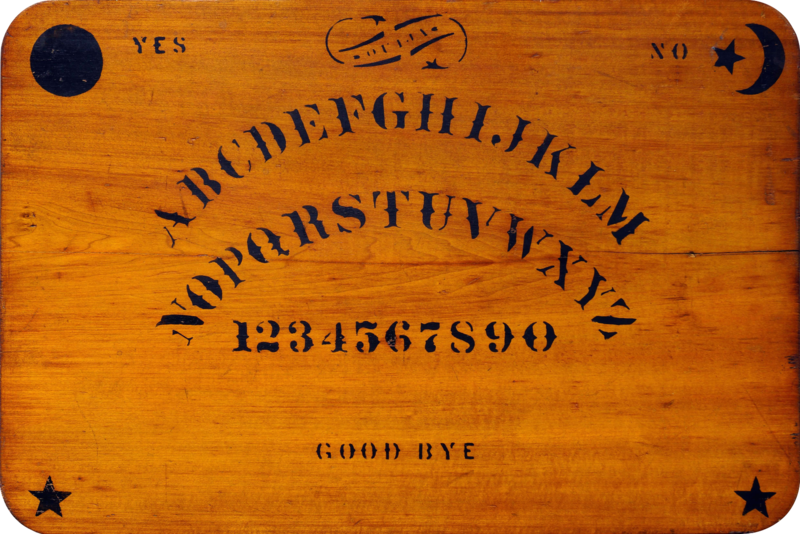
The Ouija ( , ), also known as a Ouija board, spirit board, talking board, or witch board, is a flat board marked with the letters of the Latin alphabet, the numbers 0–9, the words "yes", "no", and occasionally "hello" and "goodbye", along with various symbols and graphics. It uses a planchette (a small heart-shaped piece of wood or plastic) as a movable indicator to spell out messages during a séance. Participants place their fingers on the planchette, which is moved about the board to spell words. The name "Ouija" is a trademark of Hasbro (inherited from Parker Brothers), but is often used generically to refer to any talking board.
Excerpted from Wikipedia’s “ouija” article, available under the CC BY-SA 4.0 licence.