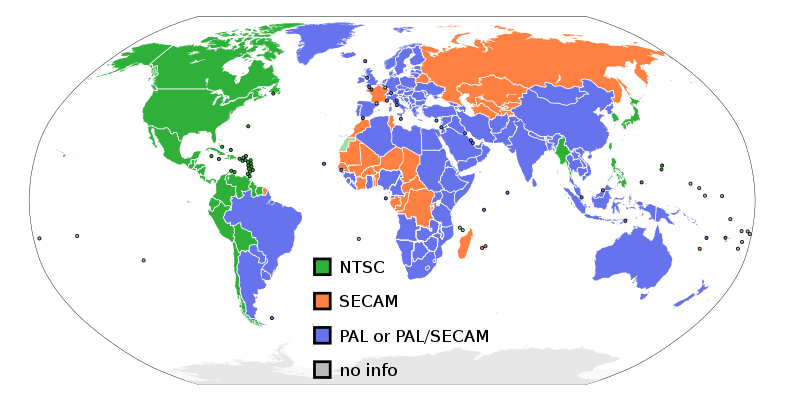
File:PAL-NTSC-SECAM.svg · Wikimedia Commons · See Wikimedia Commons
Also known as Phase Alternating Line, Phased Alteration by Line
Phase Alternating Line (PAL) is a colour encoding system for analogue television. It was one of three major analogue colour television standards, the others being NTSC and SECAM. In most countries it was broadcast at 625 lines, 50 fields (25 frames) per second, and associated with CCIR analogue broadcast television systems B, D, G, H, I and K. The articles on analogue broadcast television systems further describe frame rates, image resolution, and audio modulation.
PAL (Phase Alternating Line) is a color encoding system that was used for analog television broadcasts in most countries around the world. It mattered because it was one of the three major standards that defined how color television signals were transmitted and received, alongside competing systems called NTSC and SECAM.
AI-generated from the Wikipedia summary — may contain errors.
Wikidata facts
- Instance of
- broadcast television system
Show 3 more facts
- Commons category
- PAL
- different from
- PAL
- inception
- 1967-00-00
Sources (3)
via Wikidata · CC0
~41 min read
Encyclopedic overview
28 sectionsContents
- Geographic reach
- PAL region
- History
- Colour decoding methods
- Colour encoding
- PAL signal details
- Colorimetry
- PAL broadcast systems
- System A
- PAL-B/G/D/K/I
- PAL-L
- PAL-N (Argentina, Paraguay, and Uruguay){{anchor|PALN}}
- PAL-M (Brazil)
- Home devices
- Multisystem TVs
- VHS and DVD players
- PAL 60
- PAL vs. NTSC
- PAL vs. SECAM
- <span class="anchor" id="Countries and territories that are using or once used PAL"></span><span class="anchor" id="Experimented"></span>Countries and territories using PAL, past and present
- Using PAL B, D, G, H, K or I
- PAL-M
- PAL-N
- <span class="anchor" id="Countries and territories that have ceased using PAL"></span>Countries and territories no longer using PAL
- See also
- Notes
- References
- External links
Phase Alternating Line (PAL) is a colour encoding system for analogue television. It was one of three major analogue colour television standards, the others being NTSC and SECAM. In most countries it was broadcast at 625 lines, 50 fields (25 frames) per second, and associated with CCIR analogue broadcast television systems B, D, G, H, I and K. The articles on analogue broadcast television systems further describe frame rates, image resolution, and audio modulation.
PAL was developed by Walter Bruch at Telefunken in Hanover, West Germany, with important input from . The format was patented by Telefunken in December 1962, citing Bruch as inventor, and unveiled to members of the European Broadcasting Union (EBU) on 3 January 1963. When asked why the system was named "PAL" and not "Bruch", the inventor answered that a "Bruch system" would probably not have sold very well ("Bruch" is the German word for "breakage").
Excerpted from Wikipedia’s “PAL” article, available under the CC BY-SA 4.0 licence.